Pickup Phase Cancellation Calculator
Estimate how guitar pickup spacing, wiring polarity, level balance, fretted position, and harmonic number combine into comb filtering, hollow tones, and near-null cancellations.
Load a common guitar wiring or pickup-pair scenario, then refine the scale length, fretted note, spacing, levels, and polarity. The calculator treats the string as a standing wave and evaluates the selected harmonic at both pickup positions.
Phase Breakdown
Lactive = scale / 2^(fret / 12)
phase = 180 x harmonic x spacing / Lactive
sum = sqrt(A^2 + B^2 + 2AB cos phase)
loss dB = 20 log10(sum / (A + B))
| Pickup Pair | Typical Spacing | Scale Share | Expected Color | Calculator Starting Point |
|---|---|---|---|---|
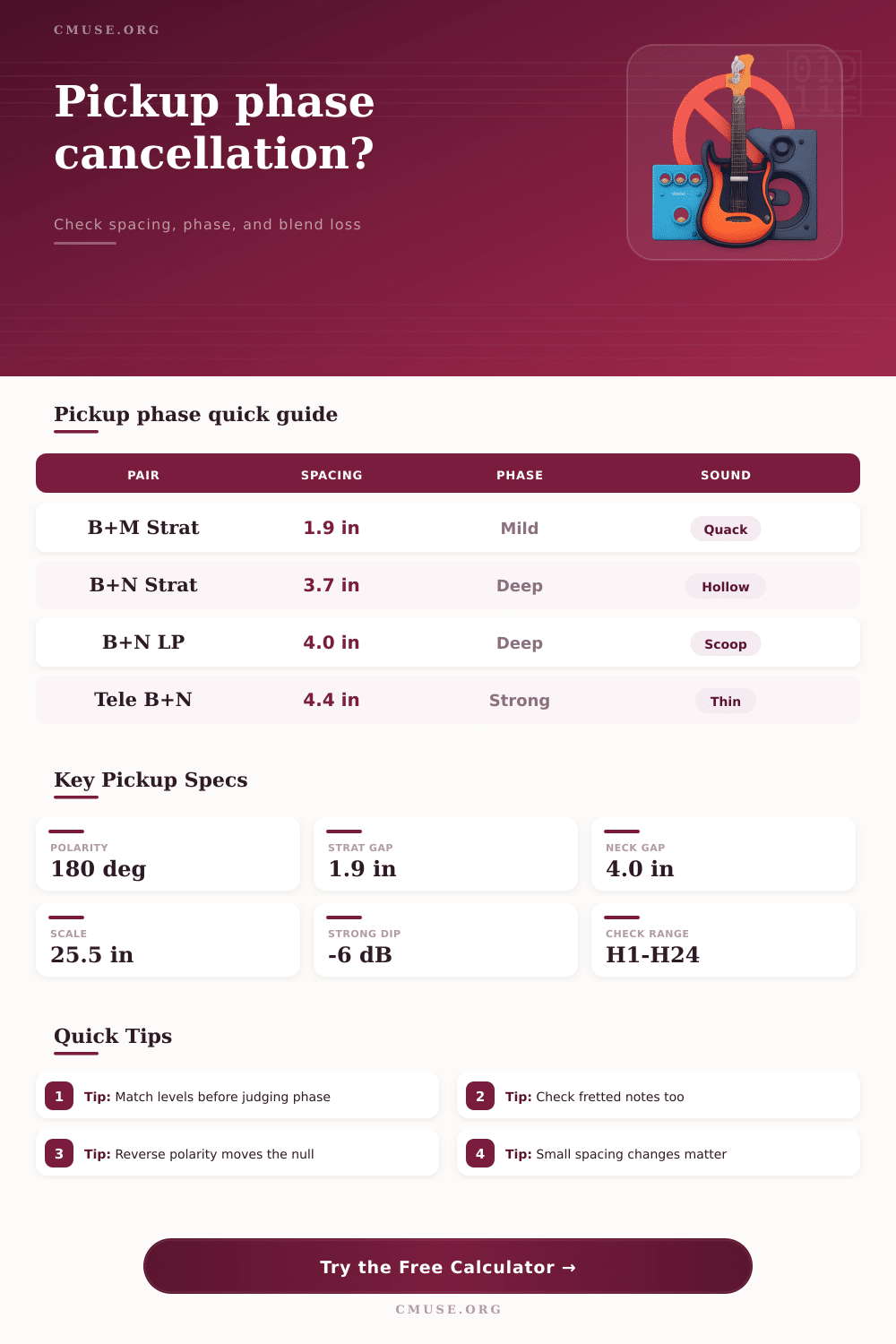
| Strat bridge and middle | 1.8 to 2.1 in / 4.6 to 5.3 cm | About 7% to 8% of 25.5 in scale | quack | Inspect harmonics 4 through 9 with same polarity or RWRP wiring. |
| Strat neck and bridge | 3.5 to 4.0 in / 8.9 to 10.2 cm | About 14% to 16% of 25.5 in scale | hollow | Check harmonic 3, 5, and 7 for deep scoops. |
| Dual humbucker middle toggle | 3.7 to 4.3 in / 9.4 to 10.9 cm | About 15% to 17% of 24.75 in scale | wide scoop | Use small level offsets because neck pickups are often louder. |
| Jazz bass pickup pair | 3.6 to 4.0 in / 9.1 to 10.2 cm | About 10% to 12% of 34 in scale | focused dip | Inspect lower harmonics because the bass fundamental is low. |
| Blend Loss | Approximate Phase Zone | Level Balance Effect | Likely Sound | Setup Note |
|---|---|---|---|---|
| 0 to -2 dB | Mostly reinforcing, under about 60 deg | Level mismatch hides small phase shifts | Full or lightly colored | Often desirable for normal parallel positions. |
| -2 to -6 dB | Partial cancellation, about 60 to 120 deg | Matched pickups make the dip clearer | Open, nasal, or glassy | Common source of classic two-pickup character. |
| -6 to -12 dB | Strong cancellation, about 120 to 160 deg | Small height changes can matter | Hollow and noticeably scooped | Good for effects, risky for core rhythm tone. |
| Below -12 dB | Near opposite phase, close to 180 deg | Equal levels produce the deepest null | Thin, filtered, or disappearing | Verify polarity and pickup height before rewiring. |
| Wiring State | Electrical Offset | Hum Behavior | Phase Result | When To Use |
|---|---|---|---|---|
| Same polarity, same wind reference | 0 deg | Not automatically hum canceling | Spatial spacing is the main phase source | Standard parallel pickup combinations. |
| RWRP single coil pair | Magnetic and coil references are reversed together | Hum canceling when mixed | Audio can still be in phase if wired correctly | Strat positions 2 and 4 style wiring. |
| Electrical out of phase | 180 deg | Depends on coil and magnet arrangement | Cancellations move to different harmonics | Intentional thin funk or special-switch tones. |
| Capacitor phase network | Frequency dependent | Usually unchanged from source wiring | Partial cancellation changes with frequency | Useful when full 180 deg reversal is too thin. |
| Instrument Setup | Scale Length | Spacing To Try | Harmonic Range | Useful Reading |
|---|---|---|---|---|
| Three single-coil guitar, adjacent pickups | 25.5 in / 64.8 cm | 1.9 in / 4.8 cm | H4 to H12 | Shows the focused high-mid combing behind bright two-pickup sounds. |
| Two humbucker guitar, middle switch | 24.75 in / 62.9 cm | 4.0 in / 10.2 cm | H2 to H8 | Shows broad low-mid and midrange scoops when both pickups are equal. |
| Tele-style neck and bridge pair | 25.5 in / 64.8 cm | 4.3 in / 10.9 cm | H2 to H9 | Highlights why bridge height and neck output balance change the middle tone. |
| Long-scale bass with both pickups full | 34 in / 86.4 cm | 3.8 in / 9.7 cm | H3 to H14 | Shows why a small bridge pickup roll-off can restore low-mid weight. |
If you’ve ever held a guitar in your hands in front of an amp wondering why that combo of pickups sounds so hollow and thin instead of thick and loud, you’re likely not alone. This stuff feels like magic, but it’s realy just physics.
Combining two pickups isn’t simply adding the volume of both. It blends two different type of audio signals that pick up string vibrations at slightly different points along the string’s length. As the string vibrates, there are fixed intervals where there is peaks and there are nulls or areas where no vibration exists. One pickup may be capturing peak of the wave and another might be catching the trough. Combine these in opposite phase inside the wiring harness and you get cancellation. This creates a comb filter effect that scoops out certain frequencies, leaving us with a characteristic tone.
Understanding Guitar Pickup Phase Cancellation
Once you’ve entered your spacing and your scale length into the calculator above it does all of this for you. You don’t have to guess if particular geometry of your guitar will give you a pleasing quack or some useless hole in the midrange. Essentially it looks at string as a standing wave and calculates amount of phase shift that builds up across various harmonics.
Why does this matter? Because phase cancellation isn’t a static thing. Depending on what note you’re playing it can change. What sounds great with open strings may be totally cancelled out or just fine when fretted up higher like the twelfth fret, where shortening actual length of string changes the ratio of wavelength vs. The distance between the pickups matter.
Though many will believe reversing electrical polarity on a pickup is simply something not to do, it’s actualy an intentional tonal adjustment too. When done correctly, wiring a neck and bridge pickup out-of-phase results in thin, nasal tone that cuts through a crowded mix better then any single-coil warmth. Use the calculator to switch the polarity offset ‘on’ and ‘off’, so that you can directly witness just how far into nothingness that null drops and what happens to your harmonics along the way.
Mimic the old Stratocaster quack by placing one pickup right next to another. Or, experiment with those deeper scoops found in Les Paul middle positions. The separation between the coils here are much greater. Generally, increasing the physical distance mean the phase differences is larger throughout the harmonic series resulting in more aggressive cancellations.
The depth of this cancellation turns out to be very dependent on relative level balance between pickups. A setup where one is much louder than another will not go to theoretical depth of cancellation. The louder signal simply overpowers the quieter one instead of cleanly canceling it. Many boutique wiring mods employ blend controls or even individual volume pots specifically for leveling the two signals so they can come together without muddiness. That way, if there’s some phase interaction it’s going to be clean and predictable. Otherwise, you’re stuck with a muddy compromise that has no definition at all.
It’s important to know the distinction between electrical polarity and magnetic polarity to understand what this tool does. For instance, humbuckers don’t sound thin but full. Their RWRP wiring reverses the magnetic polarity to cancel out electromagnetic hum while keeping audio signal in-phase. Without such automatic noise cancellation, standard single-coils wired as a pair won’t work unless they has a common ground reference where magnetic fields can interact to cancel the interference. Because you can separately control phase offset without changing the wiring, you can also see the subtle way partial phase shifts from cable capacitance or a tone capacitor affect the sound. These shifts aren’t enough to make them sound extremely thin like a full 180-degree reversal would of.
The real world isn’t all about numbers on a screen. The pickup’s height based off the string makes a big difference, too. This changes the magnetic pull from the string as well as signal level. If you raise the pickup too far, it can change harmonics of your guitar by damping out the string resonance prior to phase cancellation. Little things matter. When adjusting the pickup configuration, always compare sound of both open strings and fretted notes. This helps you get the same tone throughout the instrument.
The calculator will help you get a handle on how pickups interact so you can make educated choices regarding pickup placement and wiring mods before picking up the soldering iron. Phase cancellation is not something to eliminate; instead, it is another texture to work around. You want a quack sound that isn’t thin. And getting it right becomes the single most distinct part of your sound.