Battery Runtime Calculator
Estimate how long a battery pack will run field recorders, wireless audio, pedalboards, mixers, IEM racks, powered speakers, and portable studio gear.
Pick a realistic audio rig to load battery capacity, voltage, gear load, phantom power, duty cycle, efficiency, reserve, and target runtime settings. Then tune any field to match your actual pack label or watt meter reading.
Runtime Breakdown
Stored Energy
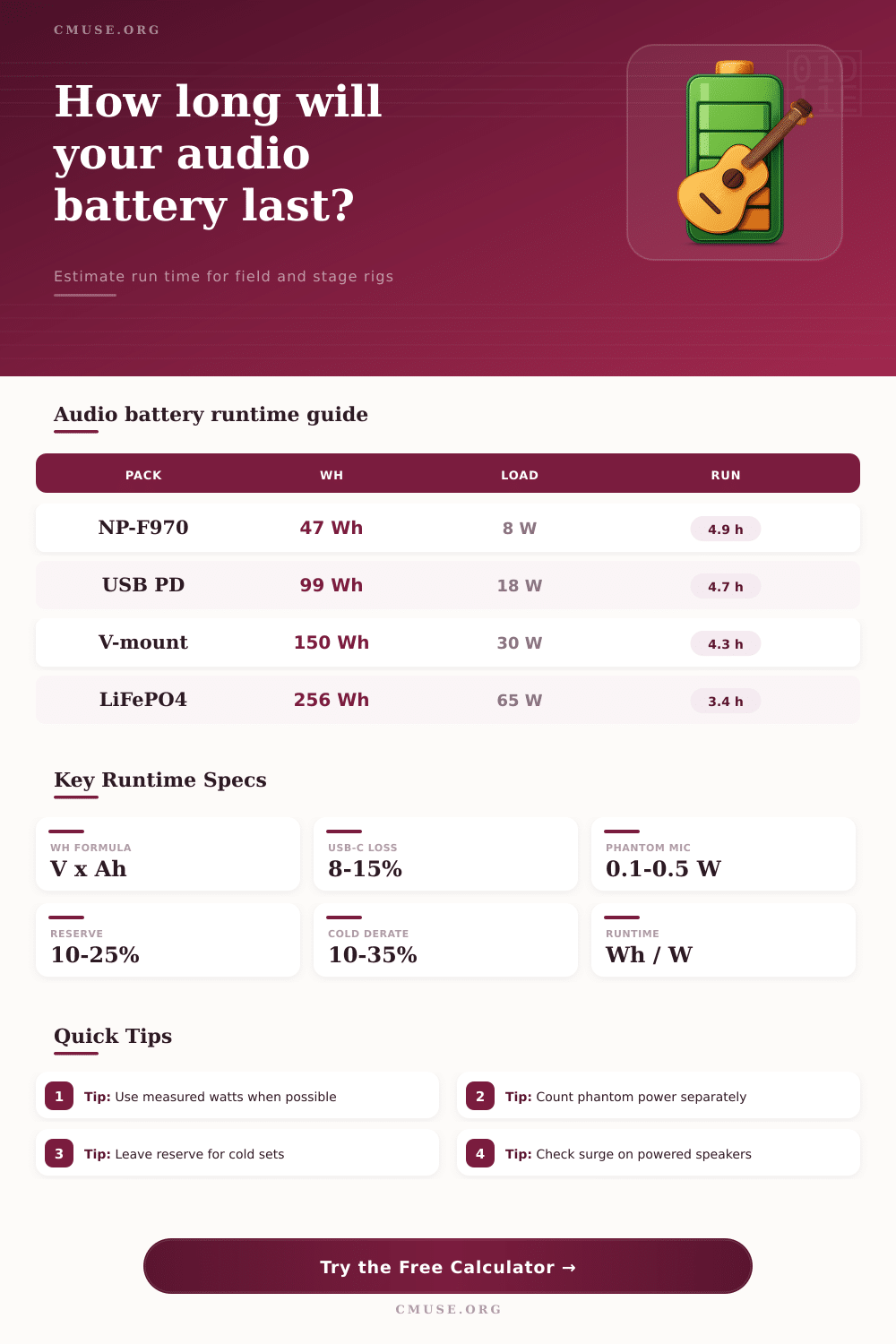
Wh = V × AhConvert Ah or mAh labels to watt hours so 7.2 V, 12 V, 14.8 V, and USB-C packs can be compared fairly.
Usable Energy
Usable Wh = Wh × chemistry × health × temperature × reservePractical runtime is lower than the label when the pack is cold, aged, or protected by reserve.
Audio Load
Load W = gear W + phantom W + accessory WPhantom power uses 48 V times microphone current, then the calculator adds support devices.
Runtime And Packs
Hours = usable Wh × efficiency / load WPack count rounds up from the target hours divided by estimated hours per pack.
7.2 V
common NP-F nominal pack voltage
14.8 V
common V-mount audio cart voltage
48 V
standard P48 phantom supply rail
90%
typical USB-C or mixed DC efficiency
10 mA
maximum P48 current per input
99 Wh
common airline carry-on battery limit
15%
normal reserve for location audio work
2x
speaker or inverter peak caution zone
| Battery format | Typical label | Nominal voltage | Useful audio role |
|---|---|---|---|
| NP-F550 camera pack | 16 Wh to 18 Wh | 7.2 V | Small recorder, wireless hop, compact monitor screen |
| NP-F970 camera pack | 45 Wh to 50 Wh | 7.2 V | Field recorder bag, shotgun mic rig, compact mixer |
| USB-C PD power bank | 74 Wh to 99 Wh | 3.7 V cells, boosted output | Podcast kit, interface, tablet, USB-powered mixer |
| V-mount or Gold mount | 98 Wh to 150 Wh | 14.4 V to 14.8 V | Audio cart, camera audio, RF rack, location recording |
| LiFePO4 field battery | 128 Wh to 512 Wh | 12.8 V | Long live sets, mixer rack, busking PA support |
| AA NiMH tray | 18 Wh to 25 Wh | 9.6 V for 8 cells | Pedals, compact receivers, emergency recorder power |
| AGM lead-acid battery | 200 Wh to 500 Wh | 12 V | Heavy but steady stage or rehearsal backup |
| Audio gear type | Typical draw | What changes it | Runtime note |
|---|---|---|---|
| Field recorder or mixer-recorder | 5 W to 12 W | Track count, screen brightness, phantom power | Measure with all inputs armed for a real session value. |
| Wireless receiver or IEM transmitter | 3 W to 8 W | Band count, RF power, antenna distribution | RF racks usually draw steadily, so use 100 percent duty. |
| USB audio interface | 4 W to 12 W | Bus power, headphone level, phantom channels | USB-C boosts can lose energy before the interface sees it. |
| Guitar pedalboard | 6 W to 20 W | Digital pedals, wireless units, expression LEDs | Startup current can trip small USB or 9 V converters. |
| Compact digital mixer | 18 W to 45 W | Screen, Wi-Fi, channel count, fader motors | Use a reserve because a mixer shutdown ends the whole show. |
| Powered speaker or acoustic amp | 40 W to 180 W average | Volume, bass content, limiter behavior | Average watts are far below peak amplifier watts. |
| Portable synth or groovebox | 4 W to 18 W | Analog voices, screen, USB devices, speakers | Several small devices can exceed one large recorder load. |
| Scenario | Battery | Average load | Expected runtime range |
|---|---|---|---|
| Recorder bag with two phantom mics | 47 Wh NP-F970 | 9 W to 12 W | 3.0 h to 4.4 h after reserve |
| Four-channel wireless kit | 99 Wh USB-C PD bank | 16 W to 22 W | 3.5 h to 5.0 h after conversion loss |
| Pedalboard busking setup | 99 Wh USB-C PD bank | 12 W to 18 W | 4.3 h to 6.3 h with 9 V converter |
| Digital mixer rehearsal rack | 150 Wh V-mount | 28 W to 42 W | 2.9 h to 4.4 h with reserve |
| Small powered PA set | 256 Wh LiFePO4 | 70 W to 120 W | 1.6 h to 2.9 h depending on volume |
| Factor | Typical multiplier | Audio reason | Calculator setting |
|---|---|---|---|
| Li-ion usable energy | 0.92 | Protection circuit, voltage cutoff, and discharge curve | Li-ion or Li-poly field pack |
| LiFePO4 usable energy | 0.95 | Flat voltage curve with strong cycle life | LiFePO4 battery pack |
| NiMH usable energy | 0.78 | Voltage sag can hit audio device cutoff early | NiMH AA or brick pack |
| AGM recommended use | 0.55 | Deep discharge shortens lead-acid battery life | AGM lead-acid, protect cycle life |
| Cold location shoot | 0.82 | Lower chemical activity and higher internal resistance | Cold outdoor set |
| Critical show reserve | 0.70 to 0.80 | Leave enough energy for encore, overtime, or media copy | 20 percent to 30 percent reserve |
The problem is that twenty minutes before showtime, when screen on your field recorder turns black, a certain kind of panic always sets in. And it’s not just annoying, it’s the sound of money leaving your pocket. No one tested the battery capacity beforehand. Audio gear doesn’t care how talented you are. Or what booking fee was involve. All audio gear cares about is watts and hours. Most productions fail here.
Yes, you might have best mics in the world. But if you is running them off a depleted pack that cannot handle phantom power draw, you’re simply recording silence. Plug in your rig information and calculator does the math. You won’t have to stare at numbers on batteries wondering what to do.
How to Calculate Your Battery Life
How many of us see a 2 amp hour rating on a battery pack? Most people looks at watt-hour label and assume that is exactly how much energy they get to spend. Nope! Under perfect lab conditions where the battery cells are all warm, there’s no load fluctuation, etc, sure. But that’s not real life. Cells degrades over time. Converters lose efficiency. Voltage also drops over cable runs.
You can account for those losses by adjusting for things like reserve margins, temperature and even battery chemistry. In other words, turn a best case scenario spec sheet into something reasonable.
The largest hurdle for most new engineer to understand is phantom power. A digital mixer? No biggie, just a couple condenser mics, right? Wrong. Even though they may pull very little current off the 48 volt rail, if you have several channels armed to phantom, this can gobble away at sizable chunk of your battery’s runtime. And if you’re not taking into account the constant draw, then your estimate for runtime is going to be more inflated then expected.
With the calculator, you can plug in the milliamp draw on each phantom powered input, as well as quantity. Before the music goes live, you’ll know exactly what kind of headroom those mics are using. It’s a tiny detail but it could save your session.
The other is something that seems self-evident but comes into play when you’re on stage in November, chilled to the bone: Temperature. It doesn’t only feel bad. It also causes greater internal resistance within the cell, as well as slowing chemical reaction inside to release its energy. What will run four hours inside could be good for two outside where reduced pack voltage trips the low-voltage cutoff prematurely.
This temperature reduction factor in the tool models same effect. You remember that it’s part of power equation. So you plan accordingly. Should of didnt hope for the best.
The other quiet assassin is battery health. If you choose a specific format for a battery with a rated capacity of 100 watt-hours, know that it will never be 100 watt-hours again. Age, storage conditions and cycles degrades what’s left. By setting the estimated battery health level, you’re admitting there’s a history to this equipment, sparing you from being embarrassed by using an exhausted pack for an important capture.
See reference table on page which gives typical battery draw examples for various rig. This can explain why a large digital mixer require sturdier juice than a minimal portable audio recorder.
This isn’t about figuring out the bare minimum. That’s not the point. This is about creating a cushion. You need enough of a buffer so that a sudden spike in power usage (like when a pedal board lights up all its LEDs), an encore, or a technical delay won’t leave you empty-handed. Fifteen percent for a normal job. Twenty percent for cold weather. More if the stakes are high.
The calculator makes this picture clear because it shows you exactly what number of packs will give you your desired run time. Worry becomes math. Respect for the medium is all part of planning your power. Setting proper levels and using good cables treats the signal path with care. Similarly, you should treats the power path with the same care.
Taking a few moments to check your inputs now saves hours of frustration later. Knowing down to the minute how long your battery lasts means no more worrying about the lights going out. And then you can focus on what realy matters. That’s when recording starts.