Floor Bounce Null Calculator
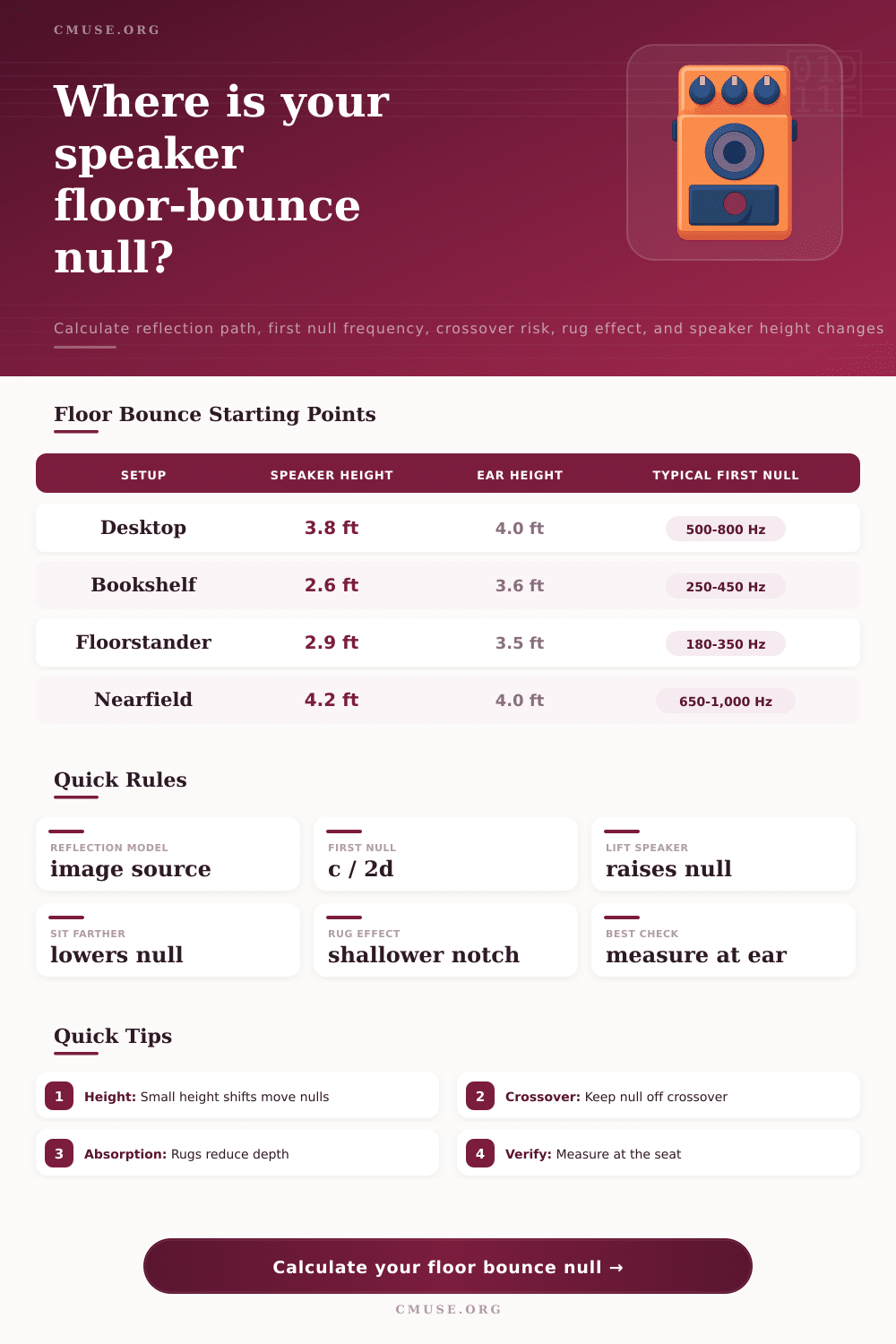
Estimate the speaker-to-floor reflection path, first cancellation frequency, crossover overlap risk, and how rugs or absorptive floor treatments reduce the depth of the floor-bounce dip.
Floor reflection grid
Calculation breakdown
| Path result | Value | How to read it |
|---|
| Null order | Frequency | Comment |
|---|
| Floor treatment | Effective reflection | Estimated notch depth | Apparent dip center |
|---|
| Placement test | First null | Change | Use case |
|---|
Maybe you’ve perfectly tuned a space for sound performance while testing…only to experience lost vocals when the bass kicks in. Where human voice resides feels hollow or thin. Crank up the volume? Nudge up the midrange? Tweak the equalizer? No dice, that frequency void persist.
No, this isn’t a failure of your speakers; it’s a function of the floor. An occurrence called a floor bounce null (a geometric cancellation dip) are typical and arises from placement of your ears (in relation to both driver of the speaker and hard surface below). Get past the jargon and it’s all pretty straightforward physics.
Fixing Missing Midrange Sounds
Your speaker fires sound into your ear, right? But it’s also fired straight back at your ear by bouncing off floor. Two sound wave travel towards your ear. One arrives first, the other follow with a small delay. When the delay corresponds to half the wavelength of a certain frequency, the crest of one wave will coincide with the trough of the other. And they cancel each other out. You end up with a deep notch in the frequency response where amplification isn’t going to help since nothing is getting through your ear at this frequency. Increasing the EQ simply result in either clipping or distortion and never fills the gap; you can’t add what’s been removed by geometry.
The key thing is that you visualize triangle created between your ear, the reflection point on floor, and the speaker. Once you enter your measurements into the calculator (above), it do all the math for you, no need to mess around with trigonometry yourself. But know how to measure first.
Most people guess their speaker height based off where tweeter sits, but that’s a mistake. You want height of your woofer/midrange drivers’ acoustic center. This is typicaly indicated with an arrow on the cabinet front. This measurement is what matter for the null calculation and bass management. If you don’t use the proper measurement, you’ll shift your calculation, treating the issue incorrectly at the wrong frequency or adding absorbance in the wrong location.
How far away you are from the speaker is also significant. Every inch or so will alter the amount of stretch on the reflected sound’s path and change its angle of incidence. That slight alteration may pull the null into a different area of vocal spectrum. So, for instance, maybe you’re currently getting a cancellation point directly over 300 Hz, but raising the speaker stand two inches may bring the dip down to 200 Hz, freeing the low-mids in which male voices resides. A little tweak makes a big difference.
Floor treatment also has some impact. At the angles shown above, it doesn’t realy absorb much energy (a thin carpet over wood does almost nothing), so there’s very little cancellation. Something with enough density or thickness can make a diffrence. This calculator on the page should of give you some idea of what kind of rug or absorber you’d need to cover, and how shallow it’ll make that notch. It’ll ask for the percent of area that the absorber covers… Meaning that if you’ve got a rug which isn’t covering the exact spot where the sound bounces back from floor, then the absorption coefficient is irrelevant; the sound won’t reach the rug at all.
The other danger occurs if the null happens to match your subwoofer handoff or speaker crossover frequency. In that case, the phase cancelation will make the driver transition issue worse. If they’re coincident, then you have some choices: Move the listener seat, lift the speakers up, tweak the crossover slope… all of which can be determined by checking for null-crossover overlap. That’s how it goes from a maddeningly unanswerable audio riddle into a solvable geometry puzzle.
The bottom line with room acoustics is controlling reflections before they turn into a problem. A floor bounce null can be addressed without spending a lot of money on fancy panels or making your room perfectly symmetrical. Just know where the wave interference occurs, and provide a different surface for the reflection to strike. Measure your ear height precisely, note the location where this reflection strikes the floor, and think about redirecting the source instead of covering up the symptom. That small hole in your sound could be an inch away from completely vanishing.