Driver Displacement Volume Calculator
Estimate the air space lost to a loudspeaker driver: basket depth, cone clearance, frame openness, magnet diameter and depth, gasket ring, rear chamber cup, and the final cabinet subtraction in liters and ft3.
Driver presets
Cabinet and unit inputs
Basket, cone, magnet and clearance
Calculation breakdown
Driver geometry grid
Displacement component table
| Component | Per driver liters | Per driver ft3 | Total liters | Method |
|---|
Cone clearance and rear chamber table
| Clearance case | Added depth | Added volume per driver | Total driver volume | Use note |
|---|
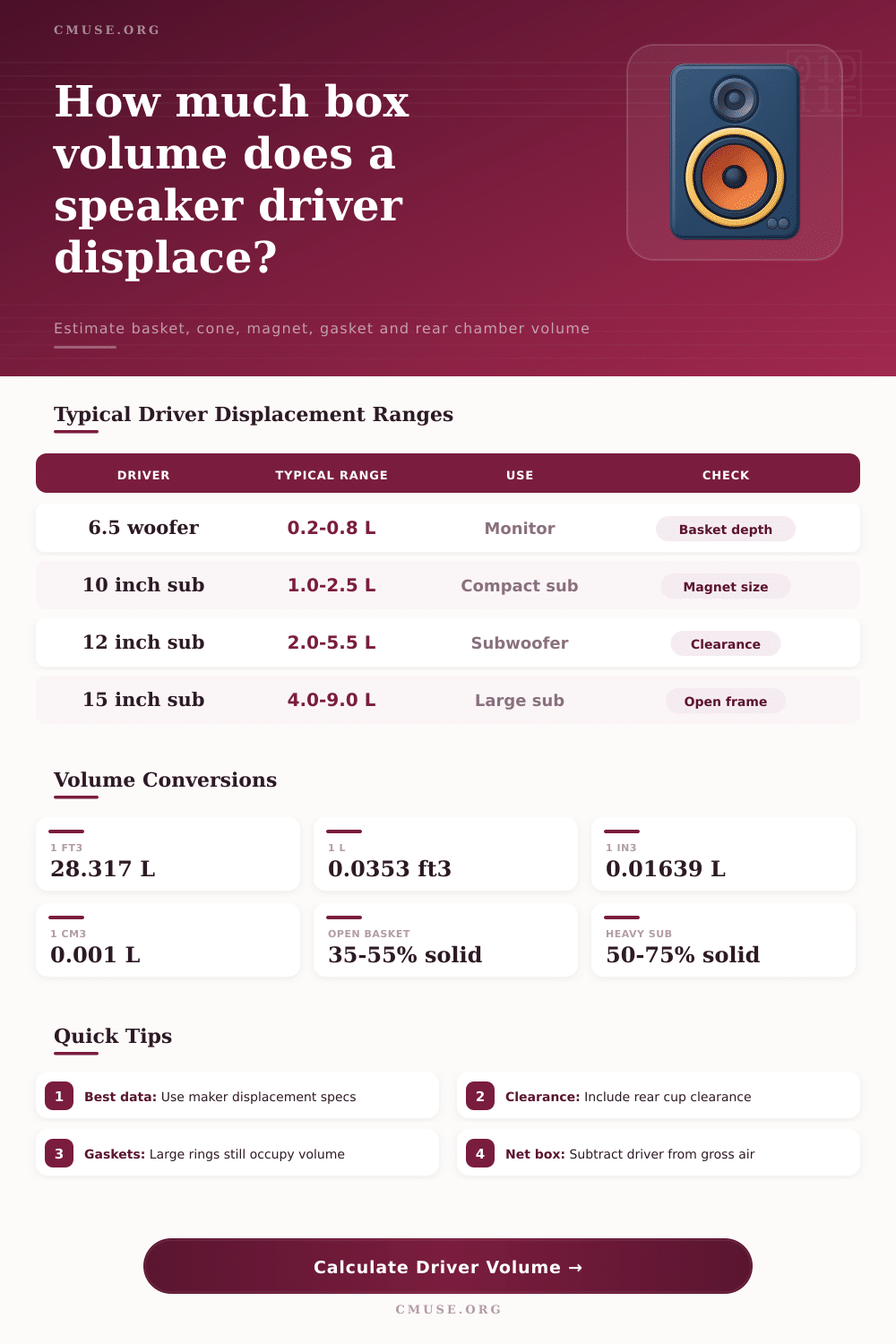
Driver size reference table
| Driver type | Common displacement | Basket depth cue | Magnet cue | Planning note |
|---|---|---|---|---|
| 5.25 to 6.5 inch midwoofer | 0.15-0.80 L / 0.005-0.028 ft3 | 2.5-4.0 in | Small ferrite or neodymium motor | Usually minor, but matters in tiny monitors. |
| 8 inch hi-fi woofer | 0.50-1.60 L / 0.018-0.057 ft3 | 3.5-5.0 in | Moderate motor and open basket | Check if the enclosure is under 20 L. |
| 10 inch subwoofer | 1.20-3.20 L / 0.042-0.113 ft3 | 4.8-6.5 in | Wide magnet, vented pole | Can shift small sealed alignments. |
| 12 inch subwoofer | 2.00-5.50 L / 0.071-0.194 ft3 | 5.5-8.0 in | Large motor and spider landing | Commonly worth modeling explicitly. |
| 15 inch woofer or sub | 4.00-9.00 L / 0.141-0.318 ft3 | 6.5-9.5 in | Large ferrite stack | Gross box may need several extra liters. |
| 18 inch pro subwoofer | 6.00-13.00 L / 0.212-0.459 ft3 | 7.5-11.0 in | Deep motor, large venting | Use manufacturer spec when available. |
Preset and conversion table
| Preset | Main geometry | Typical result | Liters/ft3 conversion | Best use |
|---|
More times than you might guess, you design a perfect-looking speaker cabinet on paper, but once mounted with drivers, sound has an odd ring or muddled bass response. It’s not typically the math involved in calculating interior dimension of the box. Typically it’s what goes into the interior dimensions of the box. All loudspeaker drivers takes up space in the real world. The massive magnet assembly, the voice coil, the spider, the metal basket, the gasket ring sealing it to the baffle (all of this add mass and takes up space). Taken together, that stuff all move air around. And if you don’t account for it, your sealed box becomes smaller than you imagined. This shift the flexibility of enclosure and raises tuning frequency of system.
The math for the geometry gets handled by calculator above. So there’s no need to be doing cylinder volume calculations in your head at work bench with glue on your fingers. When most folks calculate their box size, they do so in terms of gross internal volume. They’ll measure the inside dimensions (length x width x height), and then they stop there. That’s great as far as it goes, but it doesn’t take into account actual air volume available to the cone.
Why Speaker Drivers Take Up Space in Your Box
The driver displaces some amount of space. Depending off how it’s constructed, a typical twelve-inch subwoofer can be made to displace anywhere from two to five liters. That’s a pretty big percentage of total air mass, if you’re working with small sealed enclosure. So if you were thinking about designing a box for thirty liters, and your drivers will gobble up four liters of that space, you’ve just built yourself a twenty-six-liter box. And that change the acoustic properties enough to alter bass response from loose and bloated to tight and controlled. It may sound like a little thing, but in critical listening environment, it matters a lot.
This is where it break the driver down into geometry of each part and estimates what that portion would displace. Enter the outer frame diameter and the basket depth. Then use a solidity factor to make up for reality that the basket isn’t solid metal. An open cast basket might have only forty percent of volume being solid material. A stamped steel design might be quite dense. This matter because you are trying to estimate actual volume of object, not just its outer dimensions.
The magnet assembly gets its own calculation here too. Any holes drilled for pole vents remove air from the usable chamber so those is deducted from overall stack calculation. Rear clearance depth is how far away from baffle the dust cap or voice coil is. This keeps cone from contacting back wall on high excursion, but it also subtracts some air from total usable chamber (if you consider that air as lost volume).
The geometry of frame matters more different than many hobbyists know. A shallow bookshelf driver will take up far less space then a deep subwoofer with large ferrite magnet stack and sturdy surround. By adjusting how much of the frame is solid, you can set it to fit your desired style of build. Also, any foam or gasket surround between basket flange and baffle is added to volume as well. Yes, I know this sounds trivial, but when you are trying to get exact alignment down to a cubic centimeter, every one matter. Then it subtract that from the gross box volume giving you an estimate of the net air volume left.
The page includes reference tables so you can check your inputs using typical ranges for common driver sizes. If you input a ten inch driver and calculate a wildly different displacement than the industry norm, chances are pretty good you put in wrong basket depth or picked wrong solidity factor. When given manufacturer’s specs, they’re always best to use. But when those aren’t clear or missing altogether, this estimation method help bridge the gap. It transforms a guess to an educated calculation.
You want your enclosure to act exactly like it did in the alignment model. The starting point to that is understanding how much air is actualy in the box. Get volume planned accurately and you’ll get driver performing just like you designed it. It provides clarity and punch on the first note.