Slot Port Dimensions Calculator
Calculate rectangular speaker port area, aspect ratio, equivalent round diameter, tuning length and estimated air velocity.
Calculation breakdown
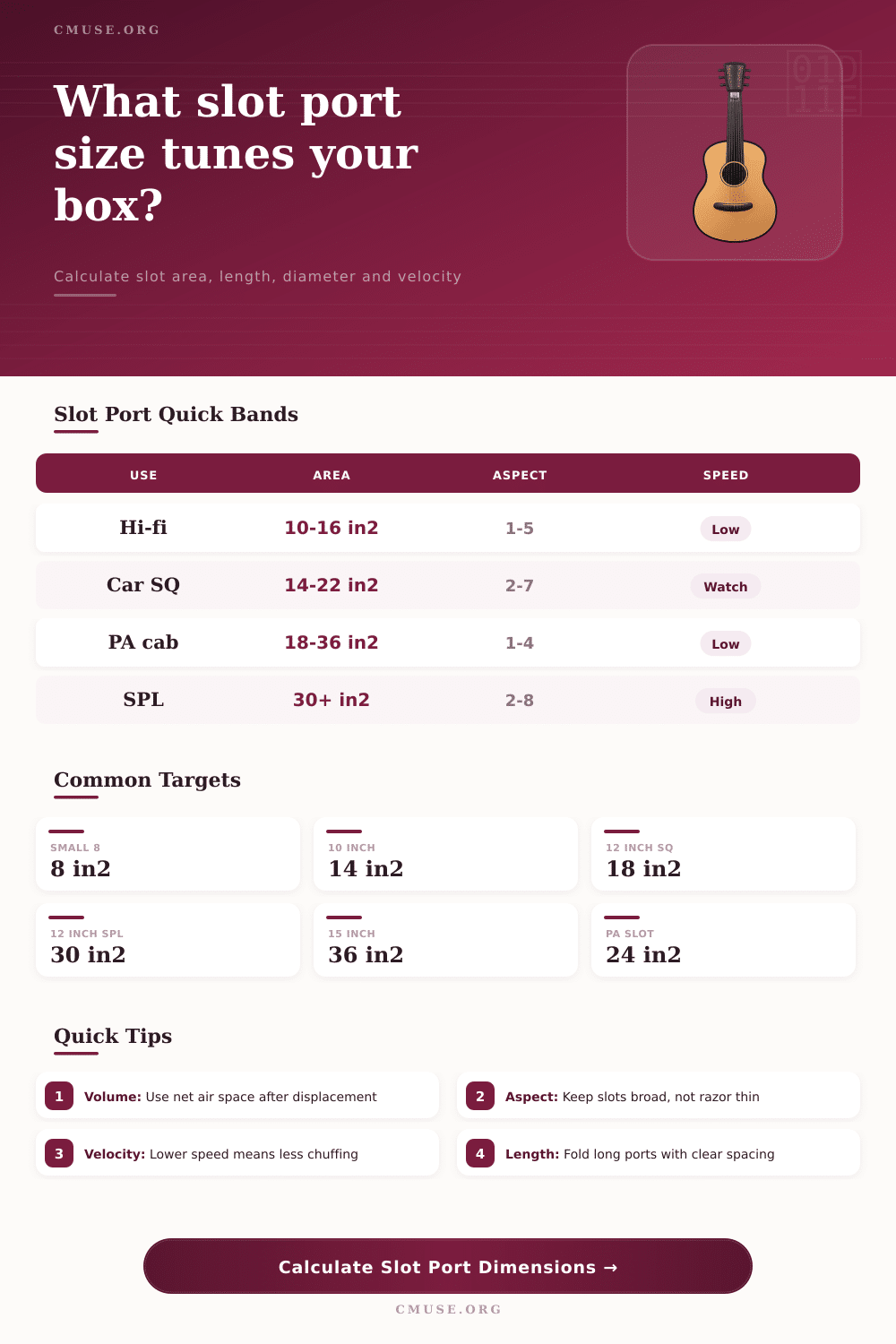
| Driver / use | Typical net box | Slot area target | Velocity note |
|---|---|---|---|
| 8 inch home sub | 0.45 to 0.9 ft3 / 13 to 25 L | 6 to 10 in2 / 39 to 65 cm2 | keep low |
| 10 inch vented | 0.9 to 1.6 ft3 / 25 to 45 L | 10 to 16 in2 / 65 to 103 cm2 | moderate |
| 12 inch hi-fi | 1.7 to 2.8 ft3 / 48 to 79 L | 14 to 22 in2 / 90 to 142 cm2 | low noise |
| 12 inch high output | 2.0 to 3.5 ft3 / 57 to 99 L | 24 to 36 in2 / 155 to 232 cm2 | watch length |
| 15 inch subwoofer | 3.0 to 5.5 ft3 / 85 to 156 L | 28 to 48 in2 / 181 to 310 cm2 | large slot |
| 18 inch home theater | 5.0 to 9.0 ft3 / 142 to 255 L | 40 to 80 in2 / 258 to 516 cm2 | fold port |
| Air velocity | Mach number | Design meaning | Practical action |
|---|---|---|---|
| Under 10 m/s | Under 0.03 | Very low risk for music listening | Port area is generous |
| 10 to 17 m/s | 0.03 to 0.05 | Common hi-fi target range | Usually acceptable with rounded edges |
| 17 to 25 m/s | 0.05 to 0.07 | Possible noise on sine waves or peaks | Increase slot area or add flare radius |
| 25 to 34 m/s | 0.07 to 0.10 | High risk for audible chuffing | Use more area, lower power or passive radiator |
| Over 34 m/s | Over 0.10 | Severe compression and noise risk | Redesign the vent system |
| Aspect ratio | Slot shape | Friction / noise risk | Recommendation |
|---|---|---|---|
| 1:1 to 3:1 | Nearly square or broad slot | Lowest boundary loss | Preferred when the cabinet layout allows it |
| 3:1 to 6:1 | Normal rectangular slot | Usable with smooth bends | Good range for most subwoofer boxes |
| 6:1 to 10:1 | Wide and shallow slot | Higher wall friction | Round edges and avoid very short height |
| Over 10:1 | Very thin slot | High compression and turbulence risk | Increase height or split into multiple slots |
| Preset | Box volume | Tuning | Starting slot |
|---|---|---|---|
| Home 10 inch | 1.25 ft3 / 35 L | 34 Hz | 10 x 1.25 in |
| Car 12 SQ | 2.25 ft3 / 64 L | 32 Hz | 12 x 1.5 in |
| Car 12 SPL | 2.75 ft3 / 78 L | 38 Hz | 14 x 2.25 in |
| PA 15 inch | 4.0 ft3 / 113 L | 45 Hz | 15 x 2.5 in |
| Home theater 18 | 7.0 ft3 / 198 L | 21 Hz | 20 x 3 in |
Get the air flowing properly in your subwoofer and it sound good. But don’t get caught up with just box size and driver specifications. The port is frequently ignored but shouldn’t be. It’s where the system breathe.
Narrow dimensions or restricting the space of the vent mean no more clean bass, just turbulence. A rushing noise called port chuffing rob the low end of impact. That’s air going to quickly through too small an opening.
How to Build a Good Subwoofer Port
Before you start cutting wood, the calculator above will help you achieve correct balance. The shape of rectangular slots also differ from that of round pipes. Typically you have a cabinet with a limited amount of height due to shelf constraints or car trunk geometry. Because of this geometry you go with a slot.
If you get the aspect ratio right then a wide shallow slot is fine. The calculator monitors this for you. It will alert you when it think the slot is getting too skinny compared to its width. In this case, one dimension are much larger than another, which causes a big increase in air friction on the walls. This creates turbulence that can’t be corrected with any kind of foam damping. Ideally, you want something close to square or gently rectangular and not a narrow slit. Reasonable aspect ratio will allow the air to flow smoothly without separating from edges.
Once you choose height and width, the tool will compute how long the port need to be. This is where a lot of folks go wrong, they forget about displacement. Enter the net amount of air space inside the enclosure. To get this, subtract wood and bracing of the port, then account for the driver’s magnet and other internal components. If you don’t compensate for a big folded slot, it use up valuable cabinet volume and moves the tuning up. As long as you accurately input the volume, the math compensates for this. If you input gross external dimensions of the box, you’ll always have a port that’s too short and your system will overpower the resonance peak.
The other key difference maker between good builds and great builds are velocity. Velocity is the speed of the air flowing through the port. At certain velocities, the sound of the air traveling past you becomes noticeable. To calculate maximum velocity, the calculator take into account both what your drivers can does in terms of excursion and how much power your amp can push. For clean music reproduction, you do not want the velocity to exceed fifteen meters per second.
If the tool shows your velocity is too high, it means there isn’t enough space in your slot area for amount of air being displaced by the cone at full volume. There’s no way around this but to increase the cross-sectional area of the slot. Flares won’t help when trying to overcome basic lack of area when running serious power.
The physical setup of the internal space within the enclosure matter too. Where does the port terminate? That’s covered in the settings with end correction numbers. A deeply recessed port terminating well into the enclosure differ from a flush slot ending on the baffle. This alters the actual length of air column, something you can model in the tool. Don’t forget that air has mass and inertia too. At low frequencies, ports can be quite long. Modifying how they terminate will shift tuning by an amount you can notice.
Last, maintain cleanliness of your build. Internal surfaces that is rounded make the speaker sound better because air flowing around corners does not produce swirls.
For basic driver sizes, the tool comes with reference tables indicating typical starting points. Your own use case may require some tweaks however. Just as a high excursion car sub would of require greater volume than a controlled studio monitor despite having the same nominal diameter. Start from the preset values to get close to the desired size. Adjust to meet your space limitations. Maintain a manageable aspect ratio and low velocity. It’s all about getting it right on the air side as well as the driver side.