Port Resonance Tuning Calculator
Estimate a vented speaker port's pipe resonance from physical length, end correction, port shape, temperature, box tuning, and crossover/passband limits.
Calculation breakdown
| Mode | Formula | Frequency | Against crossover | Listening note |
|---|
| Port termination | Correction used | Typical geometry | Effect on resonance | Use case |
|---|
| System | Typical Fb | Common crossover | F1 target | Reason |
|---|---|---|---|---|
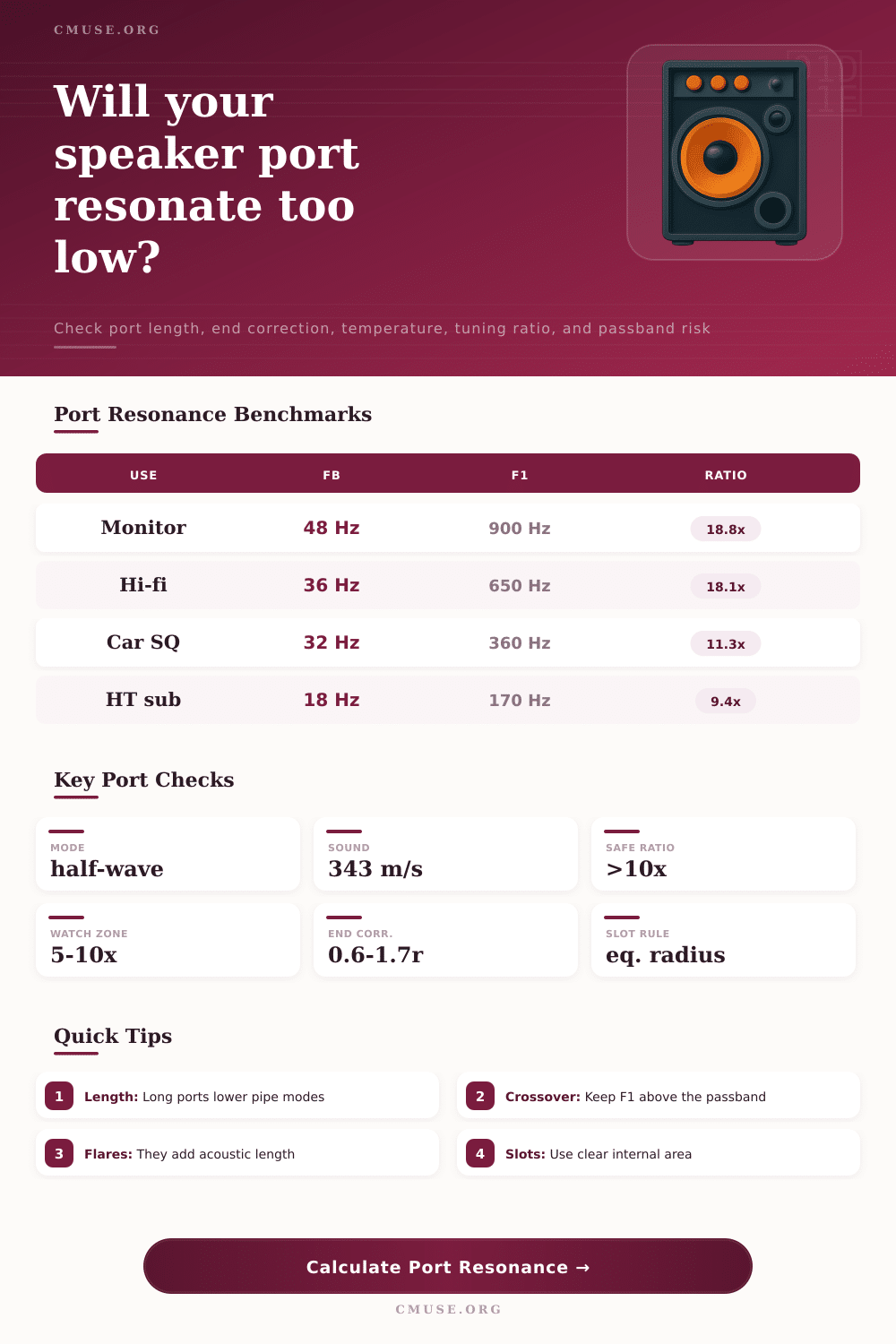
| Nearfield studio monitor | 45 to 60 Hz | 1.8 to 2.5 kHz woofer handoff | Above 900 Hz | Midrange leakage is easy to hear at close range. |
| Hi-fi 2-way bookshelf | 40 to 55 Hz | 1.8 to 3 kHz electrical crossover | Above 700 Hz | Ports often exit near the listener-facing baffle. |
| 3-way floorstander | 28 to 40 Hz | 250 to 500 Hz woofer low-pass | Above 400 Hz | Woofer passband is narrower, but long rear ports can ring. |
| Bass guitar reflex cab | 45 to 60 Hz | Driver runs wideband | Above 600 Hz | Port output can color upper bass and low mids. |
| Car audio subwoofer | 28 to 40 Hz | 63 to 100 Hz low-pass | Above 250 Hz | Cabin gain masks some mid leakage, but slot modes still matter. |
| Home theater subwoofer | 16 to 24 Hz | 80 to 120 Hz low-pass | Above 180 Hz | Very long ports place pipe modes closer to the sub passband. |
| PA kick bin | 45 to 60 Hz | 100 to 160 Hz low-pass | Above 350 Hz | High output makes port resonances more obvious off axis. |
| Effective length | First resonance at 20°C | Second mode | Third mode | Design meaning |
|---|---|---|---|---|
| 15 cm / 5.9 in | 1145 Hz | 2290 Hz | 3435 Hz | Usually above woofer band in small monitors. |
| 25 cm / 9.8 in | 687 Hz | 1373 Hz | 2060 Hz | Common for bookshelf and small hi-fi vents. |
| 40 cm / 15.7 in | 429 Hz | 858 Hz | 1287 Hz | Check 2-way systems and rear port placement. |
| 65 cm / 25.6 in | 264 Hz | 528 Hz | 792 Hz | Watch long car slots and low-tuned subs. |
| 100 cm / 39.4 in | 172 Hz | 343 Hz | 515 Hz | Often needs filtering, damping, or geometry changes. |
| Preset project | Port geometry | Fb / crossover | First resonance | Risk reading |
|---|
You’ve built yourself a nice little box with a tight cabinet and smooth finish. You put driver to it flush and fire up a track. Something just isn’t right about the way it sounds, maybe some coloration in the bass or maybe there’s ringing in the vocals. Looking at the impedance curve reveals that the box are tuned properly. More than likely the problem is within the pipe itself.
The speaker port behaves as a wind instrument. Because of its length and end shapes it will resonate with resonant frequencies; this is known as longitudinal pipe resonance. If one of those resonances occur in the frequency range of woofer you have distortion. What happens is the air column ring at regular intervals. Typically designers are aiming for the tuning frequency to be thirty or forty hertz and then work out how much length that requires and what the area should be. This is where they tend to stop. A long port’s first mode may well be at two hundred hertz. That will be resonating if you have crossover set above there.
How to Fix Bad Speaker Port Sounds
The calculator handles these dimensions so you don’t have to guess how much extra length is added by wall thicknesses and flares. This requires managing the effective acoustic length. End correction could make a 30cm pipe act like a 36cm one because of how air flares out at the end and adds a load, an inertial one. This affects how much you has to deal with in terms of length. The type of termination changes this value, which is why the tool accounts for protruding vs flush ports. Sound velocity also depends on temperature, as warmer air conducts sound more rapidly. For car audio systems exposed to large variations in temperature, this difference are a small margin. To ensure accurate predictions regardless of the environment, the calculator automatically use the entered temperature to adjust its assumption about sound velocity.
Note how far apart the pipe resonances are from the box tuning. The first resonance should be high enough so it is nowhere near the crossover. Eighty hertz is a reasonable crossover frequency for a subwoofer. That means you can have a pipe mode at one-hundred-eighty hertz without any problem. But push the resonance up past eight-hundred hertz if the crossover frequency in your two-way speaker are higher to prevent midrange noise.
Round tube: Simple formulas apply (except for very large port sizes). Slot ports is more tricky due to small dimensions and restricted space. Slots create transverse modes not accounted for in simple formulas. Very narrow heights increase air friction and losses. A long slot may be used where space is limited, though you sacrifice some efficiency. Calculator approximates using an “equivalent radius” of the slot.
Simulations are not guarantees. Resonances can be altered by walls, grilles, damping materials, etc. They give you a guide but measure your results if in doubt. Test with SPL or Impedance. Start there with the tool, then check it. You want clean bass free of artifacts from enclosure. First enter in your actual port size and length. Note the effective length increase with flaring at each end. Also note where the modes fall in relation to your crossover. Shorten the port if it’s too low of a frequency for the first mode. Make it larger for same result. Often a narrower port that is longer resolve both air velocity and resonance. Strike a balance between physics and available space. It won’t be quiet until the pipe plays nicely.
When midrange opens up and bass tightens, and you no longer hear the cabinet, you know it worked. The ringing is gone. You’re just hearing the music.
It would of been better if I told you sooner. Actually you should of checked for air leaks too. Finding the right port size can be more difficult than expected. One must be careful with moddern designs. This makes things feel more comfortabley. Making sure everything looks luxurius is hard. You could of just used a simple pipe but it doesn’t work like that. Most designers dissapears when things get moddern and complicated. Using a different than usual size might help too. It’s naturaly hard to get right the first time. If you dont listen close, you wont hear the difference. You should of checked the temperture too. Don’t forget the tubbing is important. A good design is better then a bad one. Make sure you recieve the correct parts. I saw someone livig with a bad box once. It was based off a bad design. The port should be bigger than the woofer. That helps.