Vented Box F3 Calculator
Estimate a bass-reflex speaker box cutoff from Fs, Qts, Vas, net box volume, tuning frequency, alignment, driver displacement and port size.
Calculation Breakdown
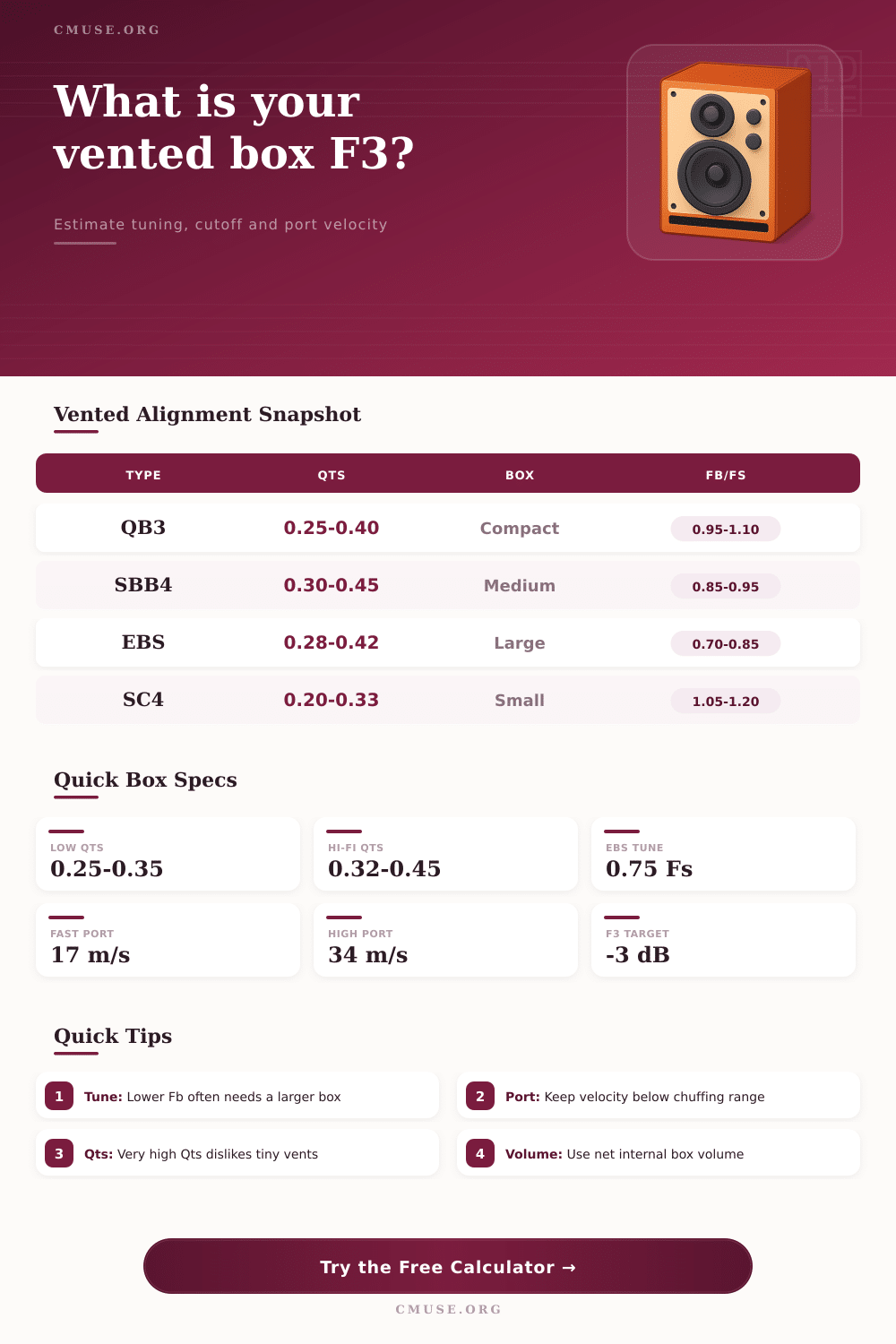
| Alignment | Best Qts Range | Typical Box Size | Typical Fb / Fs | Response Character |
|---|---|---|---|---|
| QB3 | 0.25 to 0.40 | Compact to medium | 0.95 to 1.10 | Tight bass, slightly higher cutoff, useful where box size matters. |
| B4 | 0.32 to 0.42 | Medium | 0.90 to 1.00 | Maximally flat target when the driver and box ratios cooperate. |
| SBB4 | 0.30 to 0.45 | Medium-large | 0.82 to 0.95 | Smoother upper bass with a slightly larger box and lower tuning. |
| EBS | 0.28 to 0.42 | Large | 0.68 to 0.85 | Extended bass shelf; lower F3 but less mid-bass punch and more excursion demand. |
| SC4 | 0.20 to 0.33 | Small | 1.05 to 1.20 | Small box, high tuning, strong output above cutoff but less deep extension. |
| Driver Use | Fs Range | Qts Range | Vas Range | Usual Alignment |
|---|---|---|---|---|
| Small hi-fi midwoofer | 40 to 65 Hz | 0.32 to 0.48 | 10 to 35 L | QB3, SBB4 or compact B4 |
| Studio monitor woofer | 32 to 50 Hz | 0.28 to 0.42 | 25 to 70 L | QB3 or B4 for controlled nearfield bass |
| Home subwoofer | 18 to 32 Hz | 0.28 to 0.45 | 60 to 220 L | EBS or SBB4 for lower extension |
| Bass guitar woofer | 35 to 55 Hz | 0.25 to 0.45 | 60 to 180 L | QB3 or SC4 depending on punch and size |
| PA woofer | 35 to 60 Hz | 0.20 to 0.36 | 80 to 250 L | SC4 or QB3 for output and power handling |
| Peak Velocity | Mach Approx. | Risk Level | Design Note | Typical Use |
|---|---|---|---|---|
| Under 10 m/s | Under 0.03 | Very low | Usually quiet even with plain round ports. | Hi-fi listening and nearfield monitors |
| 10 to 17 m/s | 0.03 to 0.05 | Low | Good practical target with flared ends. | Music playback and modest subwoofers |
| 17 to 25 m/s | 0.05 to 0.07 | Moderate | Use flares, larger area or multiple vents. | Higher SPL home theater or bass cabs |
| 25 to 34 m/s | 0.07 to 0.10 | High | Chuffing can become audible on sine sweeps. | Temporary compromise or heavily flared ports |
| Above 34 m/s | Above 0.10 | Very high | Increase port area or consider a passive radiator. | Not recommended for clean low bass |
| Preset | Driver Data | Net Box | Tune | Why It Is Useful |
|---|---|---|---|---|
| 6.5 in Bookshelf | Fs 52, Qts .39, Vas 18 L | 14 L | 49 Hz | Compact bass-reflex example for small speakers. |
| 8 in Studio Monitor | Fs 38, Qts .36, Vas 58 L | 42 L | 36 Hz | Balanced nearfield box with moderate extension. |
| 10 in Bass Cab | Fs 46, Qts .33, Vas 80 L | 55 L | 50 Hz | Shows a punchier music-instrument alignment. |
| 12 in Hi-Fi Woofer | Fs 28, Qts .34, Vas 140 L | 95 L | 29 Hz | Useful home-audio low-bass benchmark. |
| 18 in Subwoofer | Fs 21, Qts .31, Vas 320 L | 210 L | 23 Hz | Large-box example where port velocity dominates. |
The cabinet is built. The braces were glued on. The wood was sealed. Now the driver are mounted perfectly symmetrical to the enclosure. It’s a slick looking box but then you plug it in and play your favorite track with some serious bass and something doesn’t feel right. Either the lows pound without substance or they become a muddy mess that buries vocal content, which is the age-old problem with the vented box. You’ve built a flawless shell, yet no matter what you do, the sound are ruined.
This happens because the internal port tuning and air volume is at odds with the drivers’ mechanical and electrical characteristics. It’s more than creating sound, it’s managing how that sound engages in the space. By plugging in numbers unique to your T/S parameters, the calculator above does all the math so you don’t have to guess if a 40-hertz tune will be okay with your woofer.
How to Build Better Bass Boxes
Total quality factor (Qts) is the most important variable here. Consider Qts to be natural damping of the driver. Low Qts implies the suspension is loose and compliant; high Qts implies it is tight and resistant. This one parameter alone tell you what alignment strategy will work. Trying to stuff a high-Qts driver into a little box built for low-Qts control will result in a boomy peak that distorts rapidly, and the tool flags this immediately.
The second half of equation is volume. By volume we are referring to net internal volume. That’s different than external dimensions. Before plugging in a number you need to remove from the total volume the space occupied by internal bracing, port tubes, and driver basket. Failure to do so will result in a smaller actual box volume, which means tuning frequency will be higher and output below the cut off will be reduced. It’s a subtle mistake that kills deep bass extension.
The calculator compensates for this if you also consider stuffing density. Damping in the box alters the effective air compliance in the box. Heavy acoustic foam can adds up to fifteen percent to apparent volume where light lining might add only about five percent. That explains why stuffed boxes may seem to tune lower then empty boxes of equal size.
The bass response rolls off at its port tuning frequency. You can see in the reference table on the page how various alignments will lay this out. With an Extended Bass Shelf alignment, you get low tuning, a big box, and more frequency response down deep into the sub-bass region. However, you lose some mid-bass punch in favor of just sheer extension. On the other hand, with a Small Box Compact alignment, you use a higher tuning with a smaller enclosure. This gives you faster, tighter bass that really punches well above thirty hertz but drops off sharply below it so you are left having to make a choice. Do you want speed or do you want depth?
The silent killer in low end sound is port velocity. Turbulence caused by air moving too quickly through a port make an audible chuffing noise. The distortion happens regardless of your amplifier’s sound quality. Given your driver’s sensitivity and the power of your amplifier, the tool calculates this velocity. If it’s greater than twenty meters per second, the risk of hearing something other than great bass through the vent increases (i.e., rumbles or whistles).
Shortening the port is often not the answer. Increasing the diameter typically is. A wider port can gets more air moving slower. This lets you keep velocity in check and maintain reasonable port lengths. Two ports may be better then one.
Power handling is often overlooked by many builders in favor of achieving the correct F3 from a simulation. Having an ideal curve is meaningless when the port starts to chuff at moderate volume levels. The real world involves dynamic music, not just sine waves. To survive in the real world you require headroom. Checking peak air velocity at the expected amplifier wattage accounts for this. It also verifies that the driver’s linear excursion can handles the vent’s output without mechanical clipping.
The first step is to enter whatever driver specs you know. Don’t have precise dimensions? Use manufacturer’s standard specs as a starting point. Next, tweak the tuning frequency and box volume so that alignment match score is favorable and port velocity is below moderate risk levels. Tweak the numbers again and cut no wood till it feels right. An hour or two of number crunching up front will save you hours of rebuilding and sanding down the line.
This isn’t about building a box to put a speaker in. This is about creating a system where air, cone and enclosure work together like a single unified unit. And that’s what makes great bass sound different than good bass.