Sealed Box Qtc Calculator
Estimate sealed speaker alignment from Vas, Qts, Fs, current box volume, stuffing, losses and target Qtc, then see Fc, F3 and the volume change needed.
Calculation Breakdown
| Qtc target | Alignment character | F3 behavior | Typical use |
|---|---|---|---|
| 0.50 to 0.58 | Overdamped, very smooth rolloff | F3 well above Fc | EQ-assisted sub, studio accuracy |
| 0.60 to 0.70 | Controlled with little overshoot | F3 close to Fc near 0.707 | Hi-fi woofer, small monitor |
| 0.707 | Maximally flat Butterworth response | F3 equals Fc by definition | General sealed speaker design |
| 0.80 to 1.00 | Raised upper bass and stronger punch | F3 below Fc but peakier | Car audio, guitar, compact boxes |
| Above 1.10 | Audible hump and ringing risk | Low F3 can be misleading | Only when voicing demands it |
| Fill choice | Effective volume | Q effect | Design note |
|---|---|---|---|
| Bare sealed box | 1.00x | Highest Qtc for a given box | Best for measurement baselines |
| Light wall lining | 1.08x | Small Qtc reduction | Useful in midbass chambers |
| Moderate loose fill | 1.15x | Noticeable Qtc reduction | Common sealed hi-fi starting point |
| Heavy fill | 1.22x | Lower Qtc, more loss | Check that the cone can breathe |
| Very dense fill | 1.28x | Can overdamp and heat voice coil area | Use only with measurement checks |
| Qtc | F3 / Fc ratio | Shape | Practical reading |
|---|---|---|---|
| 0.50 | 1.55 | Gentle rolloff | Needs EQ or room gain |
| 0.58 | 1.27 | Smooth bass | Good accuracy target |
| 0.707 | 1.00 | Flat response | Classic sealed alignment |
| 0.85 | 0.85 | Mild warmth | Compact box compromise |
| 1.00 | 0.79 | Peaky | F3 hides the response hump |
| Scenario | Driver data | Box idea | Target |
|---|---|---|---|
| Small studio monitor | Vas 20-45 L, Qts .35-.45 | 10-25 L with moderate fill | Qtc .58-.70 |
| Hi-fi floor woofer | Vas 70-160 L, Qts .30-.42 | 40-90 L net before fill | Qtc .65-.75 |
| Subwoofer with DSP | Vas 80-250 L, Qts .30-.45 | Larger sealed chamber | Qtc .50-.65 |
| Car cabin sub | Vas 20-60 L, Qts .42-.60 | Small stiff enclosure | Qtc .75-.95 |
| Guitar speaker cab | High Fs and higher Qts | Often intentionally small | Qtc .85-1.10 |
When your newly built speaker box comes back to you sounding hollow, you might get a case of the panics. You did everything right by measuring and assembling it snugly. But bass seems to be missing some depth. In most cases, the glue and wood were not the issue. The issue was more likely the Qtc.
What’s that? It’s a number describing what the driver does in the enclosure vs. Than it describes what it does in free air. Once you understand it, building speakers go from guessing to an exercise in acoustical engineering. No longer do you have just a boxed up cone. Now you have system you’re tuning.
How to Fix Hollow Speaker Sound
Fortunately, this website does all the fancy math for you in their calculator. Simply input the dimension of the box and some specifics about driver and let the calculator do the rest. But what are those inputs?
For starters, there’s Vas, or the equivalent air compliance of the suspension. Imagine a spring stiffness. If your driver has a high amount of Vas then it can absorbs freely in a lot of air. Now take that same cone and try to trap it in a small box. You’ve just added a stiff spring to the suspension of that driver. So system resonance increase and the low end roll off occurs at a higher frequency. That is why box size are so important.
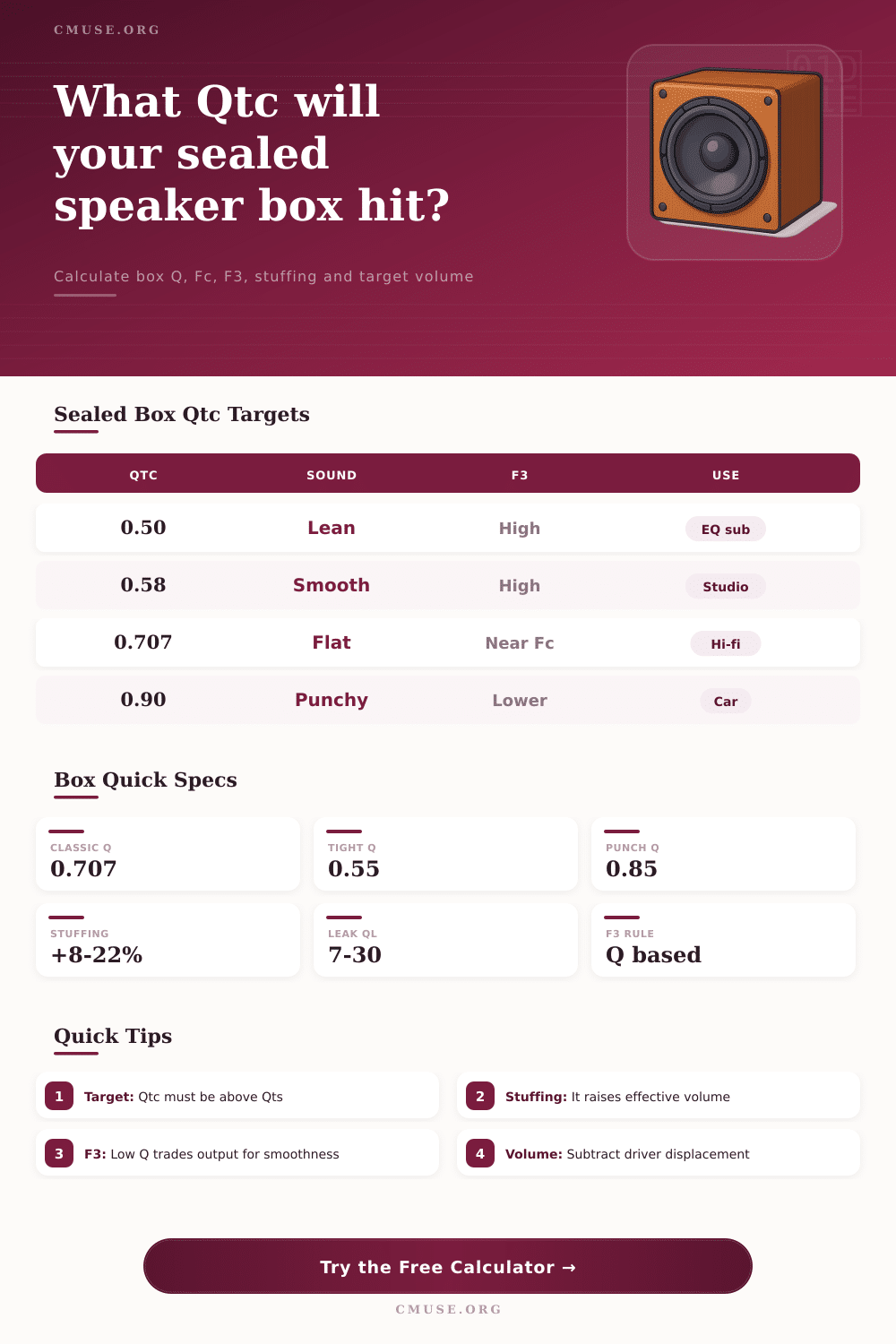
Total Quality Factor (Qts) measures how long a driver take to stop. Low Qts drivers stops fast. High Qts ring out. When a driver is sealed into a box these numbers become the Qtc. Designers generally target 0.707, which is called Butterworth alignment. This provides a flat response with no peaks or dips at the cutoff frequency. Acoustically it’s neutral.
Go lower than that towards 0.58. The bass will be smooth but lack punch. Going above it towards 0.90 or even 1.00 gives impact but produces a hump in the response that can be boomy. You can see those trade-offs based off the reference table. Then, you can select the character of the bass you like best before cutting any panels.
Stuffing is important. Builders have long thought of fiberglass or polyfill just as a way to deaden cabinets. They work that way, but they also warm up air inside the cabinet. The warmer the air, the less it will compress. That makes the apparent volume bigger to the driver. Fifteen-percent extra volume occurs with a modest amount of stuffing. This little trick lowers Fc and Qtc. It gives more bass with no increase in external width. Not bad for a low cost solution. To account for this, the tool let you set a stuffing factor. That means your prediction matches reality instead of an empty box.
Don’t overlook displacement. Inside that speaker cabinet is a big lump of wood or plastic called a woofer. That thing is going to displace some volume. You are measuring your box out externally (front to back X top to bottom X left to right) and not deducting for the terminal cup, driver basket, or bracing. You’ll end up with less interior air space than you thought. Less interior equals higher Qtc. A.707 was your goal, now it’s 0.95 because you didn’t factor in displacement and your bass is peaking. The calculator asks for net physical volume and subtracts driver displacement automatically if you provide the gross dimensions. No more mistakes caused by forgetting about what’s taking up space inside.
The real world isn’t always so good at building boxes. Poorly sealed ports and corners may leak and reduce effective Q. For this reason there’s a loss factor built into the tool. A small leak in a box is different than having a perfectly sealed box. Before you throw away those driver specs because the measured response doesn’t look right, inspect the seals. You might find that the drivers themselves vary from sample to sample. It’s wise to re-measure impedance after break-in if it matters.
Sealed box design comes down to a balancing act: you are trading extension for control, or punch for accuracy. There’s not one right answer… just what tastes best in your space. Set expectations using the calculator. Build carefully while considering volume and stuffing. Then listen with an open ear. Your ears will tell you what works best. The math should of got you there.