Cone Excursion Calculator
Estimate loudspeaker cone travel from power, frequency, effective cone area, Xmax, box loading, high-pass filtering, SPL, and displacement volume.
Calculation Breakdown
| Frequency | Excursion | Xmax Use | Risk | Estimated SPL |
|---|---|---|---|---|
| Calculate to fill the frequency sweep. | ||||
| Power | Excursion | Xmax Use | Risk | Headroom Note |
|---|---|---|---|---|
| Calculate to compare power levels. | ||||
| Nominal Driver | Typical Sd | Typical Xmax | Vd Range | Common Use |
|---|---|---|---|---|
| 5.25 inch midwoofer | 80-95 cm² | 3-6 mm | 24-57 cc | Small monitor mid-bass |
| 6.5 inch woofer | 120-145 cm² | 4-8 mm | 48-116 cc | Bookshelf speaker and nearfield monitor |
| 8 inch woofer | 200-230 cm² | 5-10 mm | 100-230 cc | Hi-fi woofer or compact sub |
| 10 inch woofer | 320-360 cm² | 6-14 mm | 190-500 cc | Bass cab and compact subwoofer |
| 12 inch subwoofer | 480-560 cm² | 10-22 mm | 480-1230 cc | Home, car, and small PA subwoofer |
| 15 inch subwoofer | 800-900 cm² | 8-18 mm | 640-1620 cc | PA subwoofer and large bass system |
| 18 inch subwoofer | 1150-1250 cm² | 9-20 mm | 1040-2500 cc | High-output pro subwoofer |
| Box Type | Excursion Behavior | Protection Need | Calculator Model |
|---|---|---|---|
| Sealed | Rises gradually below Fc | Moderate at very low frequency | Smooth low-frequency rolloff and air-spring support |
| Ported | Minimum near tuning, steep rise below Fb | High-pass strongly recommended | Port support around Fb and unload below tuning |
| Passive radiator | Similar to ported with radiator limits | Protect below tuning | Slightly gentler notch than bass reflex |
| Bandpass | Controlled inside passband, steep outside | Filter outside passband | Reduced cone travel near center frequency |
| Horn loaded | Low travel inside loading band | Avoid below horn cutoff | High acoustic loading above cutoff |
| Open baffle | More travel as bass cancels | Very high below baffle step | Dipole cancellation penalty at low frequency |
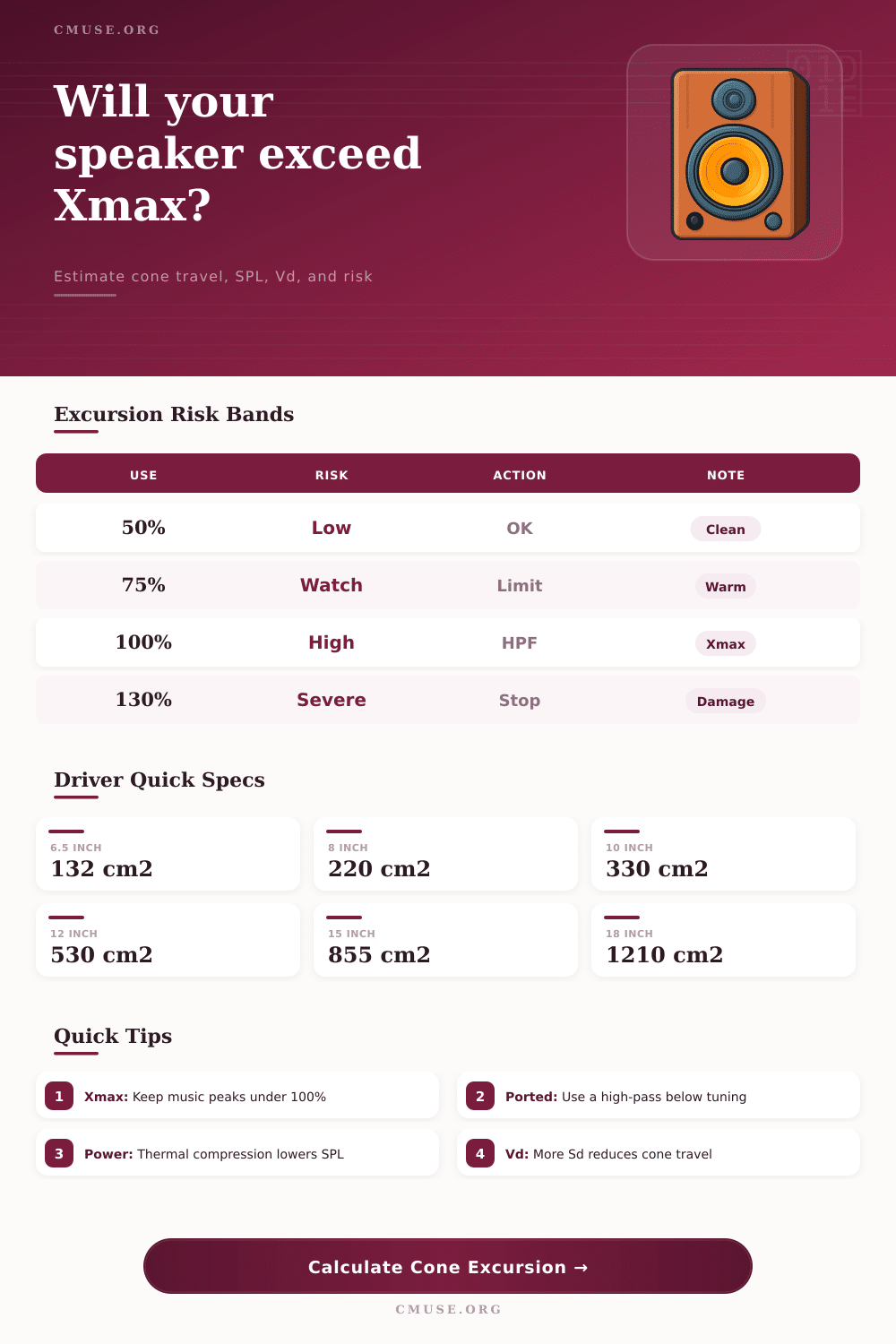
| Xmax Use | Risk Band | What It Usually Means | Best Next Move |
|---|---|---|---|
| 0-50% | Low | Good linear margin for music dynamics | System is excursion-comfortable at this frequency |
| 50-75% | Moderate | Still usually clean, but peaks matter | Check lower frequencies and heat compression |
| 75-100% | Watch | Near the linear travel limit | Add high-pass filtering or reduce boost |
| 100-130% | High | Likely distortion and mechanical stress | Lower power, raise filter, or add displacement |
| 130%+ | Severe | Over-excursion likely on peaks | Stop or redesign the low-frequency target |
How does physics apply to speakers? In most cases, you don’t know, so that’s why most of them fail. You crank it up when a bass heavy song comes on and the music stops and starts cracking. What happened? The cone just reached its mechanical limit. The driver went farther then the suspension designed it to go and tore the cone or damaged the internal components. That’s called over-excursion. It destroys more speaker than any other issue. Knowing how far your drivers needs to move will help you save your stuff.
The calculator (above) take power figures and turns them into motion. Given the shape of driver, the frequency of the music, and the output of your amp, it will tell you if the cone in question can survive. Before you trust its answer, make sure that you know what all the inputs represent. Maximum linear excursion (or Xmax) is the primary variable. It’s a measure of how far a moving cone travels during clean operation. By definition, it’s a one-way measure of distance from static. Peak-to-peak travel is another way some companies express it. Use the incorrect figure here and none of the others matters. It is at the core of everything.
How Physics Saves Your Speakers From Breaking
Safety depends on frequency as well. Lower frequency sounds requires more air movement to produce a given level of sound pressure. For instance, moving a speaker cone half as much will produce twice the output if it’s at 100 hz rather then 50 hz. Subwoofers don’t look like midrange drivers because they’re designed to handle this problem. Their suspensions is deeper and their surface area are larger. With this tool, you can test individual frequencies to discover exactly how hard the driver work at the bottom end of its range. You may find that your system fail at 35 hertz but works fine at 60.
Subwoofer performance varies greatly depending on the enclosure style. Here’s how they work: A sealed box behaves as an air spring. When the speaker cone pulls inward, it stiffens up the suspension, protecting the driver from going too far inward. But to push outward take added power. Ported box. A ported box uses resonance to boost efficiency near its tuning frequency. That’s good because the driver isn’t moving much then. This is not good because the driver get no support below that frequency. This is dangerous territory. Unless you have a high pass filter blocking sub-sonic rumbles from getting through, the cone starts moving all over the place. The calculator show when a ported design must be filtered to stay alive with real world music.
Another thing to think about is power compression. Speakers don’t sit there being passive; they gets hot. When a speaker get hot, especially during loud passages, its resistance increases. This result in a loss of efficiency as the voice coil warms up. What may have seemed like a great amp won’t deliver what was hoped for once heat has reduced the output several dB. To keep the level up, the driver will be required to do more mechanical work. Even though the electrical input remain constant, excursion will rise. If this thermal aspect isn’t factored in, then your estimation will be wrong in use.
You can get some idea from this reference table on the page which has typical specs for common size drivers. If you don’t have your datasheet, it will give you a baseline. For example, an eight inch driver is going to handle low bass different than a twelve-inch woofer that has roughly 500 square centimeters of surface area. Because they are pushing more volume per millimeter of travel, larger cones moves less distance to produce the same amount of pressure. Huge drivers is used in professional sound systems for deep bass. They don’t just move more air but also reduce mechanical stress.
It’s a planning tool, not a promise. Music has dynamics, amplifiers that clip, and real-world room acoustics. Those things are unpredictable and no static calculation will ever capture it all. The idea here is to see where you might have issues and establish sensible limits. Stay at or below 100 percent of Xmax for comfortablely sound levels. Pad for those occasional peaks that sneak up on you. It’s about being able to listen to the music while protecting the speaker. Respecting how far the cone can go protects your equipment. Stretching the suspension beyond its means isnt reversible.