Treble Bleed Calculator
Estimate guitar volume-pot treble bleed behavior from pot value, knob taper, capacitor and resistor network, pickup impedance, cable capacitance, high-pass corner, taper shift, and retained treble.
Calculation Breakdown
| Frequency | No Bleed Retention | With Bleed Retention | Bleed Lift |
|---|---|---|---|
| -- | -- | -- | -- |
| Pickup And Pot | Cap Value | Resistor Choice | Expected Result |
|---|---|---|---|
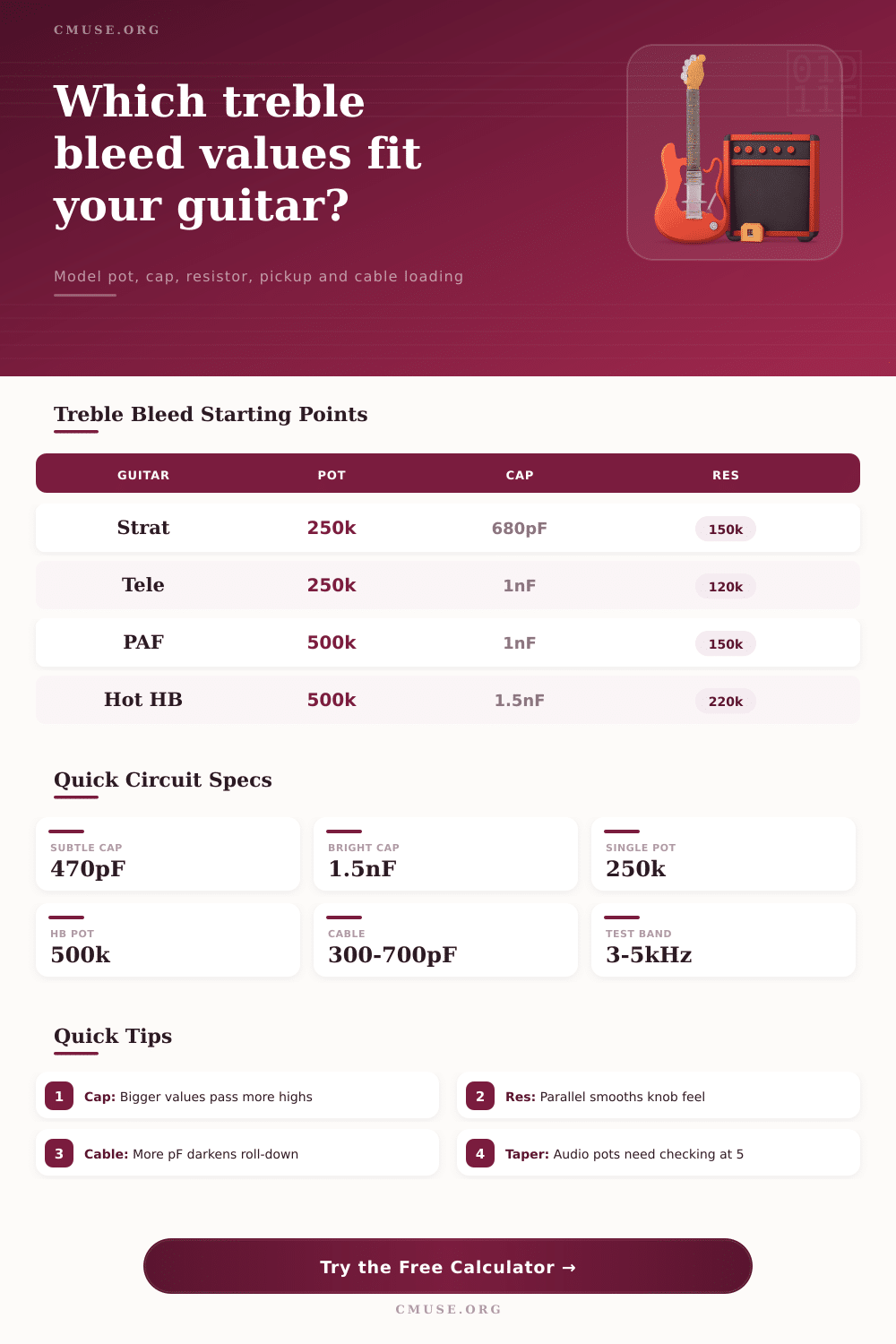
| Vintage Strat, 250k pot | 560 pF to 820 pF | 120k to 180k parallel | Preserves chime without harsh low-volume glass |
| Tele bridge, 250k pot | 820 pF to 1 nF | 100k to 150k parallel | Keeps attack and twang when backing off for rhythm |
| PAF humbucker, 500k pot | 1 nF to 1.2 nF | 150k to 220k parallel | Balanced clarity with less mud on rolled volume |
| Hot humbucker, 500k pot | 1.2 nF to 1.8 nF | 180k to 330k parallel | Offsets darker winding and longer cables |
| Passive bass, 250k or 500k | 330 pF to 680 pF | 150k to 330k series or parallel | Retains articulation while avoiding brittle upper mids |
| Network | High-pass Path | Taper Effect | When To Use |
|---|---|---|---|
| Cap only | Strong capacitive bypass around upper pot resistance | Can make the knob feel quick below 6 | Dark guitar, low value cap, player wants bite |
| Parallel resistor | Cap and resistor both bypass high frequencies and some mids | Smooths audio taper and adds retained level | General Strat, Tele, PAF, and stage wiring |
| Series resistor | Resistor limits the cap bypass current | Less jumpy, less extreme treble hold | Kinman-style and smooth volume cleanup goals |
| No bleed | No bypass around the volume pot | Classic darkening as volume drops | Players who use the tone darkening as part of the sound |
| Pickup Type | Typical R / L | Cable Range | Treble Bleed Note |
|---|---|---|---|
| Low-output single-coil | 5.5k to 6.5k / 2H to 3H | 250 pF to 600 pF | Small caps are usually enough; avoid over-bright values |
| Tele bridge | 6.5k to 8k / 2.5H to 4H | 300 pF to 700 pF | 1 nF parallel networks often keep snap intact |
| PAF humbucker | 7.2k to 8.8k / 4H to 5.5H | 300 pF to 800 pF | 500k pots usually like 1 nF and 150k to 220k |
| Hot humbucker | 12k to 16k / 6H to 9H | 350 pF to 900 pF | Larger cap or brighter cable may restore pick edge |
| Passive bass pickup | 7k to 13k / 4.5H to 8H | 400 pF to 1000 pF | Use restraint; too much cap can expose clanky upper mids |
| Taper Model | Knob At 50% | Treble Bleed Sensitivity | Practical Check |
|---|---|---|---|
| Modern audio | Low electrical wiper ratio | High, because upper pot resistance is large | Listen at 5 and 7, not only at 10 |
| Vintage audio | Slightly higher mid travel | Medium-high with smoother cleanup | Good for players who ride the knob constantly |
| Linear | Near the marked knob value | Moderate and predictable | Can feel abrupt in loudness but easier to model |
| Soft custom | Between linear and audio | Moderate-high | Useful for custom tapers and measured pots |
When you roll back your guitar’s volume pot, the resulting sound can become muddled. Maybe you’re looking for a smoother texture for your rhythms, yet you end up with mud in the low-mids that hides your chord voicings. Why? Because passive volume pots is high-pass filters: they allow the bass tones to pass through while sending high frequencies to ground. As you turn the volume pot down, the resulting tone becomes darker and less articulate. Consequently many players keep the volume all the way up or simply shut it off.
To solve this, there is something called a treble bleed circuit that will provide a parallel path for higher frequencies to go around the resistance of the pot. So it keeps your top-end air and pick attack intact even when turned down low.
How to Fix Your Guitar Volume Tone
There are calculators online where you put in the variable and it tells you what the right value should of been. Knowing what these things are will allow you to make more informed decisions about which components to use for your specific system vs someone else’s.
Next, we look at the input values, which are also important. The pot value that sets the impedance loading is critical to the starting point. In general, 250k ohm pots load a humbucker harder then a 500k ohm pot. That impacts how much bleeds back in.
It also matters what kind of taper the pot is. Taper has been modeled in moddern audio tapers so that the change from volume up and down is smooth; however, from an electrical perspective at lower levels, they can be tricky. These tapers will have the upper part of the resistance become huge very fast. Linear or vintage tapers acts different. They move the electrical sweet spot around the turn of the knob. Having the taper of the pot figured into your calculation helps ensure you aren’t bleeding in treble when you don’t want it to be there. You also won’t miss out on treble because of the spike in resistance of the pot.
High-end frequencies are cut due to cable capacitance. Each foot of guitar cable introduces a tiny bit of capacitance between your pickup, your volume pot and everything else along the way. Think of it as a low-pass filter with your pickup and volume pot. A short patch cable connected directly to an amp will behave different than a thirty-foot cable stretching across the stage. Because of this, the tool takes the cable load into account. If you don’t account for the cable load, you’ll end up overcompensating by adding too much bleed. This can result in a harsh, fizzy sound at full volume. So you’re trying to offset the darkening effect a long cable has. But you don’t want to add a permanent bright boost that’s fighting against your natural tone.
Resistor-Capacitor combos (or R-C) vs. These are capacitor-only networks. A capacitor is going to preserve the most amount of high frequency. On the other hand, it will also produce a sudden bleed. You’ll notice quite a sudden change in brightness or volume across some threshold on the pot. When you add a resistor in series with the cap, you soften the curve. In effect, you reduce the amount of treble that passes around the pot at high frequencies. What results is a more musical and gradual roll off. These setups work well because they offer both clarity and control.
What resistors and caps exactly? Depends on your pickup output. Humbuckers tend to be pretty high output, so they may need or at least handle bigger capacitors to cut through when backed off. Single coils from the past can go harsh with even a few hundred picofarads too large. Note: These aren’t hard rules; rather, they’re pointers for your ear.
What does this mean? With the calculator, you get your calculated retention percentage and rough high-pass corner frequency. This means you have some idea of how much you need to turn the pot up from zero before your tone begins to thin out from its maximum volume. From here, let these numbers help guide your selection process.
Next, test it out. Did it sound too dark? Try swapping in a 1nF capacitor. Try swapping a smaller cap like a 1nF capacitor. Is it too brittle? A little resistance might be what you need. Remember, it’s not about being right technically but something you can use musically. It should respond to your finger pressure consistently. It lets you adjust the texture while maintaining the definition.
The bottom line is that volume knob should be an expressive tool. It should not be a tonal trap. Finding the right balance between your cable length, pot taper and bleed network will give you back the upper harmonics that are inevitably stolen by passive circuits. The attack needs to still be there to articulate what you’re playing. And it gives you the warmth of lower settings too.
Begin with these calculated values. Listen critically on low volume settings. Tweak from there until the knob becomes an extension of your hands and no longer fights you.