Capacitor Tone Bleed Calculator
Model a guitar volume-pot treble-bleed network from capacitor value, resistor option, cable capacitance, pickup resistance, pickup inductance, cutoff frequency, treble retention, and output loading.
Circuit breakdown
| Frequency | No Bleed Output | With Bleed Output | Difference |
|---|---|---|---|
| -- | -- | -- | -- |
| Cap Value | Typical Pot | Expected Feel | Best Starting Use |
|---|---|---|---|
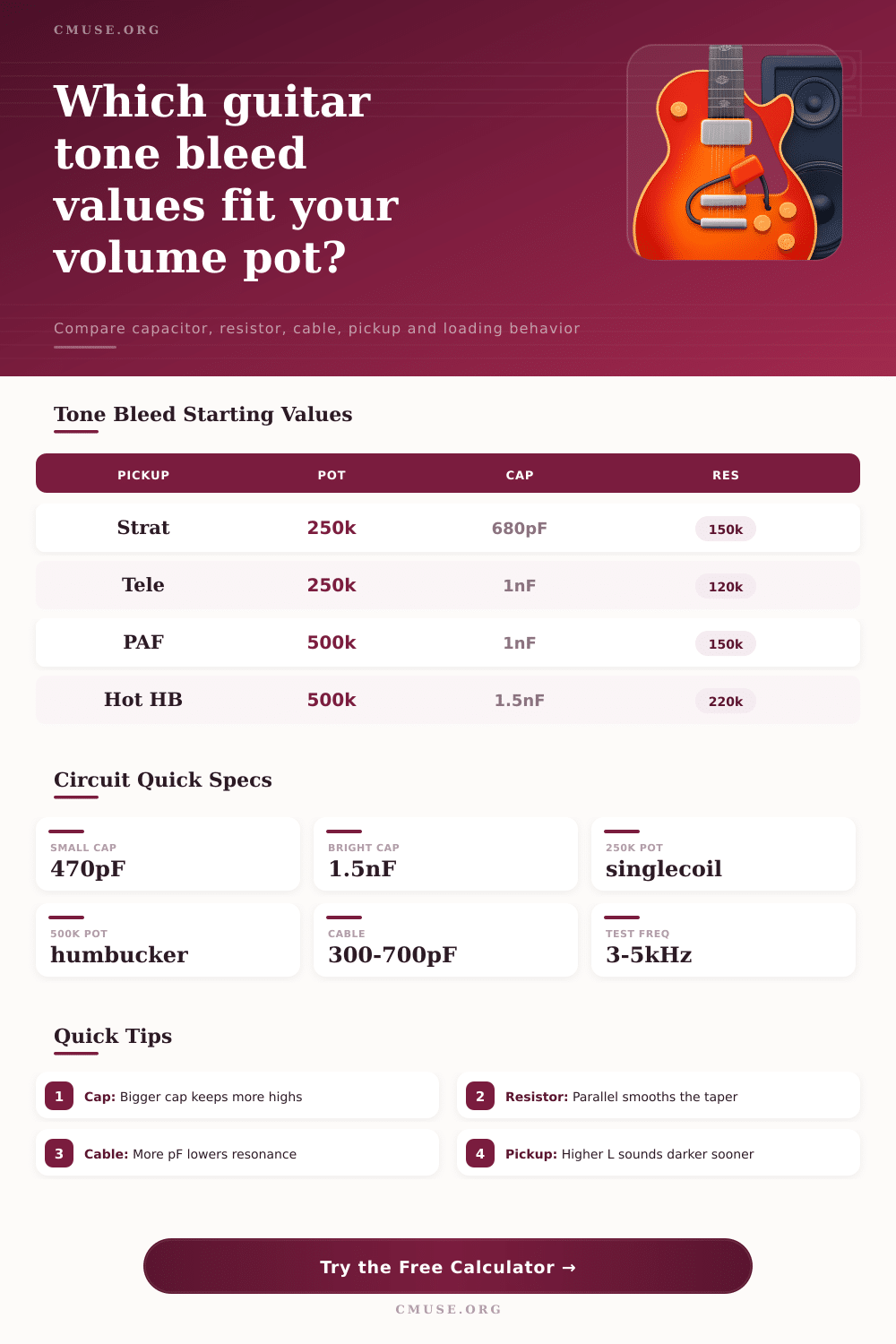
| 470 pF | 250k or 500k | Subtle top-end hold | Bright single-coils, low-cap cables, clean players |
| 680 pF | 250k | Balanced sparkle | Strat-style circuits and moderate cable capacitance |
| 1000 pF / 1 nF | 250k or 500k | Clear attack retention | Tele, PAF humbucker, and general modern wiring |
| 1500 pF / 1.5 nF | 500k | More upper-mid bypass | Hot humbuckers and darker long-cable rigs |
| 2200 pF / 2.2 nF | 500k or 1M | Very bright roll-down | Dark pickups, heavy cable loading, special effects |
| Network | Typical Values | What It Changes | Watch For |
|---|---|---|---|
| Cap only | 470 pF to 1500 pF | Strongest treble bypass, simple wiring | Can sound thin or jumpy at low volume |
| Parallel resistor | 100k to 220k with cap | Smoother taper and less ice-pick top | Too low can keep volume from cleaning up naturally |
| Series resistor | 100k to 330k before cap | Limits bypass amount while keeping treble path | Too high may make the cap barely audible |
| No bleed | Open circuit | Traditional darker roll-down | Cable capacitance dominates rolled-back tone |
| Pickup Type | Typical R / L | Cable Range | Resonance Cue |
|---|---|---|---|
| Vintage single-coil | 5.6k to 6.5k / 2.0H to 2.8H | 250 pF to 600 pF | Bright peak often above 4 kHz |
| Tele bridge | 6.5k to 8.0k / 2.5H to 3.8H | 300 pF to 700 pF | Strong bite, benefits from modest cap values |
| PAF humbucker | 7.2k to 8.5k / 4.0H to 5.0H | 300 pF to 800 pF | Lower peak needs controlled treble retention |
| Hot humbucker | 12k to 16k / 6.0H to 8.5H | 350 pF to 900 pF | Darker source often needs larger cap or 500k pot |
| Passive bass | 7k to 13k / 4.5H to 7.0H | 400 pF to 1000 pF | Use smaller cap to avoid brittle upper mids |
| Preset | Cap / Resistor | Pickup Model | Why It Is Useful |
|---|---|---|---|
| Vintage Strat 250k | 680 pF parallel 150k | 6.1k, 2.4H | Moderate retention without making positions 2 and 4 brittle |
| Bright Tele 1nF | 1 nF parallel 120k | 7.2k, 3.1H | Keeps bridge attack when rolling back from full volume |
| PAF Parallel 150k | 1 nF parallel 150k | 7.8k, 4.4H | Common starting point for 500k humbucker guitars |
| Hot Humbucker | 1.5 nF parallel 220k | 14k, 7.2H | Offsets darker inductance and long output cable |
| Series Resistor Smooth | 1.2 nF series 220k | 8.5k, 4.9H | Retains clarity with less aggressive volume-taper change |
Basic AC circuit physics is conspiring against you; as you turn down volume knob, your guitar sounds like it’s plugged into a cardboard box. When you roll back on the potentiometer, you lower impedance seen by the pickup which causes that loss of clarity and bite. What’s killing your high frequencies (which gives your tone its definition) are low impedance.
This is where a treble bleed circuit come in to play, it creates a low-impedance path that allows those high frequencies to bypass resistance and go straight from the pickup to the jack. With the calculator above, you don’t have to guess blindly at capacitors, all you need to do is plug in the specifics of your gear and let the calculator handle the math for you.
How to Fix Your Guitar Tone with a Treble Bleed Circuit
The capacitor is key to this circuit: You want something that works well with your pickup output. With a bright single-coil, a big cap can be too much of a good thing making your guitar sound shrill and brittle at full volume. Smaller caps keeps it sounding like itself but add enough top-end to keep it articulate if you back off. Sometimes hot humbuckers are too dark with little capacitor because their higher inductance dampen the treble more aggressively. In that case you may want a bigger cap here to offset that. It’s all about finding a balance, not making it as bright as possible.
Over the range of the volume pot that resistor alter the behavior of that capacitor. Without a resistor a capacitor can make the volume control sound jagged or not linear at all, whereas a resistor in parallel with the cap will help to smooth out the taper. The result is that there’s no abrupt shift in tone when you hit some threshold point on the volume pot. If you place the resistor in series then you are limiting the amount of high end that makes it through. So it’s acting more like a soft filter than a hard bypass. That might be something you should of do if you’re looking to clean your tone up but not lose all your attack. The chart on the page is a quick look at that.
The secret variable that’s screwing up your tone is probably your cable length. You might find a tonal sweet spot using different combinations of pots and caps. However, that long, coiled guitar cable can still have too much capacitance adding its own load before the signal even reaches the pot. The capacitance caused by your cable may be minimal if you’re running a short patch cable or using a buffered pedalboard. But if you’ve got a foot of vintage-type cord dangling off your guitar, it doesn’t matter what kind of treble bleed network you use, ten feet of extra load will suck the high frequencies right out. Total capacitance measurement are helpful here, but best is just to listen. Plug into another cable and notice how dark your tone gets. That means you’re subject to loading effects.
The placement of the natural resonance peak are determined by pickup inductance. Hotter pickups typically has higher inductance, which means their peak will be lower on the frequency chart, sounding less bright out of the box and needing a more aggressively tweaked treble bypass for perceived clarity. Vintage PAF style humbuckers have a medium amount of inductance, providing enough midrange focus to support modest bleed values without being too strong. Single-coils already start at a higher point in the resonant range so they need subtler intervention. A poor pairing here will result in a thin fizzy sound that just cuts off abruptly instead of smoothly rolling off.
Just keep in mind that your ears know more than any spreadsheet about exactly what microfarad number is best on paper. So, try a generic value that’s been recommended for your type of pick-up and then dial it in according to how it sounds at low, mid-range and high volumes. Ideally, you’re looking for very little change in the full-volume tone and a noticeable difference at reduced volumes. That preserves the edge while avoiding harshness or noise.
Is it too bright? Go down to a lower-capacitance cap, or throw some resistance in series. Is it still muddy? Bump up to the next size larger. Adjusting these are all part of getting your guitar set up, along with tweaking its intonation or action. You’re dialing it in for your hands and your amp.
And the goal is not to keep as many frequencies as possible but to sound consistently good no matter how hard you play. It will no longer feel like a moddern cardboard box.