Roundwound vs Flatwound Tension Calculator
Compare string construction, scale length, gauge, tuning pitch, unit weight estimate, feel factor, and total set tension
Presets fill a full set, then compare the selected roundwound-style construction against a flatwound alternative.
Calculation Breakdown
| String | Pitch | Gauge | Primary Tension | Flat Tension | Delta | Unit Weight Ratio |
|---|
| Construction | Mass Model | Feel Factor | Typical Result |
|---|---|---|---|
| Roundwound nickel/steel | Open wrap gaps, moderate wrap fill | 1.00 | Brighter response, more flexible surface feel |
| Roundwound stainless | Slightly denser steel wrap model | 1.04 | Firm attack with similar set tension to nickel rounds |
| Half-round / groundwound | More wrap contact than roundwound | 1.08 | Smoother touch and a small tension increase |
| Nickel flatwound | Higher wrap fill and less air gap | 1.13 | Usually firmer and smoother at the same gauge |
| Stainless flatwound | Dense ribbon wrap over steel core | 1.17 | Highest pull among common flatwound models |
| Nylon tapewound | Lower-density outer tape over wound core | 0.94 | Often lower pull with a soft surface response |
| Instrument | Common Gauges | Scale Range | Notes | What Drives Delta |
|---|---|---|---|---|
| Electric guitar light | .010 .013 .017 .026 .036 .046 | 24.75-25.5 in | E standard | Wound D, A, and low E |
| Jazz guitar medium | .011 .015 .022 .030 .040 .050 | 24.75-25.5 in | E standard | Wound G raises flat set feel |
| Baritone guitar | .013 .017 .026 .036 .046 .062 | 27-30 in | B standard | Long scale plus large low strings |
| 4-string bass | .045 .065 .085 .105 | 30-35 in | G D A E | All strings are wound |
| 5-string bass | .045 .065 .085 .105 .130 | 34-35 in | G D A E B | Low B unit weight dominates total |
| Scale Move | Length Ratio | Tension Change | Best Use |
|---|---|---|---|
| 24.75 to 25.5 in | 1.030 | About +6.2% | Compare Gibson-style and Fender-style guitars |
| 25.5 to 27 in | 1.059 | About +12.1% | Baritone and extended range guitars |
| 30 to 34 in | 1.133 | About +28.4% | Short-scale bass to long-scale bass |
| 34 to 35 in | 1.029 | About +6.0% | Five-string bass low B support |
| Preset | Scale | Gauge Set | Comparison Lesson |
|---|---|---|---|
| Electric 10-46 E Standard | 25.5 in | .010-.046 | Only the wound half changes much between round and flat. |
| Jazz 11-50 Short Scale | 24.75 in | .011-.050 | Wound G makes flatwound feel more obvious. |
| Baritone 13-62 B Standard | 27.5 in | .013-.062 | Scale length magnifies construction differences. |
| Bass 45-105 Long Scale | 34 in | .045-.105 | Every string is wound, so the set delta is larger. |
| Five String Bass 45-130 | 35 in | .045-.130 | Low B unit weight can dominate total pull. |
Pull a set of slick flatwounds off the spool and slip ‘em on your neck, anticipating the smooth feel under your fingertips. Strum an open chord and you’re instantly reminded that you’re playing with a layer of rubber between your fingertips and the frets. The strings feels firm and steady atop fingerboard. But it’s not in your head. The physics have changed.
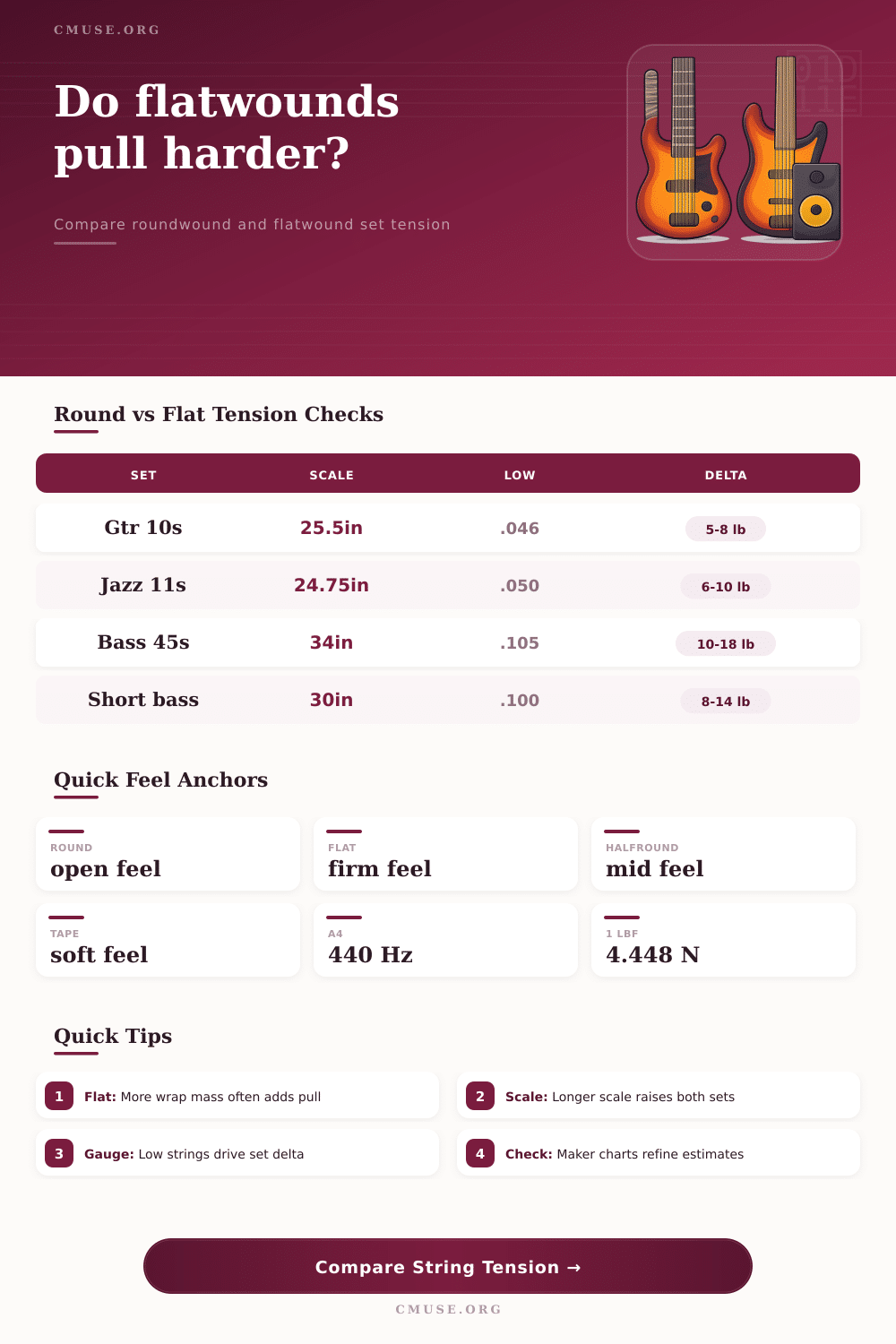
For most players, they chalk it up to their own technique or newness of the strings. But tension is almost always the culprit. Flatwounds contain more metal in their outer wrap than do roundwounds. The added mass exists at the same gauge diameter which means the string must pulls harder against the neck to get to pitch.
Why Flatwound Strings Feel Tighter
Plug in your tuning and scale and let the calculator above do the math for you…or avoid the guessing game as to why your low E feel like a steel cable. But the real reason come down to how they are constructed. On a roundwound string, there are spaces where the windings sits apart from each other. Each of those small holes of air subtracts from overall mass of metal on that string. Flatwounds compress all that same volume of wire into one unbroken band. This results in higher density. The strings has the same physical thickness. So the calculator take all of these variables and works them into an estimated unit weight (wrap type + core share). Then it uses traditional tension formulas to show you the difference between two string types.
And you notice it. It’s not always just about the collective set pull. It’s also about where that tension is distributed relative to individual strings. This change also depends heavily on scale length. For each additional inch of scale length, the tension increases at a steady rate. So as we go from say a twenty-four and three quarter inch guitar neck to a twenty five and a half inch one, each string will pull harder because they have more distance for cover. This is laid out nicely in reference table on page. Throw into the mix a longer scale paired up with a heavy flatwound set and you’ll notice that tension spike.
Not only does this affect intonation compensation, but if you don’t compensate by adjusting the truss rod, it will pull your neck out of relief. This is why many times folks who swap out sets experience some headache with their setups; they didn’t think about overall geometry of their instrument. That’s where gauge selection comes into play. You can at least soften that up some if tension difference in the upper register is large enough to show on calculator by moving high strings down a peg or two. Most of the tension is coming from those wound string anyhow. Your low E and A are taking most of the load on your neck joint. Where higher strings make all the difference is feel and how well you bend them. Sacrifice a little on the treble strings for easier movement with your hands and not really affect overall structural integrity of your string set up much. It is a small adjustment but makes a difference when you’re seeking out a certain feel.
The other wrinkle is in materials. While both nickel and stainless steel flatwounds generally play nearer to round wound tension, stainless wraps will be tighter. This is because they holds more mass per inch compared to the nickel version. You’ll be able to feel this difference across different materials. Even if you purchase two sets with the exact same gauge on each, a stainless flatwound set may feel much stiffer when played different than the nickel version. And this is important to those of us that want the silky surface of a flatwound without giving up our dynamic response. A less dense wrap will retain some of its give while delivering the attack you’re seeking.
Stiffness is another aspect of core. The same amount of pull can come from a string whose wrap material is softer than its core. That will bend differently and create a different feeling of stiffness. To account for this perceptual phenomenon, I added what I called feel factor into the calculator. Feel is the human side of physics. Two strings could have the same poundage but you pick them up and feel one are easier on your fingers. That’s where feel factor comes in. This includes the percent of wrap to core and how easily the string deforms when played or moved.
So in the end, it’s more than a visual switch. It’s a mechanical one too. And your instrument react to scale and mass as well as tone. Having some understanding of the tension shift allows you to set up and adjust to match. And don’t reject flat wound strings just because they feel a bit tight. Adjust the variables so that the math works with way your hands do. Balance.
Whatever your preference, whether it’s comfort or bright tones, understanding how it all pulls means you can make an educated decision instead of a sudden one. Your fingers would of appreciated your care for detail before they touch the fretboard.