Pickup Winding Turns Calculator
Estimate pickup coil turns, wire length, DC resistance, inductance, capacitance, magnet response, output and winding fill.
Calculation Breakdown
| Wire | Bare Dia. In | Approx Ohm / 1000 Ft | Typical Pickup Use | Turns Fit |
|---|---|---|---|---|
| 40 AWG | 0.00314 | 1049 | Low DCR experiments, compact coils | Lower count |
| 41 AWG | 0.00280 | 1323 | Early style single coils, clear neck winds | Moderate |
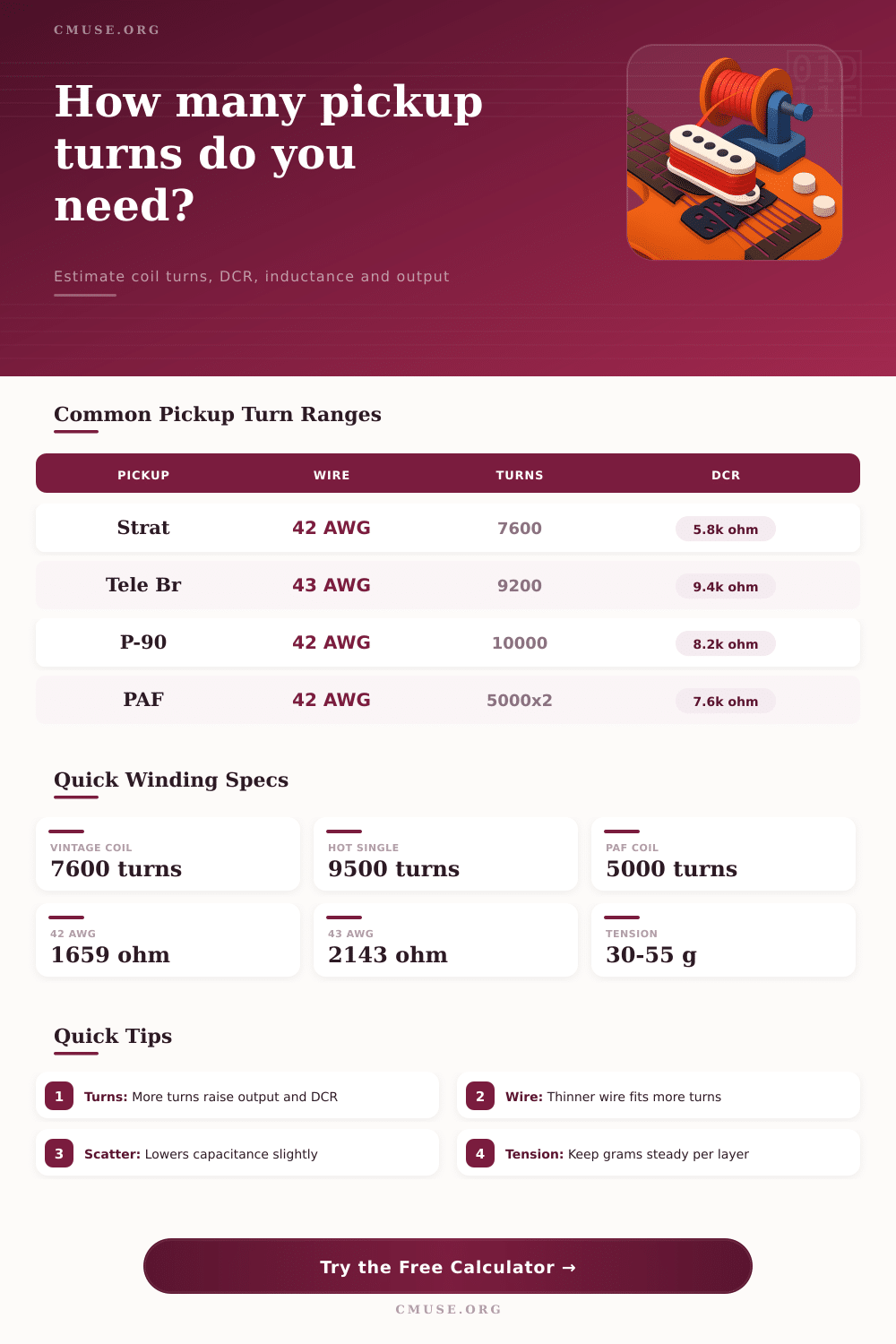
| 42 AWG | 0.00249 | 1659 | Strat, P-90, PAF and many vintage winds | Standard |
| 43 AWG | 0.00222 | 2143 | Tele bridge, hotter singles, mini humbuckers | High count |
| 44 AWG | 0.00198 | 2593 | Very hot narrow coils, rail styles | Very high |
| Magnet | Output Factor | Inductance Factor | Typical Voice | Use Case |
|---|---|---|---|---|
| Alnico II | 0.92 | 0.96 | Soft attack, sweet highs | Vintage neck and PAF style |
| Alnico III | 0.84 | 0.94 | Lower pull, open mids | Early Strat and Tele neck |
| Alnico IV | 0.96 | 0.98 | Balanced mid focus | PAF and roots bridge |
| Alnico V | 1.08 | 1.02 | Tight lows, bright snap | Strat bridge, Tele bridge |
| Alnico VIII | 1.18 | 1.05 | Strong mids, high drive | Hot humbucker bridge |
| Ceramic 8 | 1.22 | 1.08 | Firm attack, high output | Modern high output builds |
| Pickup Type | Common Wire | Typical Turns | DCR Range | Inductance Range |
|---|---|---|---|---|
| Strat neck / middle | 42 AWG | 7,400 to 8,000 | 5.5k to 6.2k | 2.0H to 2.8H |
| Strat bridge hot | 42 or 43 AWG | 8,500 to 10,000 | 6.5k to 9.5k | 3.0H to 5.0H |
| Tele bridge | 42 or 43 AWG | 8,000 to 10,500 | 6.8k to 10.5k | 3.0H to 5.8H |
| P-90 soapbar | 42 AWG | 9,000 to 10,500 | 7.5k to 9.2k | 5.5H to 7.5H |
| PAF humbucker | 42 AWG | 4,800 to 5,500 per coil | 7.2k to 8.8k total | 3.8H to 5.5H |
| FilterTron style | 42 or 43 AWG | 3,800 to 4,800 per coil | 4.0k to 5.5k total | 1.5H to 2.8H |
| Variable | Lower Setting | Higher Setting | Electrical Effect | Watch Point |
|---|---|---|---|---|
| Turns | Brighter, lower DCR | More output, darker peak | DCR and inductance rise | Check bobbin fill |
| Wire gauge | Thicker, lower DCR | Thinner, higher DCR | More turns fit with 43/44 | Thin wire breaks easier |
| Scatter | Neater, higher capacitance | Looser, lower capacitance | Resonance can shift upward | Keep traverse repeatable |
| Tension | Soft coil, larger pack | Tighter coil, small stretch | Small resistance change | Avoid snapped wire |
| Temperature | Lower DCR reading | Higher DCR reading | Copper is about 0.393% per °C | Log measurement temp |
A tool for estimating coil turns, wire length, and electrical specs before you start winding. So this is a handy tool for planning out a pickup on guitar before you begin winding it.
So many times you’re not sure if there are enough turns on a coil or too much. It calculates the wire length, number of turns, resistance, inductance, and output. That way you can see how various designs will stack up and check your ideas different than specific outcomes.
A Tool to Plan Guitar Pickups
There’s one variable: Turns. But that must be put into context. Seven thousand turns of Alnico eight magnets in a Stratocaster neck pickup will sound vintage. Ceramic magnets are strong and efficient, so you need fewer turns to get high output.
So what? We’ve built a simple online tool to calculate those variables. It shows how many turn you need to reach a specific voltage for a given bobbin shape. And we calculate wire length.
Why should that matter? This happens because of the effect on foot-per-turn, as a longer window in the coil raise the DC resistance at a rate not accounted for by adding additional turns. The number of turns you can cram into a given area also depend on the wire gauge. Standard size is 42AWG. However, some guitars like P-90s and Strats is wired with thinner 43 AWG wire, which allows for more turns within the limited space.
The thinner the wire, however, the more prone it is to breaking its enamel coating under the tension required for a good coil. In that case, the goal of making as much output as possible has to be balanced against mechanics of your winding technique. Hand wound coils typically have a lower fill percentage than machine wound coils so they has fewer turns to create different capacitance properties.
The type of magnet also influences the tone independent of the copper wire. Alnico II magnets has a higher softness rating, which is to say they generate less voltage per turn compared to Alnico V magnets. This enables you to use fewer turns to achieve the same perceived level, while maintaining a brighter coil. High output requires fewer turns too when using ceramic magnets that are stronger and more efficient. If used without the right wire gauge they can produce a compressed tone.
These magnetic characteristics is factored into the calculator’s inductance estimates, predicting the resonant peaks. Tonal clarity depends on resonance frequency. The higher it is (above five kilohertz), the more brittle and harsh the sound will be. Muddy tone results from low resonant points.
A chart of coil inductance working with various pot loads provides reference tables. For example, a one-megohm load sounds brighter then a 250-kiloohm volume pot. This interaction explains why vintage wiring can sound darker. The tool adjusts both the winding specs and the pot size.
The copper will have increased resistance because of its own heating while being wound. When you measure the coil’s DC resistance while it is still warm, that resistance value will be higher compared to what it would of been if measured at room temperature. To make this comparison normalised it helps to also record the ambient temperature. If you are matching a pair of humbucker coil so they sound identical, then this is an important step.
A pickup is also a transducer. The electrical figures don’t account for differences in pole piece saturation or how tightly wire is packed onto the bobbin. Treat it more like a road map to get you going in the right direction than an accurate map.
Begin with your desired output level. Calculate based off that number. Wind the coil with the right tension. It’s a blending of math and hand dexterity that produces a consistent tone.