DI Box Count Calculator
Plan equivalent DI channels, physical boxes, stereo keyboard pairs, active/passive DI types, spare units, ground-lift needs and console input count from one stage list
DI Count Breakdown
| Source Group | Source Count | DI Channels | Preferred DI Type |
|---|---|---|---|
| — | — | — | — |
| DI Type | Best Source | Typical Channel Use | Planning Note |
|---|---|---|---|
| Active DI | Passive guitar, piezo acoustic, vintage keys | 1 channel per source | High input impedance protects level and tone |
| Passive Transformer DI | Active bass, synth, drum machine, interface output | 1 channel per mono source | Good isolation for hot or buffered line outputs |
| Stereo DI | Keyboard, sampler, DJ controller, playback interface | 2 channels per box | Keeps left and right on the same device |
| Multi-Channel Rack DI | Large keys world, playback world, festival changeover | 4 to 8 channels per box | Fast patching when many line outputs arrive together |
| Bass DI / Preamp DI | Electric bass direct feed | 1 channel per bass path | Count amp DI sends and pedal preamp outputs separately |
| Stage Source | Count Rule | DI Channels | Common DI Choice |
|---|---|---|---|
| Mono acoustic guitar pickup | One source | 1 | Active DI, especially for piezo pickups |
| Electric bass direct | One bass path | 1 | Bass DI or active DI, transformer DI if output is hot |
| Stereo keyboard | Left plus right | 2 | Stereo passive DI for active outputs, active if low level |
| Playback laptop/interface | Left plus right | 2 | Stereo transformer DI or USB interface DI solution |
| DJ controller main out | Stereo pair | 2 | Stereo DI with ground lift and pad |
| Drum pad or mono sampler | One mono feed | 1 | Passive DI for line output, active if weak |
| Packing Style | How It Counts Boxes | Best Use | Tradeoff |
|---|---|---|---|
| Single-channel only | 1 physical box for every DI channel | Small shows, simple patch lists | Most boxes to carry and label |
| Stereo boxes for paired sources | 1 stereo box per keyboard/playback pair, singles for the rest | Bands with keys, tracks or DJ inputs | Spare channels may still need single boxes |
| Rack / multi-channel when efficient | Groups channels into 4-channel blocks, then 2-channel and 1-channel boxes | Festivals, theater pits, repeatable rigs | Less flexible if stage positions are far apart |
| Scenario | Typical Sources | Base DI Channels | Useful Spare |
|---|---|---|---|
| Solo acoustic | Acoustic guitar, loop pedal or small keys | 1 to 3 | 1 extra channel |
| Worship keys rig | 2 stereo keyboards, stereo playback, acoustic, bass | 8 to 10 | 2 extra channels |
| Wedding band | Keys, tracks, acoustic, bass, DJ handoff | 9 to 14 | 2 to 4 extra channels |
| Electronic trio | Multiple stereo synths, drum machines, playback | 10 to 16 | 3 to 5 extra channels |
| Theater pit | Keys, playback, acoustic instruments, utility feeds | 14 to 24 | 4 to 8 extra channels |
It happens all the time. The band shows up, they has one more acoustic guitar or a brand-new keyboard rig for the encore set. You had four direct inputs last week and your gut sinks as you realize that now you’ll need to pull DI boxes and replace mics. And all this happen while the stage manager looks at you with concern.
It’s not necessarily a question of whether you have enough cable. It’s a question of understanding how many channels there is (channel capacity) versus what hardware look like (physical). Two keyboards might go into one box, but each one will take two channels on your mixing console. Get those two confused and you’ve got a gig gone wrong.
How to Plan Your DI Boxes
Once you input your list of sources, the calculator (above) does the math for you. You will no longer wonder how many channels or boxes will be enough to handle that synth player’s output.
Begin by sorting out actual sources making the trip to stage. For example: Piezo-equipped acoustics or passive electric guitars require high-impedance active DIs to maintain both level and tonal quality. On the other hand, drum machine outputs, playback interface line outs and synth outputs running into hot levels are better handled with passive DIs that contains transformers. Failing to match these can result in lost frequency response; or worse, noise. Treat all your sources as though they’ll all be connected the same way and soon you’ve got a patch bay that may look right but sound like hell.
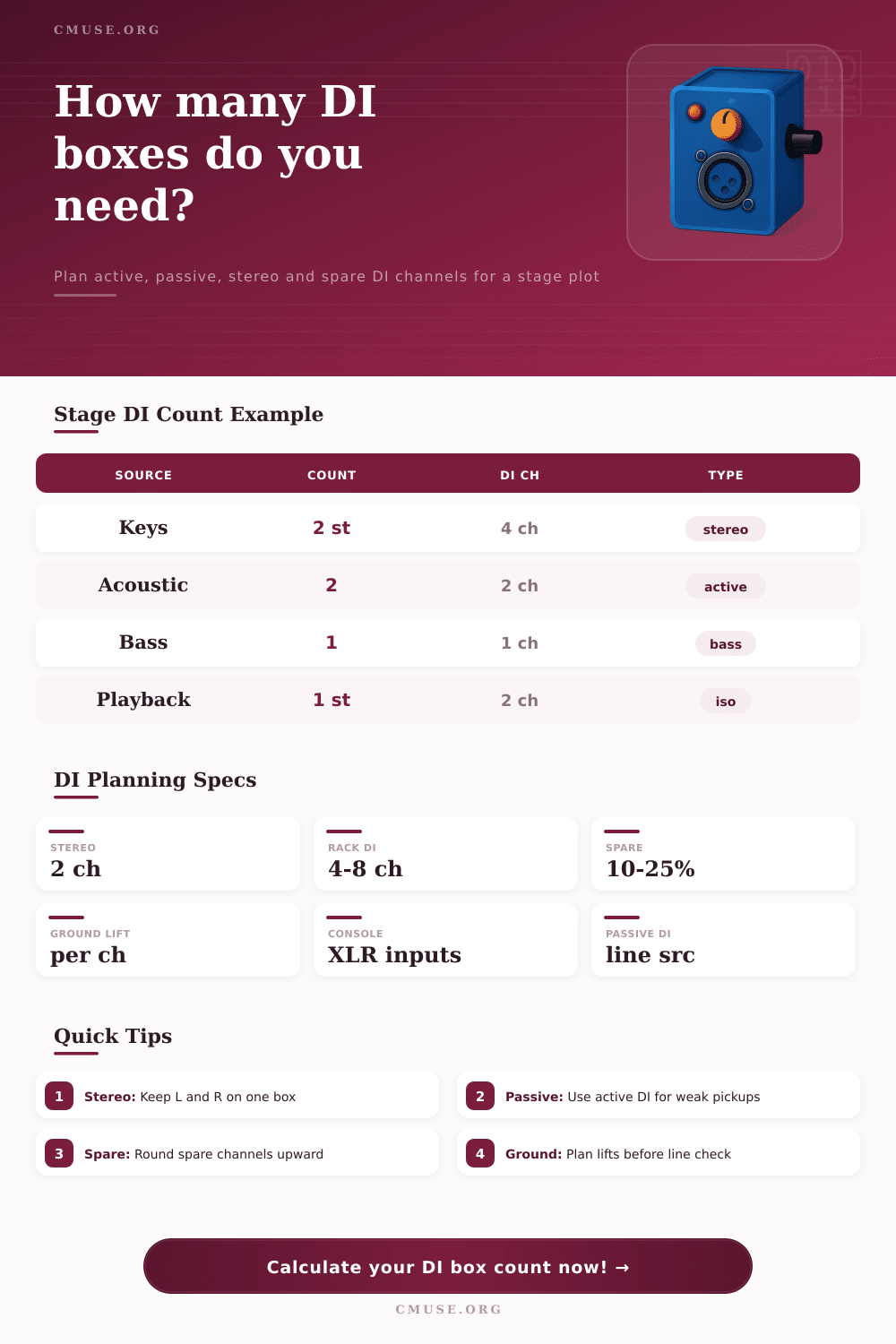
Most people underestimate stereo sources. Left and right go out of a keyboard in the same way a DJ controller does: two distinct channels from a single stereo unit. Even though it’s packaged as a stereo signal, that still mean two separate DI channels. The tool makes that visual by separating actual box count from total channel demand.
Sure, maybe you’re bringing three devices into the stagebox, but on your console, you’ll be burning eight inputs. Knowing this difference will help keep your mix flexible. It will also matter when planning for ground loops. Those pesky hums is annoying at best and are caused by poor power distribution in venues. Overkill would of be to assume all DIs require ground lift switches. Not having any on hand is risky. Planning to have half of your channels have isolation capability typically covers the bases. This way, you do not waste money on expensive units for sources that do not require them.
Experience shows that you should also have spare channels. It’s always tempting to load up only what you believe will be used but things go wrong and setlists gets changed. Having a few (ten or fifteen percent) spares takes up almost no room in your budget or gear bag. Not having enough when someone asks for an open input during the performance is pure panic. With the calculator, you can dial down that spare buffer depending on how messy it’s going to get.
An acoustic singer performing alone require less safety margin. A full-blown wedding band requires more, especially if they suddenly decides to add a second vocalist with a wireless mic or a horn section feeding through a DI.
The packaging also matters. For a touring engineer hauling his own rig it makes a difference: Single channel boxes allow for maximum flexibility on spread out stage positions, but they’re a mess of hardware to wrangle with. Rack mounted multi channel boxes is quicker to patch and neater when all the inputs concentrate in one place, as on a festival backline or a theater pit. And the tool lets you compare these scenarios and see exactly how many physical cases you’ll have to lug around.
It’s not only the sound that counts, but logistics too. Having one big rack unit instead of four little boxes makes quite a difference to your travel plans.
All told, then, what does all this mean? Planning your DI means thinking ahead: planning out the signal chain before you push the plug into the input jack. Head counts on stage are insufficient. You must understand the number of outputs and their impedance, and reserve headroom for the always-surprising “Oh, sh-!” moment. Leave space for error and the sound remains clean; everything goes well. That peace of mind makes planning each additional channel worth it.