Mic Count Per Kit Calculator
Plan drum-kit inputs for kick, snare, toms, overheads, hat, ride, room mics, triggers, spare channels, mic stands, and stagebox capacity before the patch sheet gets crowded.
Patch Breakdown
| Source | Typical mono/stereo count | Channel note | Stand note |
|---|---|---|---|
| Kick | 1 mono, 2 close, 3 with sub | Every kick mic is a separate input | Usually 1-2 short stands |
| Snare | 1 top, 2 top/bottom, 3 with side | Bottom mic needs polarity check | Often 1 stand plus clip |
| Toms | Shared, one each, or top/bottom | Close toms can dominate channel count | Clips save stage real estate |
| Overheads | Mono, stereo pair, 3 or 4 mic array | Stereo pairs take two inputs | Tall booms or stereo bar |
| Hat and ride | Optional mono or stereo spots | Usually skipped for small live kits | Small boom stand each |
| Room | Mono, stereo, or two stereo pairs | Studio rooms can exceed live needs | Count every room stand |
| Preset | Kit shape | Typical mics | Best use |
|---|---|---|---|
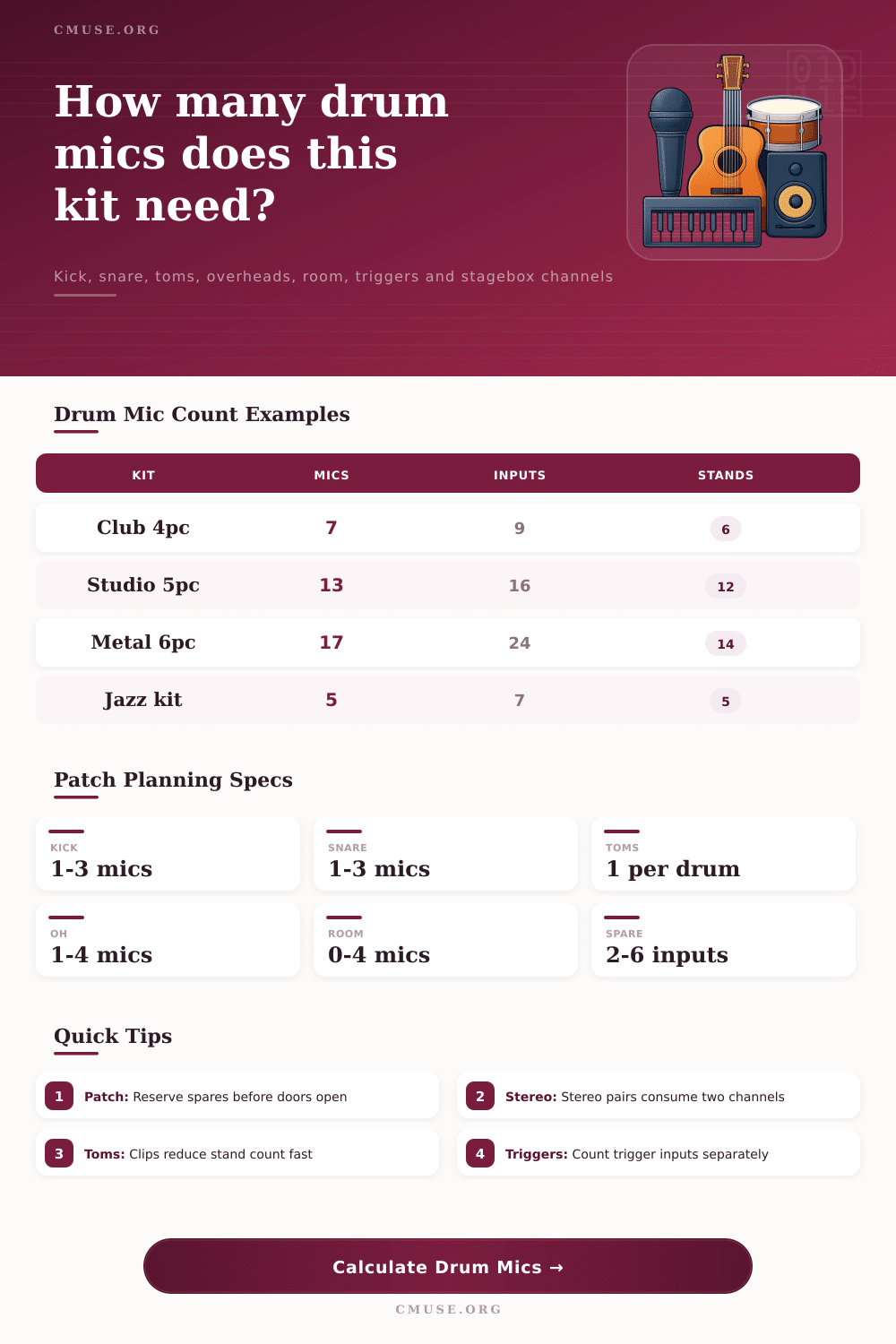
| Minimal Club 4pc | Kick, snare, 2 toms, stereo OH | 6-8 | Small stages and quick changeovers |
| Indie 5pc Stereo OH | Kick, snare, 3 toms, hat, OH pair | 8-10 | Live recording or mid-size club |
| Studio Close 5pc | Multi-kick, snare bottom, toms, rooms | 12-16 | Overdub-ready drum tracking |
| Metal Trigger Rack | Close toms, extra kick, trigger lines | 15-20 | Dense modern rock and metal |
| Jazz Glyn Johns | Kick, snare, simple overhead image | 4-6 | Natural kit balance |
| Mic area | Low stand plan | Full stand plan | Planning detail |
|---|---|---|---|
| Kick | 1 short boom | 2 short booms | Subkick or outside mic may need another position |
| Snare | Clip plus 1 boom | 2 short booms | Bottom mic can often share hardware |
| Toms | Rim clips | 1 short boom per mic | Large racks can run out of stand bases quickly |
| Overheads | 1 tall boom with stereo bar | 2-4 tall booms | Wide arrays need more safe floor space |
| Room | 1 stand per mic | 1 stand per mic | Keep room positions away from traffic lanes |
| Stagebox size | Practical drum limit | Spare target | Typical fit |
|---|---|---|---|
| 8 inputs | 5-6 mics plus few spares | 1-2 | Kick, snare, stereo OH, one tom group |
| 16 inputs | 10-12 mics plus spares | 2-4 | Most club kits with stereo overheads |
| 24 inputs | 16-20 mics plus spares | 3-6 | Studio-style close miking or triggers |
| 32 inputs | 22-26 mics plus spares | 4-8 | Large kits, rooms, broadcast split planning |
Before it begins, seeing physical limitations of your setup allows you to avoid panic mode. Instead of wishing there was a magical way to make something sound perfect, we have to face reality of the number of slots in your stagebox and amount of patch cables you have at hand. We realize that mixing drums is as much about dealing with many channel as it is about how they sound. Rather than vague plans, the mic count per kit calculator force us to commit to some configuration.
You must choose between complex or isolation for your kick or snare. Simple. One mic on top of a snare are sufficient to do the trick and leave space for everything else. Surgical, use one on each side plus one underneath with a clip mic. This give you precise control of ring and snap, but it eats up two more inputs and requires careful management of polarity. If you remove those extra channels, the calculator show they are no longer available for immediate use.
How to Choose the Right Microphones
Many times we design our dreams rig in our head without accounting for price of console faders. Live sound engineers face a similar overhead problem. For most club gigs, a stereo pair is adequate and common. This give you a cohesive image of kit while only needing to deal with two channels. Some engineers add another wide pair of mics or even a center mic to isolate cymbals more or fill out the low end. While this may help clarity in the studio mix, it quickly gobbles-up your available stagebox capacity.
Looking at tables on the page, you’ll note the clear comparison between dense metal rigs and a minimal club setup. When you add spots for individual cymbals and toms a five-piece kit turn into a twenty-channel nightmare in no time flat.
Then there’s another level of complication that’s entirely outside traditional mic logic: triggers. Onstage, a drum module appear to be a single source, yet emits several signals; for example, for attack, tone and even for ghost notes. On the patch sheet, each of these shows up separately, which is how calculator treats them. If you use many triggers or run all-electronic hybrids, those lines will eat up your available capacity just as ruthlessly as acoustic mics. The difference here would of result in a cluttered mix where none of the sources has adequate phase coherency or headroom.
While channel counting is the mental side of things, physical component is stand management. Each microphone needs a place to sit, and most of the time that requires a good clip or boom stand. Before you know it big tom racks fills up with places to mount microphones and engineers find themself stacking little stands all over the drum riser. This visualizes the tool and will give an estimate of how many stands you should need depending on what mics you place where.
Freestanding mics take up more room on stage and make it easier to knock equipment over during an energetic performance. Rim clips allow for less equipment on stage and less worry about banging into something in the dark after a long set. It is one of those small practical details that makes a difference when you are carrying gear in the dark after a long gig.
The biggest opportunity (and pitfall) lies in using room mics. With a couple of room mics, you can glue a dry mix together while also adding ambience that close mics just can’t deliver. But using four room mics on-stage is an input channel hog and causes phase problems unless they’re extremely carefuly placed. One or two well-placed room mics usually produce plenty of atmosphere without clogging up the board.
Remember to leave some spare inputs available for those “what-if” moments: a last-minute vocal add-on, a guest percussionist. Spare inputs are your insurance policy should a rigid mix prove unable to fit changing circumstances. Setting realistic boundaries is all about knowing how many mics you can handle. Once you know what’s in your kit, the calculator above will do the math for you, but more importantly, what are those numbers? They’re physical things that take up space and draw power; they requires gain structure.
More often than not, a simple set-up is a better set-up. Leaving space for creativity and error. Visualize total load of your stand inventory and stagebox so you don’t end up with the cluttered patch sheet which inevitably leads to frustrated engineers and muddy mixes. Have fewer sources to begin with and add only if needed, making sure each mic has earned its spot on the spectrum.