Channel Count Calculator
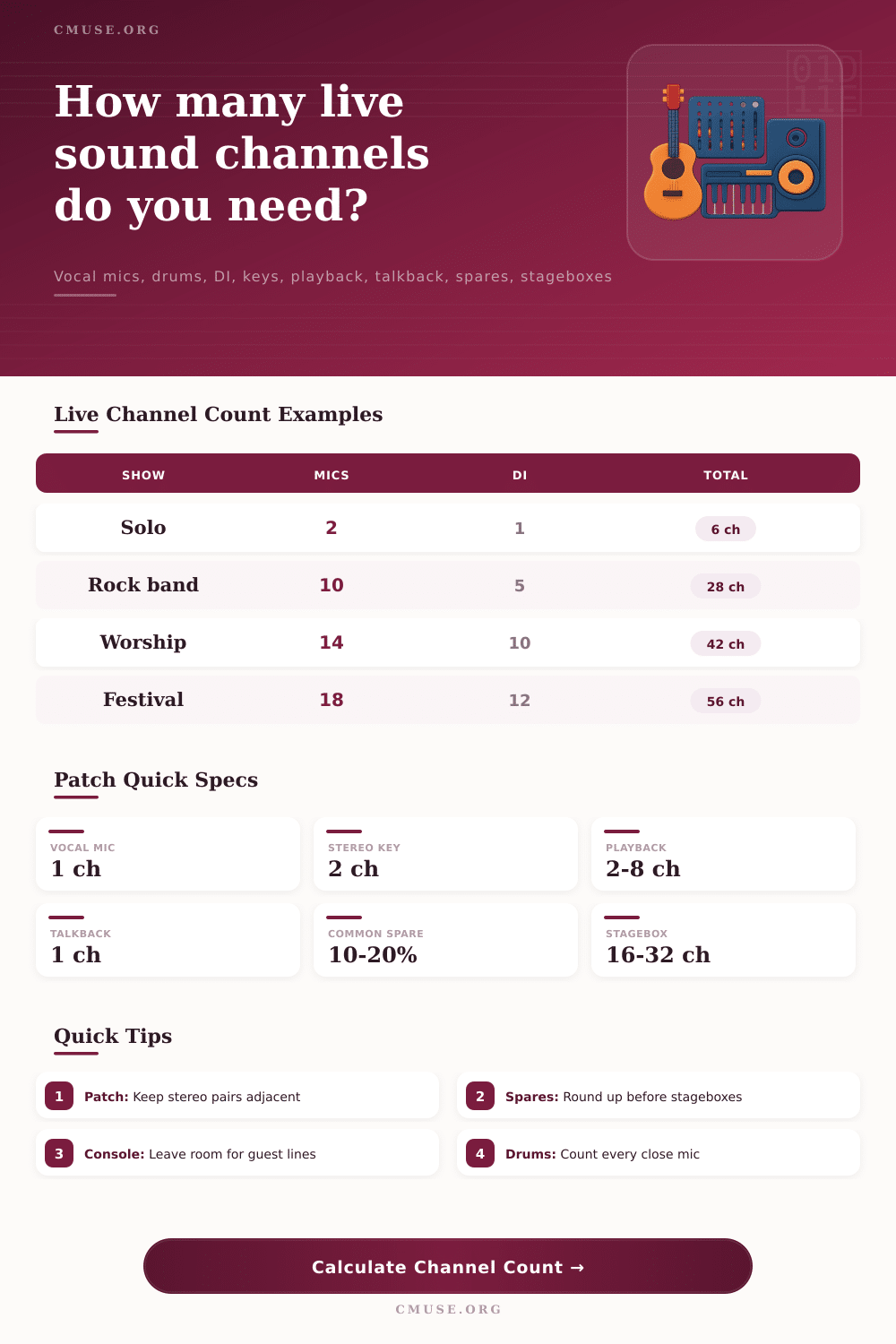
Plan a live-sound input list from vocal microphones, drum channels, guitars, DI boxes, stereo keys, playback, talkback, audience mics, spare channels, stagebox count, and console capacity.
Channel breakdown
| Source | Typical Channels | Patch Note | Common Use |
|---|---|---|---|
| Lead vocal | 1 per mic | Keep guest vocal next to leads | Clubs, houses of worship, festivals |
| Stereo keyboard | 2 per rig | Patch odd-even as L/R | Piano, synth, organ, tracks rig |
| Bass | 1 to 2 | DI plus mic when needed | Rock, jazz, worship, theater |
| Guitar amp | 1 per mic | Double only for real blend needs | Electric guitar and Leslie cabinet |
| Playback | 2 to 8 | Stereo or stems in pairs | Tracks, DJ, video, cues |
| Talkback | 1 to 4 | FOH, MON, MD, stage manager | Rehearsed shows and large stages |
| Drum Package | Inputs | Included Sources | Best Fit |
|---|---|---|---|
| Minimal kit | 4 | Kick, snare, overhead L/R | Small room, fast changeover |
| Club kit | 8 | Kick, snare, 3 toms, hat, overheads | Standard club rock stage |
| Full kit | 12 | Kick in/out, snare top/bottom, toms, hat, ride, overheads | Theater, broadcast, worship |
| Production kit | 16 | Full close mics plus cymbal spots or pad | Touring headline package |
| Festival kit | 20 | Expanded close mics and percussion | Large stage with shared patch |
| Hardware | Usable Inputs | Good Target | Risk Point |
|---|---|---|---|
| 8 input box | 8 | Acoustic acts or breakouts | Runs out once drums appear |
| 16 input box | 16 | Small bands and side-stage splits | Needs two boxes for full bands |
| 32 input rack | 32 | Club bands and compact festivals | Little room for large worship teams |
| 48 input console | 44 after 4 reserves | Full band with playback and ambience | Guest lines need discipline |
| 64 input console | 60 after 4 reserves | Festivals, worship, theater pits | Large stems can consume headroom |
| Scenario | Active Sources | Suggested Spares | Console Target |
|---|---|---|---|
| Solo acoustic | 4 to 8 | 2 fixed | 12 to 16 channels |
| Club rock band | 22 to 32 | 10 to 15% | 32 to 48 channels |
| Modern worship | 36 to 56 | 15 to 20% | 48 to 64 channels |
| Theater pit | 40 to 72 | 10% plus RF backup | 64 to 96 channels |
| Festival headline | 48 to 80 | 20% or patch blocks | 64 to 128 channels |
The moment of truth in live sound happen 30 minutes before first chord rings out. It’s when you look down at your blank patch list and suddeny remember you didn’t account for a guest singer. Now, you’re staring into a console that doesn’t have enough input for her. You can prevent this panic by sizing your input lists and saving spare channels in advance of rehearsal with calculator above. Save yourself from embarassing yourself by cutting a vocal track due to lack of faders.
Engineers begin with the obvious sources: kick drums, lead vocals, etc. While a rough estimate is fine for a rough sketch, it overlook hidden bandwidth hogs. This can be particulary tricky when dealing with stereo keyboard rigs, since any one player may bring several synthesizers that each require left/right pairs of inputs. Counting these source as mono channels means that you will soon run out of inputs. You must plan for this in advance which the tool does by treating stereo pair as double channels.
Plan Your Input Channels Carefully
Finally, think about what’s needed on the drums. If it’s a jazz trio playing in a coffee shop, then a simple four-mic configuration is fine. But if the drummer have his own sample pads and congas that are being played separately, that won’t cut it. Before you even start plugging things in, you need to determine just how detailed you wish to make this mix. Each close mic added on an elaborate kit can add another twelve or sixteen channels to your count. That’s a sizable chunk of capacity before even considering the guitar(s).
Good planning differentiates itself from luck by leaving a few channel unfilled as spares. Having ten percent of channels open is insurance in case a cable breaks, someone wants a last minute change, or some guitarist suddenly decide he needs his amp miked individually. If you plan exactly what you need and have no buffer space, small changes will force you to make compromises at the gig. Usually that means cutting off frequency range or lowering volume levels. Neither are a good audience experience.
The second consideration is physical limitations. Even with sixty digital inputs on your console, the snake may be a thirty-two channel snake. This limit your stagebox capacity. The solution is to round up to the next box size which costs you money and rack space but also affords you some freedom. Since you can’t split a physical box in half, a forty-nine channel plan becomes different than a sixty-four channel package.
But how do you group sources logically? Make sense of your live mix by keeping playback stems isolated. Keep drums next to each other. Keep vocals all bunched up. Your eyes will see where your hands are and your ears won’t be searching for the right fader, that’s where the real skill comes into play.
Use the reference tables as a starting point, a sanity check, not a rule book. Each band is unique. Each room have an acoustical personality that may require additional talkback lines or more ambient mics. Ultimately, channel count planning is about predicting the future… You’re attempting to foresee what’s going to be needed for a performance that hasn’t occurred. It involves looking beyond the instruments that appear onstage and visualizing the signal flows that pass through each one. If done correctly, the console simply dissapears from sight and thought. Inputs fade into the background while music takes centre-stage. The goal is to have no scrambling or cuts, just sound.