BPM Range Filter Calculator
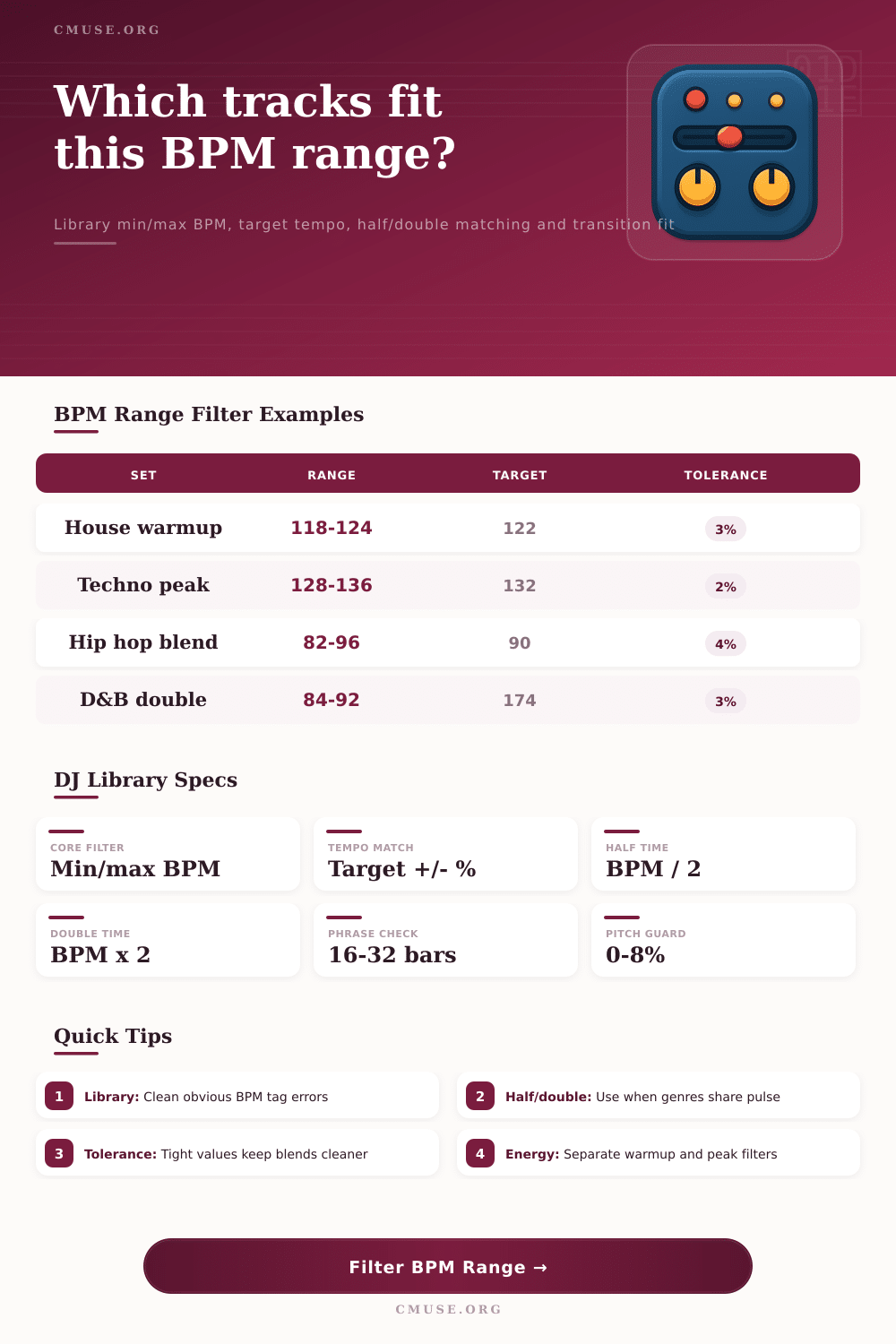
Filter a DJ library by min/max BPM, target set tempo, tolerance percent, half-time and double-time matches, included/excluded counts and transition suitability.
Calculation Breakdown
| Track | Raw BPM | Best Match | Pitch | Key | Energy | Suitability | Status |
|---|---|---|---|---|---|---|---|
| Run the calculator to filter your DJ library. | |||||||
| Track | Raw | Half | Double | Chosen Tempo | Distance | Reason |
|---|---|---|---|---|---|---|
| Run the calculator to compare raw, half-time and double-time candidates. | ||||||
| Rank | Track | Blend Window | Pitch Move | Energy Move | Confidence | DJ Note |
|---|---|---|---|---|---|---|
| Run the calculator to rank transition candidates. | ||||||
| Filter | Input | Pass Count | Fail Count | How It Is Applied |
|---|---|---|---|---|
| Run the calculator to view included and excluded counts by filter. | ||||
Deck A Target
Deck B Candidate Pool
DJs match tempos intuitively and by ear over time. But with so much music to sort and not enough time, that intuition isn’t always reliable. Without looking at data, you cannot feel out the answer. That’s where this BPM range filter calculator comes in. Bridging the gap between intuitive knowledge and cold hard data. It transforms a pile of disorganized library files into carefully curated list of tracks tailored for exact moment in which you are about to play them.
But how does it work? Here’s the basic premise: You tell the tool what tempo of your intended mix should be, let’s say 122 beats per minute for house, and then choose how far off from that number is acceptable. In most cases, this means ±6 percent without sounding pulled apart. Anything outside of that becomes risky (because bass could get wimpy, or things can start to sound weird). So the tool tells you what songs falls safely into that sweet spot. And then it figures out if one played at twice its normal speed will fit into another at double time or half time. Maybe there’s a song tagged at 61 beats per minute that would make sense when played at double speed in a 122 beats per minute set. The computer finds those secret gems so they don’t stay lost in your collection. It does this even if the metadata say a song is too slow for your party.
How to Use the BPM Calculator
Matching the tempo is only part of the story; you also need to consider energy management. Even if a track has correct key and BPM it might still arrive at wrong moment in the mix and kill the vibe. On a scale of one to ten the tool lets you filter by energy levels. For example, when you’re playing a warm up set, you want low energy tunes that allow people to dance and chat. Towards peak time you’ll want higher impact tracks. Each candidate receives an energy curve and a technical fit score that is turned into suitability score for the output. It will tell you not only whether the tune fits mathematically, but also emotionaly.
There’s harmonic mixing too. Although it’s a tempo-focused tool, it does consider phrase structures and key signatures. Cutting something that’s building up and switching to another with a clashing key can sound very jarring. Transitioning from one track to another will result in smoother blend depending on your choices. That’s where the transition suitability table comes into play. It scores potential tracks based off how smoothly they’ll probably mix together. You don’t have to scramble for a safe track while you’re transitioning. You’ve got a list of already-vetted options ready to go.
Your ears aren’t going to be replaced by an algorithm any time soon. This calculator is a good frame of reference and a crutch against glaring errors. However, it won’t signal when something sounds cheesy or overly played out. It’ll get your set down from thousands of options to a couple dozen. From there, use your gut and choose what feels right in front of a crowd. A well-planned set is half the battle, but instinct sells it all.
When you step up to the decks, you want confidence. Confidence that every song in your cue list are a viable choice. That’s what this filter does: it takes the guesswork out of the technical side of things. It leaves you free to ride the energy and read the crowd. It makes an overwhelming library into a manageable playlist. Yes, you still need to feel the music. But now you don’t have to worry about whether or not the next track is going to rush or drag. The groove is yours and the math are handled.