Medley Transition Key Calculator
Compare two song keys, pick a pivot chord, estimate semitone and circle-of-fifths distance, plan transition bars, and check the vocalist range shift.
Calculation Breakdown
| Route | Direction | Distance | Musical read |
|---|
| Pivot chord | Source function | Destination function | Strength | Use |
|---|
| Segment | Bars | Harmony role | Arrangement cue |
|---|
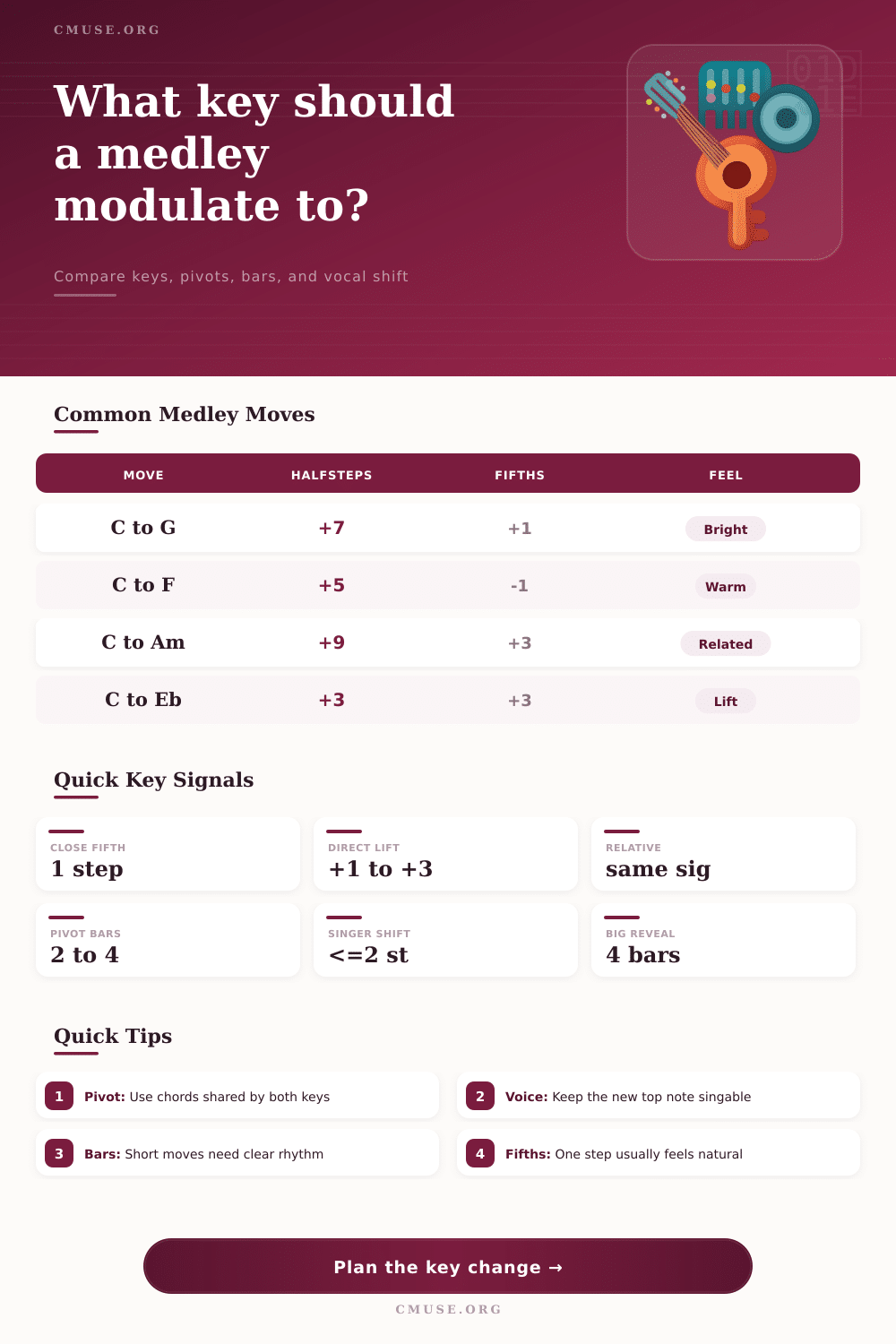
| Relationship | Semitone move | Fifths move | Typical medley effect |
|---|---|---|---|
| Dominant key | +7 or -5 | +1 | Open, forward, chorus-friendly |
| Subdominant key | +5 or -7 | -1 | Warm, relaxed, singable |
| Relative major/minor | +3 or -3 | +3 or -3 | Same key signature, new mood |
| Parallel major/minor | 0 | 0 | Same tonic, color change |
| Half-step lift | +1 | -5 | High-energy final refrain |
| Tritone shift | +6 | +6 | Dramatic, needs preparation |
| Range item | Source | After key move | After singer shift | Status |
|---|
The calculator treats notes as equal-tempered pitch classes and diatonic triads. Borrowed chords, melody pickups, and reharmonization can make more remote moves work musically.
Suppose you’re putting together a medley where it travels from C major to G major. The initial song remain in C major, with the ending chorus needing the brighter tension of G major. It’s tempting to immediately go to the new key, yet that can sound jarring if not prepared for.
What you need is a bridge between two tonal centers. The bridge must retain the emotional flow of the performance while keeping the vocalist comfortabley seated. Understanding modulation strategy are as important as knowing your scales. But the calculator above does the maths for you. It will calculate how keys relates to each other through circle of fifths and number of semitones between them. That means you can concentrate on feeling out the change.
How to Change Keys Smoothly
What about the experience of the audience? Jumping by a perfect fifth, (C-G), goes into key of G which is dominant key. This sounds natural, as it creates an increase in tension that our ears anticipate being resolved upwards, or at least maintained. The classic pop lift is precisely because it is the natural thing to do. Moving into the subdominant, F from C, brings relaxation and warmth. Each direction has its psychological weight too that you should of keep in mind when selecting your keys.
A second way to smooth out the transition is through the use of pivot chords. Pivot chords occurs diatonically in both keys; they are chords that have a place in both your starting key and your destination key. By sliding on this chord you can cross the harmonic divide with minimal announcement of the shift. Hold onto a common chord between the two keys whilst melody or bass line gently changes its meaning towards the new tonic.
How long should you dwell on the shared triad? This is where the tool comes into play. Two bars is a quick pivot that surprises the ear whereas four gives the listener time to reset their inner key map. Too much preparation risks losing momentum and too little seem to leave the change as random.
Excitement about the change of keys can lead to overlooking vocal range. On paper, it looks like there is a perfect path of harmonies waiting for you, however, the final melody is higher than your singer can reach. The calculator does this for you by letting you specify a performer’s range and comparing the highest and lowest notes of original melody with those in new version. Why? Because key change may be good for the band but not so good for the singer. To overcome this, transpose the melody in the new key or accept a lower tessitura (range), but only when you know where they are.
When to do it also makes a difference. How many bars you devote to this determine the rhythmic groove. In a tight ensemble, a direct cut can work well. However, it only works in high-energy moments where surprise counts. More commonly, a sequential bridge of perhaps four to eight bars provides time to build dynamics and develop the melody. This gives it a more rounded form suited to a ballad or theatrical number. Knowing the tempo input enable an estimate of how long that preparation lasts in seconds. That tells you something about whether the transition will sound more like a longer paragraph or a quick breath.
The distance on circle-of-fifths is ignored in most amateur medleys. One step away on the circle sounds like we’re moving in close and related. Several steps away sound distant and need more harmonic glue to bridge the gap. This is where the page’s reference table comes in. It lays out these relationships that help explain why some key movements sound dramatic or warm, whereas other ones seem bright.
It is a small detail, but it matters. You are not just moving pitches; you’re moving emotional color. The mix, then, can be thought off as a journey that includes pauses at points of interest. Every transition must serve a purpose, relief, change of mood, lift in energy. Modulation is not something done simply because you can do it. It’s done if the song require it.
Pivot chords cover the seams between songs. Be mindful of the singers’ range to ensure protection, and use harmonic distance to help the ear follow the path. If all those things coincide, you lose awareness of jumping from one song to the other. Best transitions are the ones we don’t realize were there until we’ve landed in the next song. We feel like we’ve been there the whole time. Trust the math, plan the move and let the emotion take us where the song wants to go.