Setlist Total Time Calculator
Plan a complete show clock from song count, average length, exact song entries, talk breaks, encore timing, changeovers, curfew buffer and stage start time.
Timing Breakdown
| # | Entry | Parsed length | Source |
|---|---|---|---|
| Run the calculator to parse the setlist entries. | |||
| Set type | Typical songs | Music target | Total stage clock |
|---|---|---|---|
| Support act | 6 to 8 | 24 to 32 min | 30 to 40 min |
| Festival slot | 9 to 12 | 38 to 48 min | 45 to 60 min |
| Club headline | 14 to 18 | 55 to 75 min | 70 to 95 min |
| Theater headline | 18 to 24 | 80 to 110 min | 100 to 135 min |
| Acoustic set | 10 to 16 | 38 to 65 min | 50 to 85 min |
| Transition | Lean timing | Loose timing | Use when |
|---|---|---|---|
| Song-to-song count-off | 5 to 10 sec | 15 to 25 sec | Band stays in place |
| Guitar or patch swap | 45 to 75 sec | 90 to 150 sec | Instrument or keyboard changes |
| Guest entrance | 60 to 120 sec | 2 to 4 min | Featured performer joins |
| Encore walk-off | 90 sec | 3 to 5 min | Audience call-back moment |
| Hard curfew exit | 0 sec | Not advised | Venue has strict stop time |
| Preset | Song count | Extra timing | Best check |
|---|---|---|---|
| Club Headline | 16 plus encore | Moderate talks and swaps | Curfew buffer |
| Festival Slot | 10 direct songs | Almost no dead air | Overrun risk |
| Support Act | 7 short songs | No encore | Handoff time |
| Theater Show | 20 songs | Interludes and encore | Finish clock |
| Jazz Combo | 8 long tunes | Solos and stage talk | Average length |
You’ve been in venues where the band walked off stage for the encore and then realized that house lights were turning back on because they ran out of time. That’s not bad luck; that’s bad math. The vast majority of musicians don’t measure their sets in minutes, they count them as songs, which is a dangerous blindspot. Sixteen four-minute songs on paper look much different than the actual set.
The timing change if there are two minutes to switch guitars midway or if band needs 30 seconds to thank venue owner. Now all you need to do is plug-in your own variables and let the calculator do the math (the one up top). You don’t have to guess at how all those little gaps add up. This forces you to consider actual non-music time that sets the pace of a live show.
How to Plan Your Band’s Set Time
A big part of that is what we call “talk breaks,” plus any equipment changes and encore walk-offs, which eat up a significant chunk of clock. Ignore those minutes and your set’s either going to be rushed/disjointed or it’ll run overtime. The tool help you see where that time goes before you step on stage.
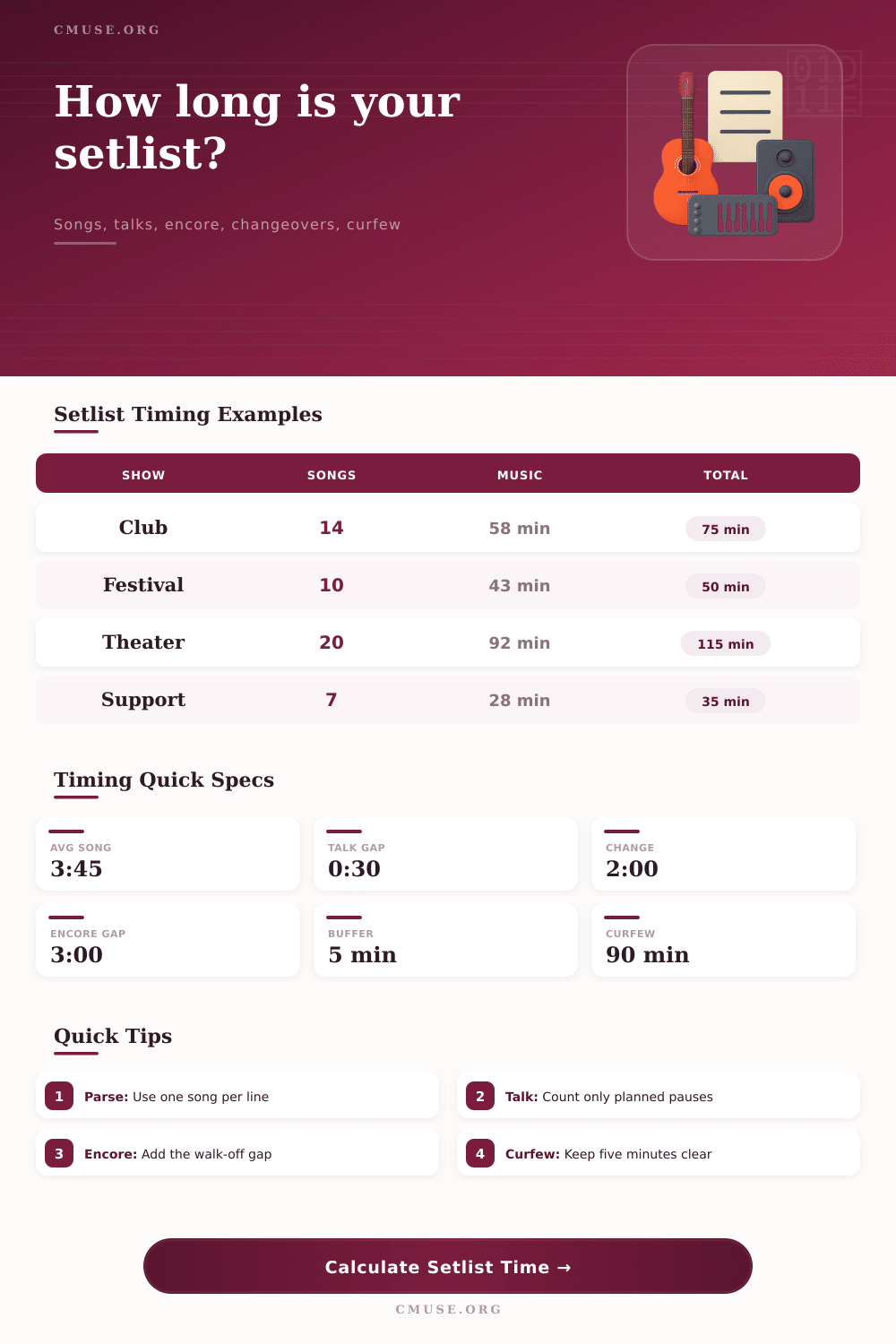
Let’s begin with what you know. How long are your actual entries? If you’re a band that has been streaming their music or recently rehearsed, you probably have some idea of how long most of your songs is. Paste them into the text box if they apply. For the rest, use an average song length (typically three minutes and forty-five seconds for pop/rock artists). Using this combination will provide you with closer estimates without having to guess how long the set might be. After all, a high-energy opener will likely be tighter and a ballad will be longer.
And what about all that space between songs? Thirty seconds might seem like no time at all to your crowd, but multiply that by six and you’ve got three minutes of dead air. If you switch instruments or bring someone else onstage (a keyboardist), tack another minute or two onto that. That’s when sets can bleed time and nobody notices, because those technical transitions and gaps add up. The chart on the page show how different venues approach variables here. An intimate club show may leave room for some more conversational padding between songs; a festival slot might require zero dead air.
Respect the curfew too. Every venue has a hard stop time. This will usually be based off union rules for the sound crew or noise ordinances in the area. There’s no waste in giving yourself a five minute buffer. That is insurance in case you run into unexpected delays such as feedback loops, lost picks, or an especially enthusiastic crowd.
If your calculations put you right up to the edge of the cutoff, take off a talk break first. Don’t compromise the artistic product and cut a song to save time. That buffer allow you to exit gracefully without having to rush the final bow.
And then there’s the encore, which multiplies the complication. It depends on what songs you perform and how long it takes to exit the stage and re-enter. Depending on how hard you want to make your audience applaud, this could be anywhere from 90 seconds to five minutes. Subtracting that from your allotted space becomes crucial, because failing to do so turn your return into a frantic scramble under rising lights.
In the end, creating a set list is all about managing resources: how many minutes do I have on stage? How many songs can I reasonably play given that context? How long does it take to get from song A to B to C? Each of those seconds, including the ones when nothing is happening… Is something you must account for to have control over the arc of the show.
When you think in terms of controlling time, instead of racing against a deadline, you create a more coherent experience. Did the band own the clock, or did the clock own the band? That’s often the key distinction between a good show and a great one. Apply these numbers ahead of time to get back that control, even before you play your first note.
You should of used this earlier. It makes things more comfortabley.