Measures Per Page Calculator
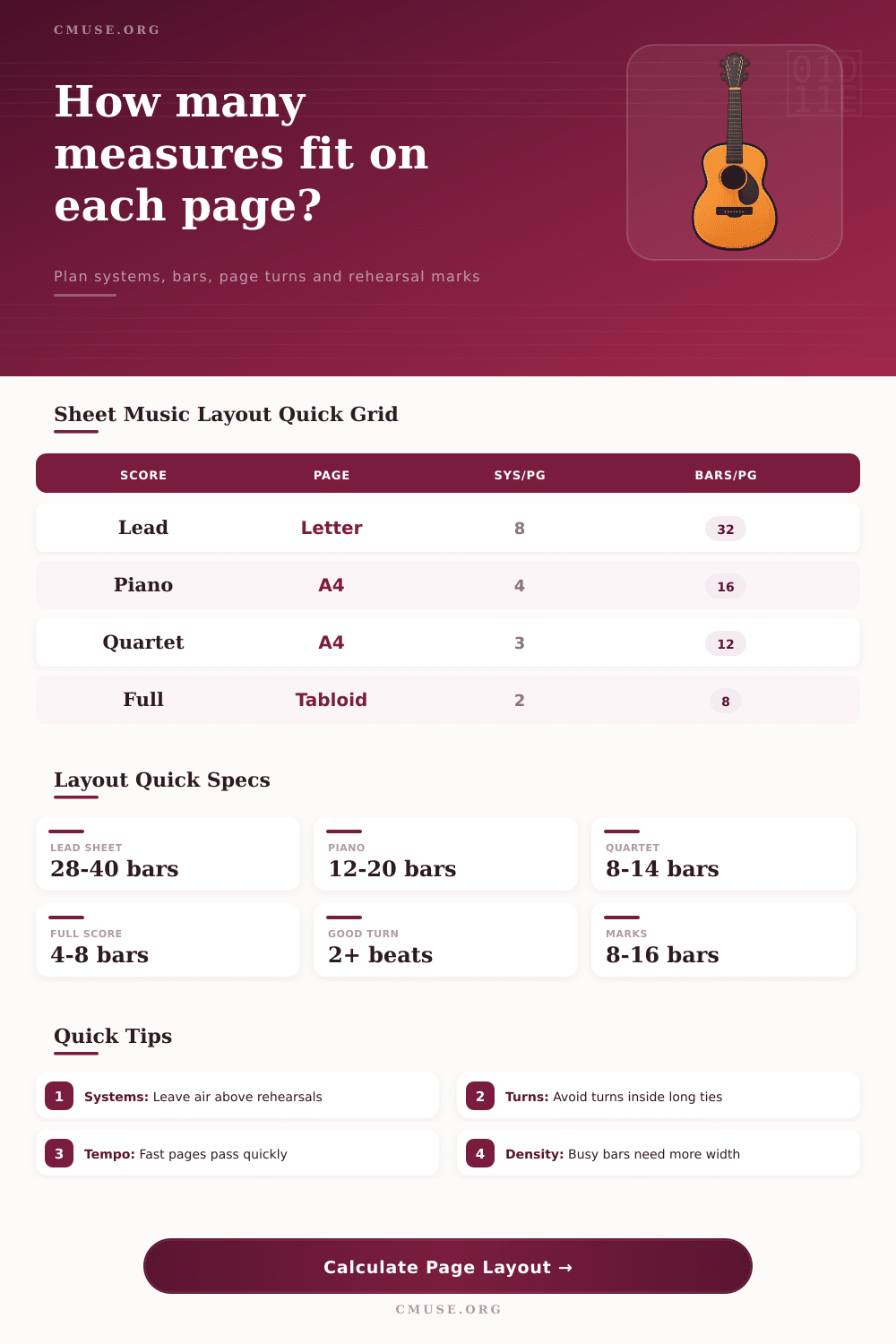
Estimate sheet music page layout from page size, usable staff height, systems, measures per system, rhythmic density, rehearsal marks, page count, seconds per page and page turns.
Calculation Breakdown
| Page | Measures | Systems | Seconds | Turn Note |
|---|---|---|---|---|
| Run the calculator to populate the page plan. | ||||
| System | Measures Covered | Rehearsal Marks | Width Per Measure | Density Check |
|---|---|---|---|---|
| Run the calculator to populate system spacing. | ||||
| Turn After Page | At Measure | Elapsed Time | Rest Needed | Risk |
|---|---|---|---|---|
| Run the calculator to populate page-turn timing. | ||||
| Layout | Common Staves | Systems/Page | Measures/System | Best Use |
|---|---|---|---|---|
| Lead sheet | 1 | 7 to 10 | 4 to 5 | Melody, chords and lyrics with easy page turns. |
| Piano solo | 2 | 3 to 5 | 3 to 4 | Grand staff music with readable hand spacing. |
| Choral score | 4 | 3 to 4 | 3 to 4 | Vocal systems with lyrics and rehearsal marks. |
| Chamber score | 4 to 8 | 2 to 4 | 3 to 4 | Small ensemble scores for rehearsal reading. |
| Full score | 12 to 30 | 1 to 3 | 2 to 4 | Conductor pages that prioritize vertical clarity. |
| Flipbook | 1 | 5 to 7 | 2 to 4 | Marching parts on smaller landscape pages. |
| Page Size | Portrait Inches | Approx Millimeters | Layout Note |
|---|---|---|---|
| US Letter | 8.5 x 11 | 216 x 279 | Common for parts and short scores. |
| A4 | 8.27 x 11.69 | 210 x 297 | Slightly taller than Letter for extra systems. |
| US Legal | 8.5 x 14 | 216 x 356 | Useful for conductor reductions and charts. |
| Tabloid | 11 x 17 | 279 x 432 | Large ensemble scores and pit books. |
| Flip folder | 6 x 8.5 | 152 x 216 | Small field parts with fewer bars per page. |
It’s happened to us all: You’re learning a tricky piece, reach the end of bar at the far side of the page, but then you have to turn over and there is white space. It breaks the flow of music; it shatters focus as your hands scrabble with sheet while your eyes leap back up to stave.
This little measure per page calculator allow you to pre-plan how you want things printed before hitting the print button so no more panic moments for you!
How This Calculator Helps You
Getting it right is all about how much can fit horizontally within each system. You must also allows enough vertical space for staves without crowding dynamic markings, articulations and notes. Making it too small make it hard to read quickly; make it too large for available page size and you simply won’t get everything you need into the score.
You must consider your choice of paper and number of staves per system alongside desired number of systems on that piece of paper. Does your idea of the score fit on this piece of paper? This is where calculator comes in, helping you achieve balance between staves and page.
How much is on each page turn also have something to do with how many notes are played in a certain amount of time. Even though two measures might be equal in duration (one whole note and the other sixteenth notes), second will take up more horizontal space then the first. The solution is to give an option to choose density level that matches texture of your music. This then adjust how much space it thinks there is on each measure. Then busy passages won’t get squashed into unreadable fonts, one of the pitfalls of amateur layouts that appear okay on sparsely populated pages but break down at a complicated piece of music.
These rehearsal marks take up not only mental focus but also physical space on manuscript paper. Too many of them scattered across the page look like a jumble of boxes and numbers, which distracts you from notes themselves. Too few and you run into problems when trying to refer to certain part of the piece in a collective rehearsal. By entering distance between these rehearsal letters in the calculator you can see what impact this will have on available vertical space compared to your chosen system of staves. It’s a fine line that results in a pleasing looking score that is still usable by performers.
More than just math go into page turns. The right layout will match a page-turn to a relatively easy spot in the music so performer can take a breath and turn the page without stumbling. How long does each page last? Depending off tempo and measures-per-page, the calculator tell you about how many seconds are contained on each page. Use this information to help you find problem areas. If it’s only taking three seconds to play through a page at performing tempos, then chances are it’s going to be too brief and/or dense for comfortabley turning. Time to change spacing in the system or hope for a taped down fold-out for that set of pages.
Layout differs depending on the ergonomics of each instrument. A piano solo part can be tightly spaced since it’s written for a sitting stationary musician; however, a marching band flipbook has to have greater margins and bigger text due to the fact that players are reading while walking around in the light. The tool comes preloaded with settings reflecting current moddern industry standards, giving you a place to start engraving something like what you’re used to seeing. From there, you can adjust variables to meet your particular set-up instead of having to begin again from square one.
You should of adjusted them earlier.
To a performer, sheet music is just a tool used to play. If it’s well designed then the physical task of reading doesn’t hinder the mental one of playing; it all flows more easly. It’s a tool to plan turns, margins and systems beforehand, taking away any unnecessary friction during rehearsals. The idea is to present things transparently so the performer’s mind can concentrate fully on the sounds being made. Everything flows freely when page turns effortlessly, and there’s no anxiety about encountering a blank edge.