Notes Per Second Calculator
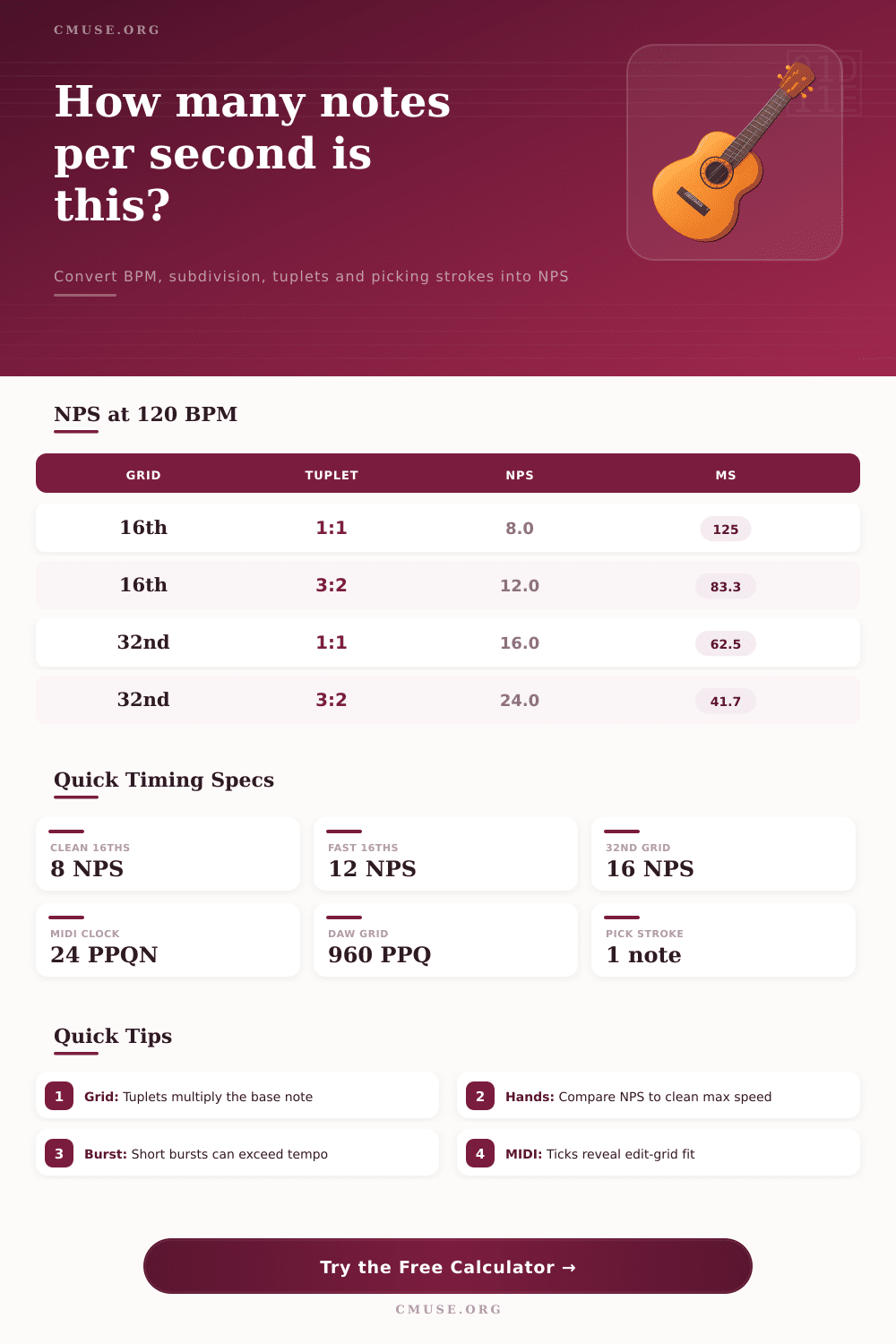
Convert tempo, note subdivision, tuplets, picking strokes, burst length, and MIDI PPQ into notes per second, milliseconds per note, stroke rate, and grid ticks for practice, transcription, programming, and speed checks.
Calculation Breakdown
| Subdivision | Notes Per Beat | NPS at 120 BPM | Milliseconds Per Note | Typical Reading |
|---|---|---|---|---|
| Quarter notes | 1 | 2.00 | 500.00 ms | Steady pulse or slow melody |
| Eighth notes | 2 | 4.00 | 250.00 ms | Basic alternate picking |
| Sixteenth notes | 4 | 8.00 | 125.00 ms | Common rock lead grid |
| Thirty-second notes | 8 | 16.00 | 62.50 ms | Fast runs or drum rolls |
| Sixty-fourth notes | 16 | 32.00 | 31.25 ms | Extreme bursts or MIDI edits |
| Tuplet Ratio | Multiplier | 16ths at 120 BPM | MS Per Note | Use Case |
|---|---|---|---|---|
| 1 in 1 | 1.000 | 8.00 NPS | 125.00 ms | Straight sixteenth-note grid |
| 3 in 2 | 1.500 | 12.00 NPS | 83.33 ms | Triplet over two notes |
| 5 in 4 | 1.250 | 10.00 NPS | 100.00 ms | Quintuplet phrase spacing |
| 6 in 4 | 1.500 | 12.00 NPS | 83.33 ms | Sextuplet picking group |
| 7 in 4 | 1.750 | 14.00 NPS | 71.43 ms | Septuplet flourish |
| Clean NPS Range | MS Per Note | Strokes Per Minute | Practice Meaning | Watch For |
|---|---|---|---|---|
| 4 to 6 NPS | 250 to 167 ms | 240 to 360 | Foundation timing and relaxed motion | Even tone between strokes |
| 7 to 9 NPS | 143 to 111 ms | 420 to 540 | Intermediate sixteenth-note control | String crossing accuracy |
| 10 to 12 NPS | 100 to 83 ms | 600 to 720 | Fast but still phrase-friendly | Unwanted tension buildup |
| 13 to 16 NPS | 77 to 63 ms | 780 to 960 | Advanced speed or short bursts | Synchronization with fretting hand |
| 17+ NPS | Under 59 ms | 1020+ | Very fast tremolo or programmed grid | Whether notes remain distinct |
| Grid | 24 PPQ | 96 PPQ | 480 PPQ | 960 PPQ | 1920 PPQ |
|---|---|---|---|---|---|
| Quarter note | 24 | 96 | 480 | 960 | 1920 |
| Eighth note | 12 | 48 | 240 | 480 | 960 |
| Sixteenth note | 6 | 24 | 120 | 240 | 480 |
| 16th triplet | 4 | 16 | 80 | 160 | 320 |
| Thirty-second note | 3 | 12 | 60 | 120 | 240 |
| Scenario | BPM | Grid | NPS | MS Per Note | Why It Matters |
|---|---|---|---|---|---|
| Clean rock sixteenths | 120 | 16th straight | 8.00 | 125.00 ms | A readable lead-guitar speed baseline |
| Metal rhythm picking | 180 | 16th straight | 12.00 | 83.33 ms | Shows down-up consistency under tempo |
| Triplet blues run | 140 | 8th triplet | 7.00 | 142.86 ms | Fast feel without thirty-second notation |
| Drum roll programming | 120 | 32nd straight | 16.00 | 62.50 ms | Good threshold for roll density |
| MIDI ratchet edit | 128 | 64th straight | 34.13 | 29.30 ms | Checks if the PPQ grid has enough ticks |
If you’ve ever played something at a specific tempo and then changed how you divide the beat, you’ll likely notice the feel has changed. Sixteenths at a hundred and twenty beats per minute sit somewhere in sweet spot for most players. They are fast enough to be interesting yet slow enough to play clean and relax with an alternate picked approach.
Triplets, however, make the math more complicated. Your ears begin to catch rhythms that do not align with what your hands must play out loud, and you have to navigate this rhythmic shift in real time. This is where most speed practice falter. You need some means of measuring the physical demand without turning to vague concepts like ‘play faster’ or guessing.
Measuring Real Speed for Better Practice
This brings us back to the above calculator which converts abstract musical notation into something more concrete. The physical demand being placed upon you. The calculator take ratios like tuplets, note subdivisions, beats per minute and turns them into notes per second. From this metric, you remove the rhythmic context leaving just the raw speed needed from your fingers.
A certain number of notes per second then represents the exact rate at which your fingers need to move in order to be able to hold that phrase. It’s helpful because it serves as a standard to compare a simple stream of thirty-second notes with a more complex sextuplet run on equal terms.
The calculator also factors in picking mechanics. The density may sound the same between economy picking and tremolo picking. However, there will be a difference in the strain on your arm due to the number of physical strokes per sounded note.
Inevitably many players only consider the issue of tempo as they asses their own progress in speed. They want to play fast tracks and not be concerned about how fast they need to articulate within those same tracks. A song played at sixty beats per minute may feel like a slow jog compared to a song at one hundred eighty beats per minute. However, if both songs involve a steady stream of sixteenth notes, the physical demand over each second will still be mathematicaly similar, although they will differ in terms of stamina demands.
How long can you hold such a high level of note density before your forearm begins to tense up? This knowledge assists you in creating a practice routine that works towards stamina and not necessarily pure velocity alone. In a solo, perhaps you can manage a high-density note for a few seconds then let off the gas; but through a whole verse? Not likely.
Adding a further twist are tuplets, which extend and contract basic grid. For example, playing three notes in the space of two creates a rhythmic feel that defies straight binary counting. Instead, your hand will need to divide the bar into three rather than two and then map these non-standard divisions onto your fingers. Until you have automated this your timing can be uneven at best.
Looking at it on the calculator shows just how tuplets multiply your starting note length. Playing a triplet over sixteen’s really takes your hand speed way past regular sixteenth-note work. This is what makes triplet-based lines feel harder than they sound. You hear a flow of rhythm. However, your hand must play fast, precise intervals that don’t match the underlying pulse.
Another important element not accounted for in pure tempo calculations is burst length. Our human hands can make very rapid bursts at speeds beyond what they could sustain as a cruising speed. Think of a shredding solo where the player makes brief bursts of 32nd notes that couldn’t possibly be sustained over even one full measure.
You can enter the length of those bursts and the tool will tell you whether it fits into your technical capabilities. If you find that your calculated notes per second exceeds your personal clean speed limit then you’re probably depending on adrenaline or getting lucky with your fingers syncing up. That gives you useful insight when setting realistic practice goals. It helps stop you getting frustrated by trying to force a passage that sits just outside your current mechanical capability.
This discussion gets technical with digital audio workstations and MIDI resolution. Today, we’re dealing with accurate grid alignment expressed in terms of pulses per quarter note. If you’re editing guitar parts or programming drum grooves, knowing which note value has X number of MIDI ticks will help you get your notes cleanly quantized. A high resolution grid retains all the fine details of the performance while a lower resolution one may blur together any fast runs.
This is important if you are trying to capture a certain feel. Slight humanizing variations add groove where tight quantization makes it seem like you’ve got a robot playing instead. Knowing what’s going on behind the scenes allows you to determine if a small change in timing was intentional or not.
In conclusion then, speed isn’t all about moving your fingers quicker. Speed is about working out how many notes you can fit into a space whilst keeping them relaxed and clear. This applies whether you are practising a tricky solo, transcribing a challenging passage, or programming a midi part. Using these accurate metrics takes some of the guesswork out of practice.
You no longer wonder if a line is too quick; instead, you now know exactly what makes it feel so tough. It’s not only about getting up to a high figure, but maintaining that level of density with control. Knowing the physical cost of each tuplet and subdivision allows us to view the journey towards speed as a step-by-step process instead of a mysterious hurdle. That clarity is far greater than any numerical tempo.