Average Tempo Calculator
Estimate average BPM from tap count, elapsed time, bar count, meter and tempo-map segments. Check weighted BPM, song length, drift, min/max tempo and segment timing for real music sessions.
Calculation Breakdown
| Segment | Bars | BPM | Duration | Weight |
|---|---|---|---|---|
| Calculate to analyze the tempo map. | ||||
| Method | Best Input | Formula | Use Case |
|---|---|---|---|
| Tap count | Taps and elapsed time | beats x 60 / seconds | Fast estimate from listening or conducting |
| Bar count | Bars, meter and duration | quarter beats x 60 / seconds | Checking edits, intros, loops and live sections |
| Tempo map | BPM and bars per segment | total beats x 60 / total seconds | Weighted average for songs with tempo changes |
| Known length | Total bars and song length | project beats x 60 / length | Matching a cue or arrangement to a target time |
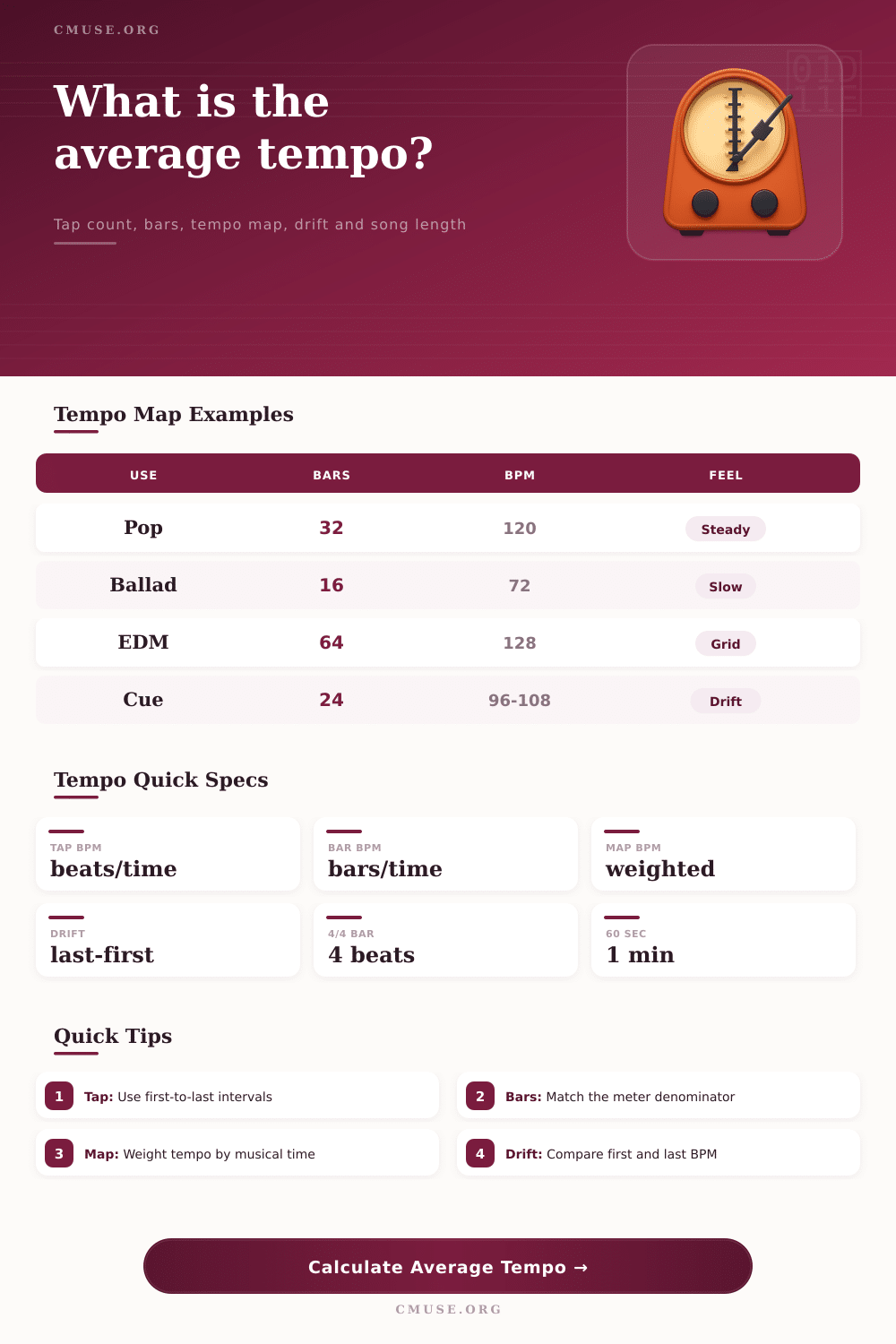
| Tempo Area | BPM Range | Timing Feel | Typical Check |
|---|---|---|---|
| Largo / ballad | 50-76 | Wide beats, long bars | Subdivide taps for accuracy |
| Midtempo song | 80-112 | Comfortable pulse | Use 8-16 bars for bar timing |
| Dance / pop | 118-132 | Tight grid and loops | Watch drift against click tracks |
| Fast / punk | 150-210 | Short beats | Tap half-time if manual tapping slips |
| Meter | Bars | Tempo | Approx Length |
|---|---|---|---|
| 4/4 | 96 | 120 BPM | 3:12 |
| 4/4 | 80 | 100 BPM | 3:12 |
| 3/4 | 96 | 96 BPM | 3:00 |
| 6/8 | 80 | 76 BPM | 3:09 |
If you’ve ever listened to a song and felt like there’s something wrong with it, like it rushes into choruses, or drags in the center, you know that feeling isn’t usualy caused by harmony or melody. It’s nearly always caused by an unstable sense of tempo. Tempo (or BPM) is not a rigid concept like we imagine when we think “tempo.” In live performance and recording it’s closer to a river: swelling, flowing and changing direction. The calculator above allow you to put a number on that flow, comparing a simple tap-based time against a complex tempo map to determine the actual weighted average.
It’s easy in digital audio workstations to lock everything to a grid which leads most people to think of tempo as static. But this isn’t how human musicians plays. A drummer might push slightly ahead of the beat during a verse and lay back during bridge. When you measure just the beginning and the end, you’re missing out on the narrative arc of their performance. This is what makes a weighted map versus a raw tap estimate so important.
Why Music Tempo Changes
While a simple tap count will get you a quick snapshot, it doesn’t take into account the length of various section. Because you can input segments with specific BPM values and bar counts, longer slow sections pulls down the average more than shorter fast transitions. Drift is perhaps one of the most poorly understood metrics available in music production. In simple terms, drift is measured by how far you end up from where you started during a certain time frame. A little bit of drift in a ballad can bring it to life without making it sound robotic. Too much drift though and it can sound like your mix is out of sync with other elements or even disjointed. The reference tables within the tool shows what is considered a normal variation for each genre. Generally live rock recordings or folk tend towards larger swings, whereas pop and dance requires tighter tolerances.
The key to tapping numbers into the fields is being clear about what you are doing when you enter them. For example, if you are tapping out a rhythm on your stopwatch then you are counting the intervals between taps and not simply how many times you press the button. One missed interval will make a large difference on short counts. To compensate for this the calculator ask if you are counting intervals or events? In addition, it takes into account the meter. This is important since there can be double the number of eighth notes per bar depending on the meter (e.g., a bar in 6/8 time versus 4/4 time). Not taking into account the meter result in lopsided averages that are not representative of song’s true pulse.
When it comes to arranging multi-trim projects or syncing video, weighted average BPM is the gold standard. Because it takes duration into account in addition to speed. Imagine a thirty-minute piece with twenty-eight minutes at a moderate backing pace and two minutes of fast soloing. This will give you an average tempo closer to the moderate speed then the middle point between those two tempos. This makes lining up multiple takes or matching the audio to video frames much less frustrating. The breakdown section shows you exactly what each segment is doing to get you there. This lets you see where things are coming from, which is something a simple online beat counter could of not do.
In conclusion, then, having an idea of your average tempo is not so much precise as intentional. Whether you’re mixing a live album, editing a podcast intro, or preparing a film cue, knowing that tempo give you control over the final result. You no longer guess why something sounds ‘off’ and instead know exactly by how little/much you need to speed/slow it down. Your ear will determine if it sounds right or not, but the arithmetic has been left to the tools. That’s the difference between sounding correct and sounding good.