Helmholtz Pitch Notation Calculator
Convert scientific pitch, MIDI number, frequency, or Helmholtz text into exact octave marks, note names, tuning offset, and audio reference values.
Full Conversion Breakdown
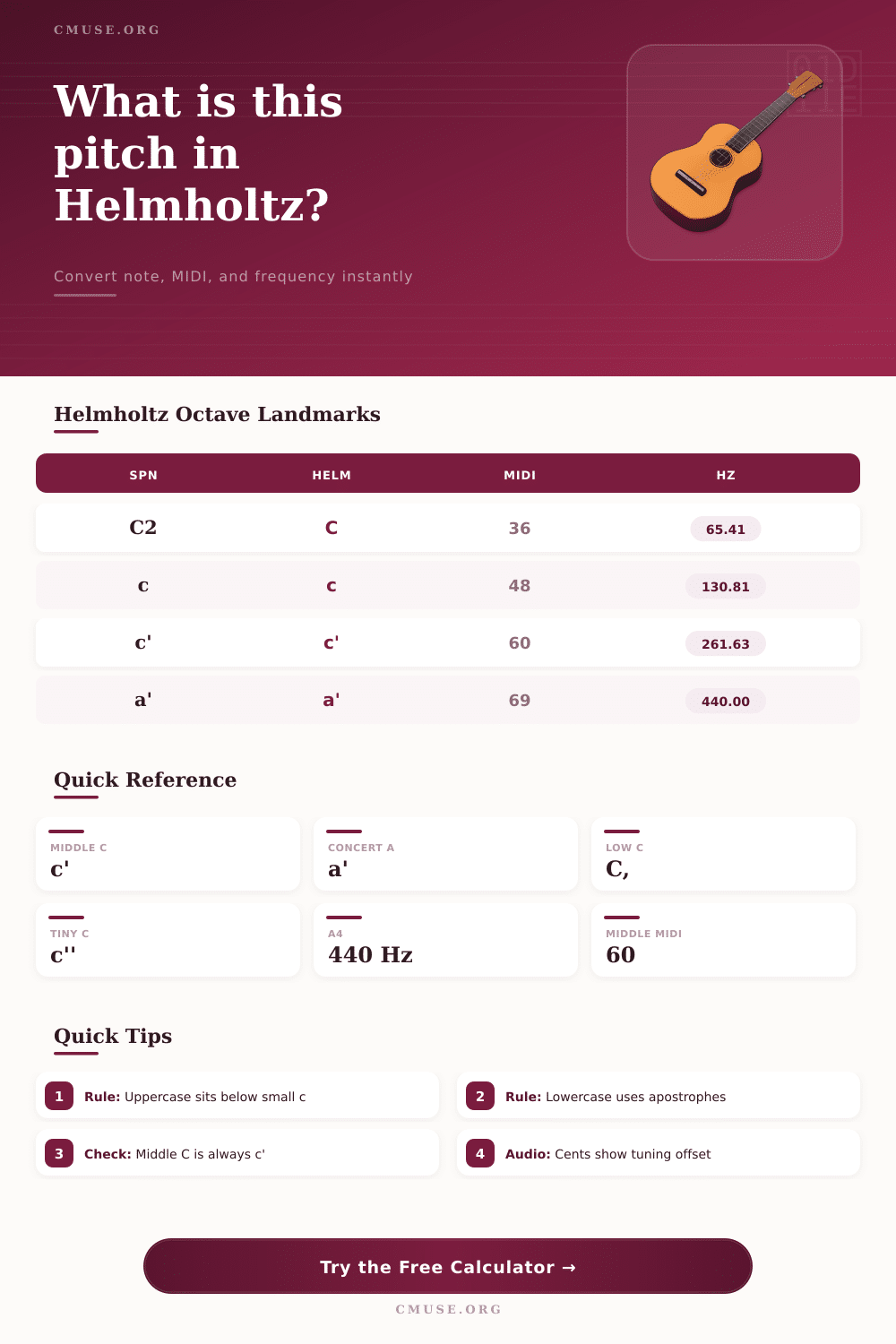
Helmholtz notation changes case and marks at C. Uppercase names are lower registers; lowercase names are small and one-line octaves upward.
| Scientific Range | Helmholtz Example | Octave Name | Typical Use |
|---|---|---|---|
| C0 to B0 | C,, to B,, | Sub-contra | Pipe organ, piano bottom |
| C1 to B1 | C, to B, | Contra | Double bass, low piano |
| C2 to B2 | C to B | Great | Bass clef foundation |
| C3 to B3 | c to b | Small | Lower staff, guitar midrange |
| C4 to B4 | c' to b' | One-line | Middle C, concert A |
| C5 to B5 | c'' to b'' | Two-line | Treble melody range |
| C6 to B6 | c''' to b''' | Three-line | Flute, violin high range |
| C7 to B7 | c'''' to b'''' | Four-line | Piccolo, piano top |
| Context | Practical Range | Helmholtz Range | Frequency Span | Calculator Use |
|---|---|---|---|---|
| 88-key piano | A0 to C8 | A,, to c''''' | 27.50 to 4186 Hz | Keyboard location check |
| Violin | G3 to A7 | g to a'''' | 196 to 3520 Hz | String and score register |
| Viola | C3 to E6 | c to e''' | 130.81 to 1319 Hz | Alto clef planning |
| Cello | C2 to C6 | C to c''' | 65.41 to 1047 Hz | Bass/tenor clef span |
| Double bass | E1 to C5 | E, to c'' | 41.20 to 523 Hz | Low register sanity check |
| Flute | C4 to D7 | c' to d'''' | 261.63 to 2349 Hz | Treble octave naming |
| Clarinet | E3 to C7 | e to c'''' | 164.81 to 2093 Hz | Written pitch conversion |
| Guitar | E2 to E6 | E to e''' | 82.41 to 1319 Hz | Fretboard note reference |
| Audio band | 20 Hz to 20 kHz | near E,, to above d'''''''' | 20 to 20000 Hz | DSP and oscillator labels |
| System | Middle C | Concert A | What It Optimizes | Common In |
|---|---|---|---|---|
| Helmholtz | c' | a' | Classical octave naming | Acoustics, musicology |
| Scientific Pitch | C4 | A4 | Computer-readable octaves | DAWs, tuners, MIDI docs |
| MIDI | 60 | 69 | Integer note events | Sequencers, samplers |
| Frequency | 261.63 Hz | 440.00 Hz | Audio measurement | Synthesis, analysis |
| Piano Key | 40 | 49 | Keyboard position | Piano pedagogy |
| Pitch | Helmholtz | MIDI | Frequency at A4=440 | Common Anchor |
|---|---|---|---|---|
| A0 | A,, | 21 | 27.50 Hz | Lowest piano A |
| C1 | C, | 24 | 32.70 Hz | Contra C |
| E2 | E | 40 | 82.41 Hz | Guitar low E |
| C3 | c | 48 | 130.81 Hz | Small octave C |
| C4 | c' | 60 | 261.63 Hz | Middle C |
| A4 | a' | 69 | 440.00 Hz | Concert pitch |
| C5 | c'' | 72 | 523.25 Hz | Treble octave C |
| C8 | c''''' | 108 | 4186.01 Hz | Highest piano C |
| Semitone | Sharp Spelling | Flat Spelling | Helmholtz Example | Use When |
|---|---|---|---|---|
| 1 above C | C# | Db | c#' or db' | Key signature decides spelling |
| 1 above D | D# | Eb | d#' or eb' | Chromatic lines need consistency |
| 1 above F | F# | Gb | f#' or gb' | F major uses flats, G uses sharps |
| 1 above G | G# | Ab | g#' or ab' | Harmony label affects the name |
| 1 above A | A# | Bb | a#' or bb' | Wind parts often prefer flats |
It’s common to hear someone say they’re confused by pitches when what they mean is ‘the notes on my piano’, or perhaps someone else thinks of them as a frequency. Acousticians, audio engineers, and even other musicians tends to talk about things using subtly different terminology. Often this stems from question of who labels the position of a note on the scale.
For those working with computers, scientific pitch notation is straightforward. It is clunky in everyday speech though. Written music theory has always use Helmholtz notation. This system maps the staff onto a visual representation using apostrophes and case changes.
How Helmholtz Notation Works
You don’t have to remember all intervals yourself with help of the calculator above. That way you can concentrate on the sounds themselves instead of arithmetic. Once you understand the pivot point, the logic of the system become clear. Middle C in Helmholtz notation marks the divide where letter casing change completely. Any notes beneath the anchor point are written in capitals plus commas to signify each falling octave. The visual weight of these lower-case symbol corresponds to acoustic depth of those notes.
Anything above middle C is written in lowercase with increasing amounts of apostrophe added for every higher-pitch note. It is more than decoration; it serves as a diagram of the musical staff. If you look at a capital C followed by two commas, your eyes immediately recognize it as being in sub-contra range (an area underneath the double bass clef). You spot a c followed by three primes and you know it’s heading up towards flute territory. These are not random decorations but visual clues that link the world of abstract notation and actual sound vibrations, changing them into precise MIDI numbers and hertz values.
More important then being able to do it yourself is understanding why and where we would want to translate them at all. All of this boils down in numbers or frequencies in digital audio workstations. It doesn’t matter whether you refer to a note as a flat A or a sharp G; what the synthesiser is concerned with is the rate at which it oscillate. When you ask a conductor to play something quietly, loudly, etc., the dynamic level is always related to a physical place on the instrument, a touch point on the string or wind key. That is not a number but a place on an instrument.
The calculator enable you to check that the digital patch you’ve created aligns with sound you expect. Want to transpose something for a clarinet? You’d better know that written pitch you’re given falls neatly onto throat tone or otherwise bumps into the harsh altissimo end of the instrument range. The reference tables that come bundled with the calculator detail these working ranges and help you write notes that don’t sound thin or strained on certain instruments.
It also highlights how moving the tuning of the variation around alter everything. Orchestral strings, for example, commonly tune up slightly to make them sound brighter. For authentic baroque performances they may even go down as low as 415 hertz. Every note on the keyboard move in terms of percent change. You set this reference point and see what happens to all those values when you move just one cent up or down. That is a tiny turn of the setting dial. But if you are layering live musician against recorded ones, it makes a huge difference in getting the intonation right.
But that’s the point, you need to be able to tie together these different systems and not get lost. Acoustics doesn’t require a math wiz to grasp, but it does help if you know what you’re doing when you can check yourself. If you’ve got a midi sequence you want to debug or just want to know why an octave sounds light on the violin and heavy on the cello, having it all right in front of you keeps mistakes from costing to much.
No matter which name Middle C may have, it is still there and helps the other octaves fall into place easy. When you keep the middle clear, the rest comes naturaly.