Concert Pitch to Written Pitch Calculator
Convert a sounding concert note into the written note needed for transposing instruments, octave parts, and custom score transpositions.
Calculation Breakdown
| Concert Note | Instrument | Written Note | Write Shift | Check |
|---|
| Written Part | Written C Sounds | Concert From Written | Concert To Written | Typical Use |
|---|---|---|---|---|
| C instruments | C | 0 semitones | Same pitch | Flute, oboe, piano, violin |
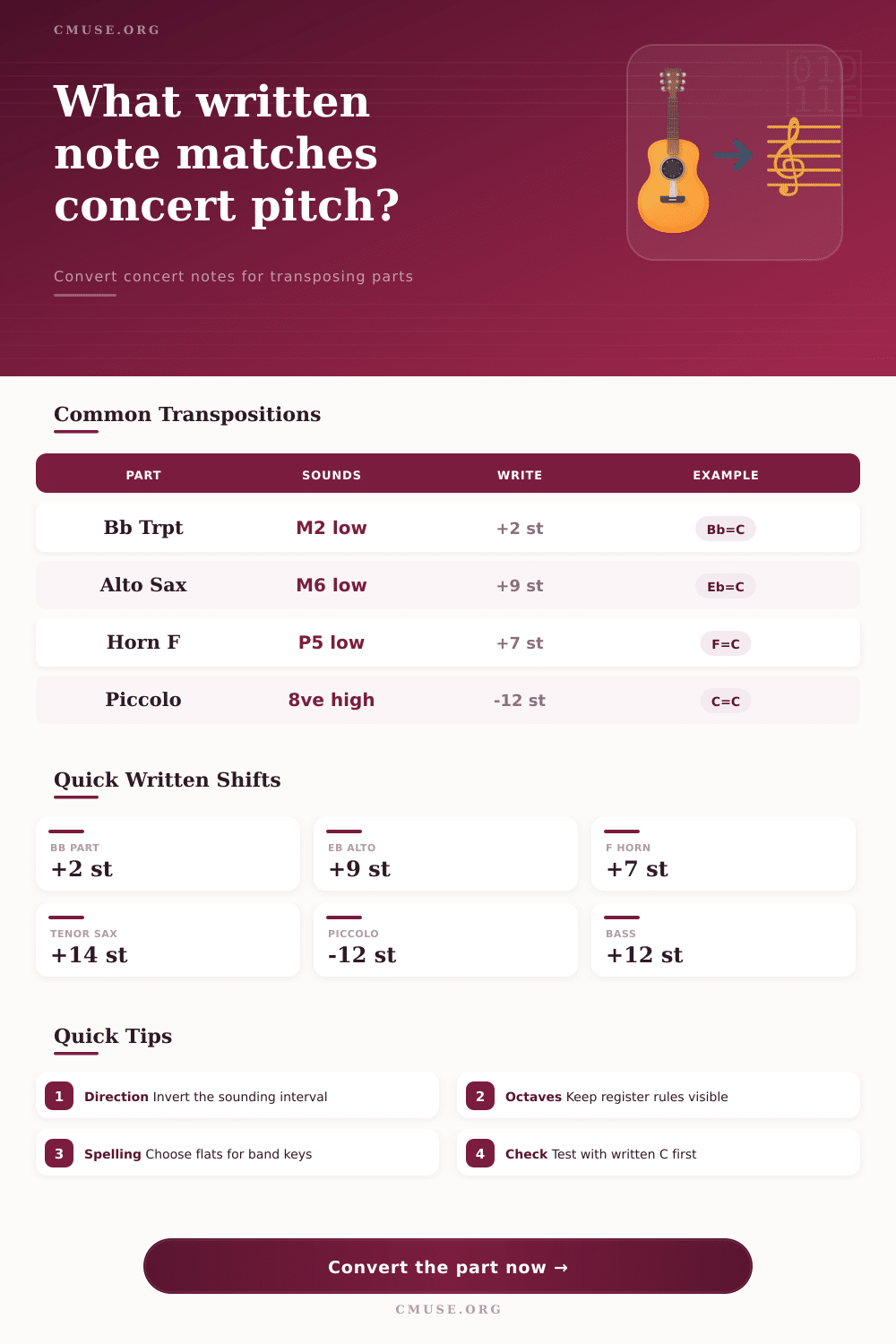
| B flat trumpet / clarinet | B flat below | -2 semitones | Write up M2 | Band and jazz parts |
| B flat tenor sax | B flat ninth below | -14 semitones | Write up M9 | Tenor sax lead sheets |
| E flat alto sax | E flat sixth below | -9 semitones | Write up M6 | Alto sax, alto clarinet |
| E flat baritone sax | E flat thirteenth below | -21 semitones | Write up M13 | Baritone sax parts |
| F horn / English horn | F fifth below | -7 semitones | Write up P5 | Orchestra and wind ensemble |
| Piccolo | C octave above | +12 semitones | Write down P8 | High flute-family part |
| Guitar / bass | C octave below | -12 semitones | Write up P8 | Octave-transposed notation |
| Concert Pitch | B flat Trumpet | Alto Sax | Horn in F | Piccolo |
|---|---|---|---|---|
| C4 | D4 | A4 | G4 | C3 |
| B flat3 | C4 | G4 | F4 | B flat2 |
| E flat4 | F4 | C5 | B flat4 | E flat3 |
| F4 | G4 | D5 | C5 | F3 |
| A4 | B4 | F sharp5 | E5 | A3 |
| If Written C Sounds | Sounding Offset | Write From Concert | Interval Name | Quick Test |
|---|---|---|---|---|
| B flat | -2 | +2 | Major second up | Concert B flat = written C |
| A | -3 | +3 | Minor third up | Concert A = written C |
| G | -5 | +5 | Perfect fourth up | Concert G = written C |
| F | -7 | +7 | Perfect fifth up | Concert F = written C |
| E flat | -9 | +9 | Major sixth up | Concert E flat = written C |
| C octave higher | +12 | -12 | Octave down | Concert C5 = written C4 |
| Part Type | Notation Goal | Best Spelling Bias | Octave Risk | Use When |
|---|---|---|---|---|
| Band B flat | Write up whole step | Flats in flat keys | Low for bass clarinet | Trumpet, clarinet, soprano sax |
| Saxophone E flat | Write up sixth or thirteenth | Usually flats | High for alto, very high for bari | Alto, baritone, E flat clarinet |
| Horn / English horn | Write up perfect fifth | Context dependent | Middle register confusion | Orchestral score extraction |
| Octave transposer | Move octave only | Match key signature | Most common mistake | Piccolo, guitar, bass, tenor voice |
| Custom part | Use exact semitone offset | User selected | Depends on offset | Rare instruments, historical parts |
| Concert Note | MIDI | Frequency at A440 | B flat Written | E flat Alto Written |
|---|---|---|---|---|
| C4 | 60 | 261.63 Hz | D4 | A4 |
| D4 | 62 | 293.66 Hz | E4 | B4 |
| E flat4 | 63 | 311.13 Hz | F4 | C5 |
| F4 | 65 | 349.23 Hz | G4 | D5 |
| G4 | 67 | 392.00 Hz | A4 | E5 |
| B flat4 | 70 | 466.16 Hz | C5 | G5 |
Here’s what happens: you’ve got a great melody running through your head. You’re standing in front of a band and are confident enough to put a C on the stave because you know it’ll give you the concert pitch you want to hear. Then the trumpet player looks at you with raised eyebrows and plinks out a D; the horn section heads for G-land and there you have it, immediate disaster! That’s the universal panic of transposing instruments. The note on paper doesn’t match the one that comes from bell, which means poor old brain has to do some instant arithmetic while panicking. Do I go up or down a step? Did I just go wrong by an octave? Usually yes, but…
When an instrumentalist sees the letter ‘C’ written down they will hear it different depending upon their instrument family. If you’re a pianist or flautist, the ink on the paper represent concert C. If you’re a trumpeter, the same notation are heard as a B flat. The beauty of this calculator (above) is that it removes mental effort at rehearsal time, doing all the maths for you based off the family of instruments you choose and the note you wish to reach. Simply choose which is the target part: French horn, say, or alto sax; then let the calculator do its work. The right interval shift get applied automatically. And the answer will be precise pitch that needs to be notated.
Why Instruments Change Notes
Rather than memorise a chart it’s important to understand what is going on here. Centuries ago instrument manufacturers settled on these transpositions because musicians could change instruments within the family without needing to learn new fingering patterns. Even though the concert pitches can be wildly different for an E flat and an A clarinet they use the same fingerings for a C major scale. We write out the part in transposition so as to retain the muscle memory, not force each person to read the part in concert pitch. If this were the case, orchestral music would of have to use a non-transposing score. Each player would then have to calculate the intervals as they go, which would slow sight reading down to a crawl.
If you glance over to the reference table on the page, you will see that B flat instruments has to be written up a major second. If you want a concert C note, you should write a D. Otherwise, it feels counterintuitive because the instrument sound lower than what is written. You push the notation upwards to compensate for this drop in pitch. The horn in F is trickier because it sounds a perfect fifth lower. Because of this, you need to write down a fourth or up a seventh depending on context of what you want to play. This is where mistakes can happen, as the fifth interval does not cross key signatures the same way than simple whole steps.
Another complexity is octave displacement. A flautist reads standard notation but sounds an octave higher. Similarly, a double bass read standard notation but sounds an octave lower. This convention avoids having to have too many ledger lines cluttering up your staves and keeps the note in comfortabley places on the line of the staff. This tool takes all this into account, not wishing to hand a flautist a part that is now impossibly high or the trumpeter one that’s way too low! It simply look at the MIDI number and checks its frequency and ensures that it ends up where it can be played.
It does matter which spelling you select too; do you want an A flat or a G sharp? You can choose either sharps or flats because this calculator use the key signature for your selected instrument. For example, brass players is usually used to natural spells in their home keys, while woodwind players may approach accidentals differently depending on the register. This little detail can make the part more easily read at sight and avoids any hesitation when playing faster passages where every second counts.
Transposing is simply translating the language. It is turning your composer’s intention into the player’s native tongue. If you have confidence in the mathematics involved in the process, you can concentrate on dynamics and phrasing instead of worrying if that third note should be a C or a B flat. Everyone are reading what they know to be true and the harmony falls into place.