Transpose by Interval Calculator
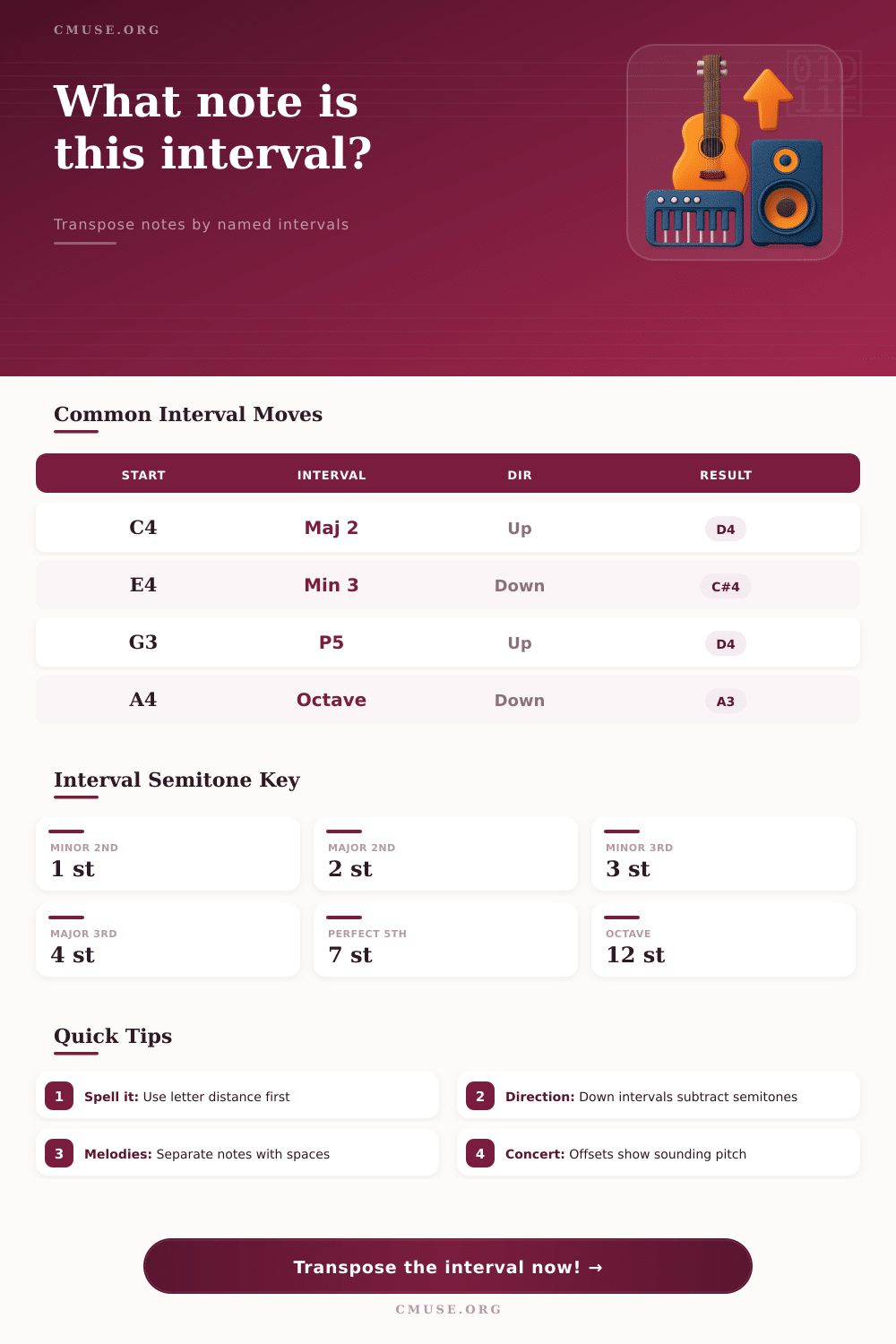
Move a note or short melodic line up or down by a named interval, then check the spelling, semitone distance, octave, frequency ratio, and concert-pitch result.
Calculation Breakdown
| Original | New Note | Interval | Original Hz | New Hz | Concert Result |
|---|---|---|---|---|---|
| Run the calculator to populate the melody table. | |||||
| Interval | Semitones | Letter Span | Example Up From C |
|---|---|---|---|
| Minor 2nd | 1 | 2 letters | Db |
| Major 2nd | 2 | 2 letters | D |
| Minor 3rd | 3 | 3 letters | Eb |
| Major 3rd | 4 | 3 letters | E |
| Perfect 4th | 5 | 4 letters | F |
| Tritone | 6 | 4 or 5 letters | F# / Gb |
| Perfect 5th | 7 | 5 letters | G |
| Minor 6th | 8 | 6 letters | Ab |
| Major 6th | 9 | 6 letters | A |
| Minor 7th | 10 | 7 letters | Bb |
| Major 7th | 11 | 7 letters | B |
| Octave | 12 | 8 letters | C |
| Move | Formula | Pitch Effect | Frequency Ratio |
|---|---|---|---|
| Up minor 3rd | n + 3 | Higher by 3 semitones | 1.1892 |
| Down minor 3rd | n - 3 | Lower by 3 semitones | 0.8409 |
| Up perfect 5th | n + 7 | Higher by 7 semitones | 1.4983 |
| Down perfect 5th | n - 7 | Lower by 7 semitones | 0.6674 |
| Up octave | n + 12 | Double frequency | 2.0000 |
| Down octave | n - 12 | Half frequency | 0.5000 |
| Part Type | Written C Sounds | Offset | Use In Calculator |
|---|---|---|---|
| Concert pitch | C | 0 semitones | Piano, violin, flute, voice |
| Bb instrument | Bb | -2 semitones | Clarinet, tenor sax, trumpet |
| Eb alto instrument | Eb | -9 semitones | Alto sax, baritone sax octave families |
| F horn | F | -7 semitones | Horn parts to concert pitch |
| G alto flute | G | -5 semitones | Alto flute written pitch |
| Guitar | C one octave lower | -12 semitones | Sounding pitch from notation |
| Use Case | Input | Interval | Main Result |
|---|---|---|---|
| Vocal melody lift | C4 D4 E4 | Major 2nd up | D4 E4 F#4 |
| Harmony below | E4 G4 B4 | Minor 3rd down | C#4 E4 G#4 |
| Fifth doubling | G3 | Perfect 5th up | D4 |
| Octave reduction | A4 C5 E5 | Octave down | A3 C4 E4 |
| Tritone color | F3 | Tritone up | B3 |
Learning music theory can feel like a collection of strict rules you have to learn and remember before you’re permitted to produce anything. You spend hours memorising intervals and how many semitones apart they is. (A perfect fifth is seven semitones, for example.) Then you sit down at the piano and hope it all sticks in your brain.
Once you get past the idea of thinking about an interval as a abstract mathematical problem and begin to think about it as a real distance from one note to another it’s much simpler. If you move a melody or single note up or down while maintaining that same distance then you’re transposing by interval. In other words, shape remains but the note may change altogether. So let’s leave the mathematics to the calculator (above) and focus on music outcome. Simply type in your start note, decide if you want it going upwards or downwards, and then pick the interval you wish; say a minor second or major sixth. It will work out resulting note and spell it correctly for normal notation.
Making Music Theory Simple
It is this difference between what you hear and what you write that trips up most musicians. Moving from a C to E mean you have moved up four semitones. This lands on E in a major third context, but it could be spelled F flat if you are working out a diminished fourth. On equal temperament tuning systems, both of these pitches sounds the same but their harmonic meaning differs. Spelling a note correctly is not just about being legible but also about knowing the function of that note in terms of its key.
Then think practically about how an ensemble work with instruments that don’t necessarily play in concert pitch. When you’re composing a melody for a B-flat clarinet, for example, all of your Cs becomes B-flats. These transposing instruments has their offset added to the calculator so you can know which written note is going to be your intended sounding one. That means no mental gymnastics when arranging. First, establish vocal range you can write in comfortabley; then decide exactly which notes the horn player will have to play. It closes the gap between the world inside your head and practical requirements of certain instruments.
It is not just an issue of perception but one of frequency ratios. When you double the frequency, you move up a perfect octave; there’s the same note on different scale and it sounds the same. If you then increase the frequency by approximately 1.5, you are now a perfect fifth above what sounds like a steady consonant interval in nearly all musical traditions. Knowing about these acoustic connections allows us to gain insight into why some intervals sound like they’re part of our home whilst others cause tension. The tritone or six semitone interval lies exactly halfway across the octave without wanting to resolve. This quality has been used by composers over many hundreds of years, propelling music onward.
This is where consistency matters when dealing with multiple notes (melody) versus isolated individual notes. You can enter a brief passage of melody into the tool to transpose it all at once. This is helpful for testing whether moving a piece down a major second, for example, keeps the melody comfortably inside singer’s range. Quickly input a short sequence of pitches to see if the melody has gone too low or too high. Adjust the interval up or down as needed and see impact instantly. No need to open up your digital audio workstation or hand write lines of sheet music to experiment with this idea.
Accidentals can make or break your work. It’s all about spelling; do you prefer flats or sharps? If you’re working in A major then you don’t want flats. You can select flat preference, sharp preference, and automatic spacing. The choice guarantees that results are theoretically aligned with your work. Sometimes, for example, F-sharp may be called G-flat. In practice, these notes will sound the same. However, if you have lots of sharps in your key signature then labeling this as G-flat only confuses the reader of your music. Less confusion means less mental effort for the performer, who can focus on interpretation instead of figuring out potentially misleading accidentals.
There is flexibility in transposition. This allows you to adapt a song to another voice range or work harmonically on a variation. If you know your intervals, then you’re free to be in any key. Your ear does the rest. Is the slight change from minor to major 3rd sufficient to create the desired emotional impact? Or do you feel it’s too far away from the original character? It’s not about right notes as such: it’s about how they relate to each other. When you’ve got hold of these distances, shifting the idea from one key to another becomes second nature. Where once you were afraid to change the key, you now understand how its structure determines what it sounds like. That’s where the power lies in getting the mechanics right, so you can get on with creating something that realy does feel good to sing and play.