88 Key Range Calculator
Find the low note, high note, frequency limits, MIDI numbers, octave span, and physical keyboard width for an 88-key piano or smaller keyboard range.
Presets set the written key range first; the transpose field shows the sounding range after a semitone shift.
Calculation Breakdown
| Item | Written Note | Sounding Note | MIDI | Frequency | Key Number |
|---|
| Keyboard | Typical Written Range | Keys | Semitone Span | Best Range Check |
|---|---|---|---|---|
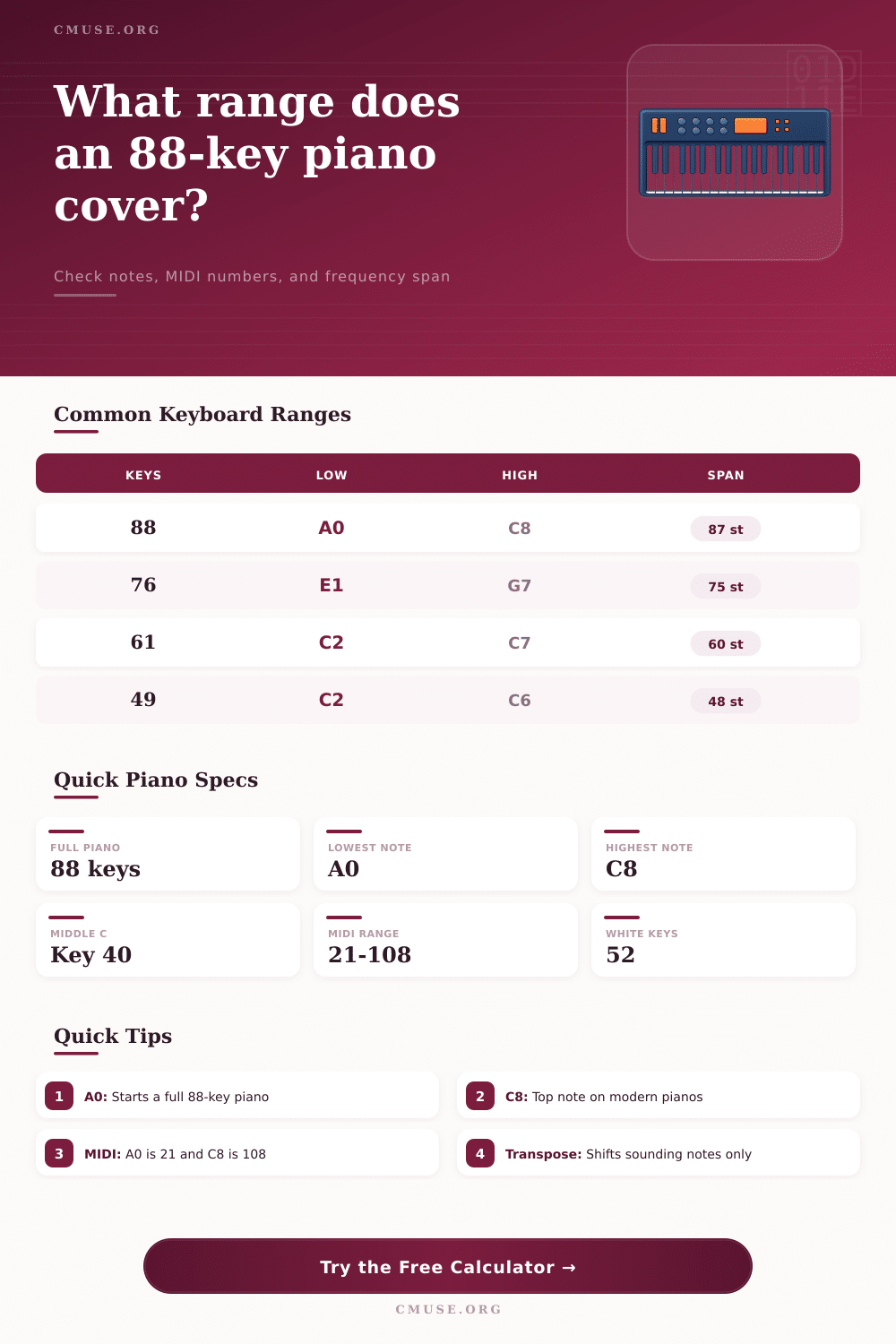
| Full piano | A0 to C8 | 88 | 87 | Classical piano, full scores |
| 76-key stage piano | E1 to G7 | 76 | 75 | Gigging piano parts |
| 73-key electric piano | E1 to E7 | 73 | 72 | Vintage-style stage layouts |
| 61-key keyboard | C2 to C7 | 61 | 60 | Synth, organ, pop parts |
| 49-key controller | C2 to C6 | 49 | 48 | Desk controller ranges |
| 37-key controller | C3 to C6 | 37 | 36 | Lead synth or compact rigs |
| 25-key controller | C3 to C5 | 25 | 24 | Melody, bass, and MIDI entry |
| Landmark | Key Number | Note | MIDI | Frequency at A4=440 |
|---|---|---|---|---|
| Lowest piano key | 1 | A0 | 21 | 27.50 Hz |
| Low C | 4 | C1 | 24 | 32.70 Hz |
| Bass C | 16 | C2 | 36 | 65.41 Hz |
| Tenor C | 28 | C3 | 48 | 130.81 Hz |
| Middle C | 40 | C4 | 60 | 261.63 Hz |
| Concert A | 49 | A4 | 69 | 440.00 Hz |
| Treble C | 64 | C6 | 84 | 1046.50 Hz |
| Top piano key | 88 | C8 | 108 | 4186.01 Hz |
| Octave C | MIDI | Frequency | 88-Key Position | Range Role |
|---|---|---|---|---|
| C1 | 24 | 32.70 Hz | Key 4 | Bottom sub-bass C |
| C2 | 36 | 65.41 Hz | Key 16 | Deep left-hand register |
| C3 | 48 | 130.81 Hz | Key 28 | Low-mid accompaniment |
| C4 | 60 | 261.63 Hz | Key 40 | Middle C reference |
| C5 | 72 | 523.25 Hz | Key 52 | Upper melody range |
| C6 | 84 | 1046.50 Hz | Key 64 | Bright treble range |
| C7 | 96 | 2093.00 Hz | Key 76 | Very high treble |
| C8 | 108 | 4186.01 Hz | Key 88 | Top piano note |
| Transpose | A0 Sounds As | C4 Sounds As | C8 Sounds As | Use Case |
|---|---|---|---|---|
| -12 semitones | A-1 | C3 | C7 | Octave-down controller layer |
| -2 semitones | G0 | A#3 | A#7 | Whole-step down part |
| 0 semitones | A0 | C4 | C8 | Standard written piano range |
| +1 semitone | A#0 | C#4 | C#8 | Half-step up performance |
| +12 semitones | A1 | C5 | C9 | Octave-up MIDI layer |
Even though they appear to be very similar at first glance, you’ve likely realized that not all keyboard is equal. Stretching from A0 through to C8, the traditional eighty-eight keys is the expected norm for the serious pianist. It represents entire tonal range a composer could use in both jazz and classical music without having to compromise at either end of range. It offers a sense of wholeness instead of something being cut short.
It’s a starting point. When working with a home studio where floor space isn’t plentiful, this full range begins to feel like a luxurius that perhaps isn’t necessary. It’s one thing to have a number of keys, but knowing precisely what you’re getting is quite another.
Why Choose 88 Keys?
To that end, where do they fall within the overall range of musical pitch? If you’ve ever played or listened to a piano, you’ll know that the lowest note has a frequency of only twenty-seven and a half hertz; it’s low enough that you feel it in your chest more then you hear it with your ears. This is why bottom end of the bass matters so much when it comes to immersion.
The calculator (above) takes care of the maths by plotting these physical confines into MIDI numbers and frequencies, sparing you from needing to commit to memory a chart of pitch standards. Once you enter the reference you want to tune to, it does the rest of work for you. This takes away guesswork of matching hardware that might otherwise sound slightly out of tune against each other.
Players tend to inhabit middle region of the piano. This is almost exactly halfway through the keyboard. Middle C serve as the reference point for arranging finger patterns and reading music.
If you remove very top end of the instrument to save space, you will constantly have to change your hand position or hit physical limits that disrupt your flow. To save weight many stage pianos cuts off early, often starting at E1 instead of A0. On paper this may seem like a small compromise but if you attempt to play something that needs these lowest octaves for harmony you’ll be disappointed. It’s not only a question of range but also of color and texture possibilities in the lower end of the instrument.
One more aspect of the piano’s design that’s simple yet potentially confusing is called ‘transposition‘. You can adjust pitch of your keyboard a few semitones up or down so it aligns with a vocalist who prefers singing in a different key. They still play same keys but now the note they create has shifted.
For instance, this will throw new players who is learning to associate a black key with C#. They might think white keys should always spell the same letters no matter what state they’re in. The visualisation here clearly shows you the difference between what you’ve written down (written range) against what you’ll hear (sounding range). So even though you might hit C4 with your finger, with the keyboard pitched a couple of octaves higher it would actualy emit a D4 instead.
If you’re doing a piece with pitch-correction, then having this right is necessary for correct tracking data. Surprisingly, physical size figures into the decision as well. Remember: An eighty-eight key keyboard requires considerable room, typically between 60 and 65 inches wide depending on case design. To fit this, the calculator assume standard key spacing so you’ll get an accurate estimate of how much width you’ll need. Next time you’re thinking about purchasing one, you can measure your stand or desk first.
It also factors in side clearance, meaning additional space required to comfortabley access the outermost keys without knocking into any edges. Who doesn’t want that? This nifty measurement will help you avoid purchasing something that sounds great based off paper but won’t actualy fit in real life.
It comes down to physical limitations and musical requirements. If you’re just learning scales within middle range or writing a few simple pop melodies, you don’t really need the entire span. However, if you want to play piano music, those outermost keys will seem as though they’ve been amputated.
In the tables below I have presented some commonly available configurations side by side so you can see at a glance what you’ll be sacrificing should of opt for a sixty-one-key instrument instead of the full eighty-eight. It is only a little, but it is still something to consider. When planning that tour or setting up a home studio, knowing exactly where limits of your music are enables you to play freely without continually needing to check where the edge of board lies.