Harpsichord String Length Calculator
Calculate speaking length, cut length, pluck point, unit weight, and break margin for iron, brass, bronze, or steel harpsichord wire.
Calculation Breakdown
| Material | Density | Typical Use | Estimated Tensile Strength |
|---|---|---|---|
| Historic iron wire | 0.283 lb/in³ / 7.83 g/cm³ | 8′ middle and treble scaling | 170,000 psi class |
| Modern steel / music wire | 0.283 lb/in³ / 7.83 g/cm³ | High treble, 4′ choirs, replacements | 230,000 psi class |
| Yellow brass wire | 0.307 lb/in³ / 8.50 g/cm³ | Shorter bass strings and Italian scaling | 70,000 psi class |
| Red brass wire | 0.316 lb/in³ / 8.75 g/cm³ | Warm low bass where scale is short | 55,000 psi class |
| Phosphor bronze wire | 0.318 lb/in³ / 8.80 g/cm³ | Modern substitute for compact basses | 95,000 psi class |
| Soft iron reconstruction wire | 0.283 lb/in³ / 7.83 g/cm³ | Historically gentle tension plans | 130,000 psi class |
| Note | Frequency at A415 | Usual Wire Range | Typical Speaking Length |
|---|---|---|---|
| C2 | 61.74 Hz at A440, 58.33 Hz at A415 | 0.024–0.030 in brass | 78–96 in / 198–244 cm |
| C3 | 123.47 Hz at A440, 116.67 Hz at A415 | 0.016–0.020 in brass or iron | 52–66 in / 132–168 cm |
| C4 | 261.63 Hz at A440, 247.16 Hz at A415 | 0.010–0.013 in iron | 28–38 in / 71–97 cm |
| C5 | 523.25 Hz at A440, 494.33 Hz at A415 | 0.007–0.009 in iron or steel | 13–18 in / 33–46 cm |
| C6 | 1046.50 Hz at A440, 988.65 Hz at A415 | 0.005–0.007 in steel | 6–9 in / 15–23 cm |
| Register | Pitch Relationship | Length Rule | Use In Calculator |
|---|---|---|---|
| 8′ choir | Written pitch | Baseline length for the note | Use the sounding note directly |
| 4′ choir | Sounds one octave higher | About half the 8′ speaking length | Raise the octave by 1 |
| 16′ choir | Sounds one octave lower | About twice the 8′ speaking length | Lower the octave by 1 |
| Short-octave bass | Layout may remap keys | Calculate by sounding pitch | Choose the actual note heard |
| Double choirs | Same pitch, separate strings | Each string uses its own length | Repeat per choir if gauges differ |
| Part of String | Imperial Allowance | Metric Allowance | Reason |
|---|---|---|---|
| Hitchpin loop | 1.5–3.0 in | 4–8 cm | Loop, twist, and bridge approach |
| Wrestpin winding | 3.5–6.0 in | 9–15 cm | Enough wraps for tuning stability |
| Trimming reserve | 0.5–1.0 in | 1–3 cm | Final cut after coils settle |
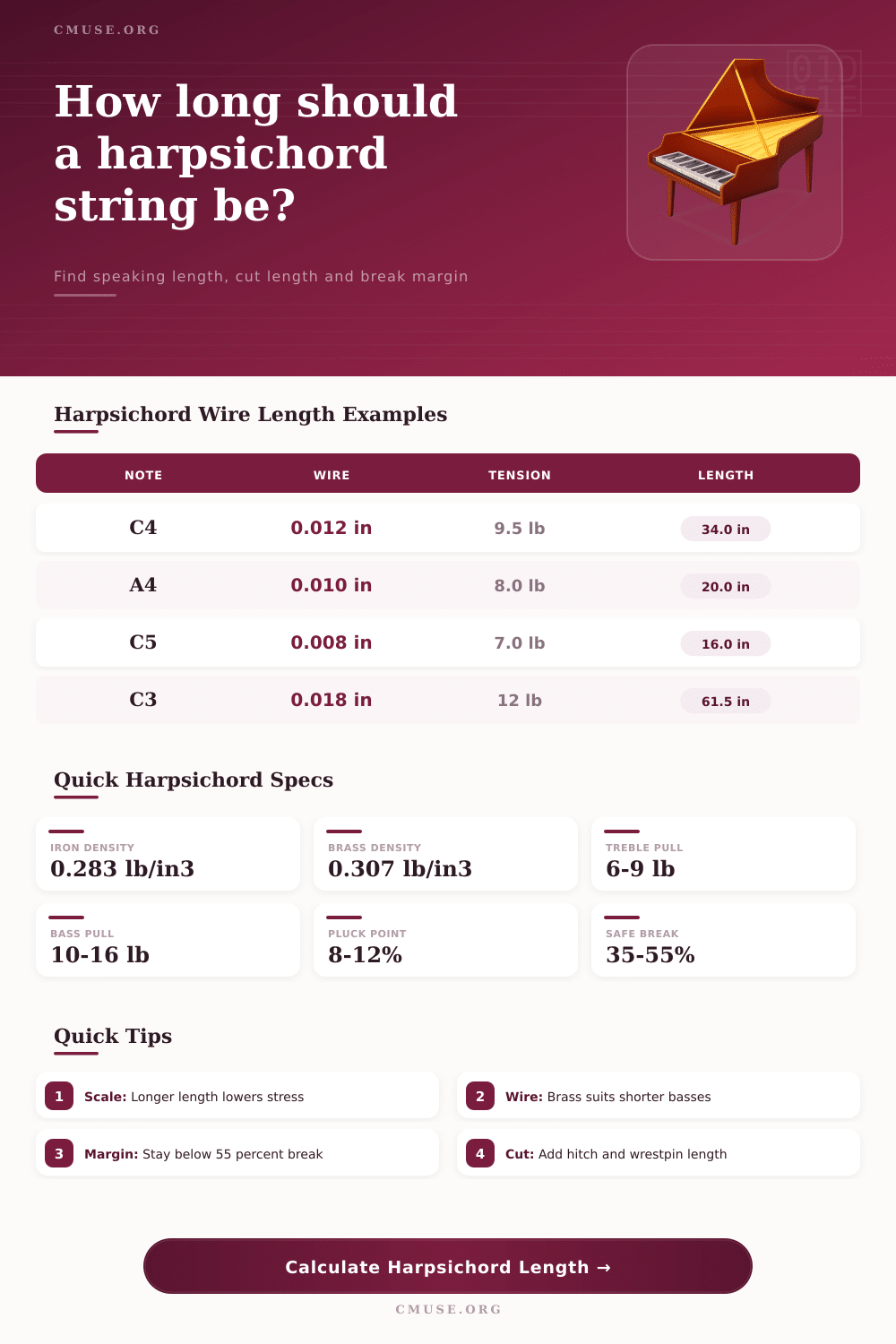
| Pluck point | 8–12% of speaking length | Same ratio | Balances brightness and strength |
During harpsichord restoration, there is no need to guess about tension or even length required when using right wire gauge and target pitch. Simply plug in what you want for each parameter and the calculator do the rest, it figures out how much metal needs to be cut off the spool as well as speaking length. This avoids tearing a hole through sound board.
Variations on this relationship between length, mass and force is simple to grasp and have been in use by luthiers for centurys. It’s surprising than how many fail to consider concept of density and therefore continue to get it wrong. Iron is not as heavy as brass. Brass are heavier then iron per inch of length. This means if you switch material without changing the length or size of diameter, you either risk a dangerously high level of tension or your string length will drop flat. The tool account for these differences by letting you select from moddern steel, historical iron, yellow or red brass, and phosphor bronze. These materials vary both in their tensile strength and density. For example, if you’re restoring an old Italian virginal that specifies shorter scales, you may find brass your friend here as it allows a greater thickness of string with less length before reaching dangerous levels of breaking tension.
How to Choose Harpsichord Strings Safely
What does it mean? Speaking length is the actual vibrating portion of the string from bridge to nut. What you get out of box is cut length. This is where it gets important. To twist on tightly enough to keep the string tuned, you’ll want some added length so that wire can go around tuning pin. At the other end you’ll want some slack to wrap under hitchpin. If you cut precisely to speaking length, there won’t be enough space to adequately twist the ends. That means a string that breaks or slips through knot when you’re trying to tune. Builders typically add a few inches as an allowance. In the inputs section you can tweak this value based off your exact bridge style and pinblock shape.
The thing that creates the biggest problem is a variable not seen: Tension. Ask the strings to do too much and they snaps. Your target tension tells you how much room you have left before the strings break. The calculator provides an estimate, which tell you what percent of the wire’s ultimate strength you’re using. Anything greater then 55% is playing with fire. It’s that part that folks seem to miss. They get caught up in pitch and forget that a thin steel string might hit A4 perfectly at eighteen inches, but only if it can withstand twenty pounds of pull. If that wire break at fifteen pounds, your scale is physically impossible. The tool flags this for you.
The type of material used makes all the difference. Older instruments tended towards lower tension as the historic iron wire used was softer and prone to breakage. On a faithful reconstruction you may wish to set things up with low soft iron settings to experience the problems encountered by the instrument’s builders back then. In contrast, modern steel can holds high tension and allow for shorter scales on, say, spinets and other pieces of furnitures. However, just because steel is stronger doesn’t mean that tone will be good.
Further down the speaking length, the shape of the plucking point also form an important part of the harmonic content. Typically the plucking point would have been about eight to twelve percent of the speaking length distance from the bridge. Too near to the bridge produces a harsh brittle tone; too far away loses its brilliance. Look at the results and notice the unit weight. This will tell you if your mass per inch is in line with what was common for the register in the past. You may find that your scale is consistent in terms of frequency but weights do not seem correct based on adjacent strings.
Smooth harpsichord scaling involves a gradual change in thickness and stress throughout the keyboard. The tension should gently curve rather than leap sharply from string to string. Take some time to compare Flemish, Italian or French approaches using presets, then adjust one variable at a time to learn what each does. If you increase length of the scale, observe how it lowers the tension. If you beef up the wire, you’ll notice an increase in tension and a more stable pitch. Patience pays off as this becomes a balancing act.
You’re not only looking for a string that sounds good but also lasts. Cut confidently when the break margin remains safely in place and math adds up. Your bridge won’t budge, the wire holds its pitch, and the music sings on with no snap-back.