French Horn Tubing Length Calculator
Estimate total acoustic length, physical cut length, and valve-slide additions for F, Bb, descant, natural, and custom horn tubing.
Calculation Breakdown
| Horn Side | Open Root | Acoustic Length | Metric Length | Typical Use |
|---|---|---|---|---|
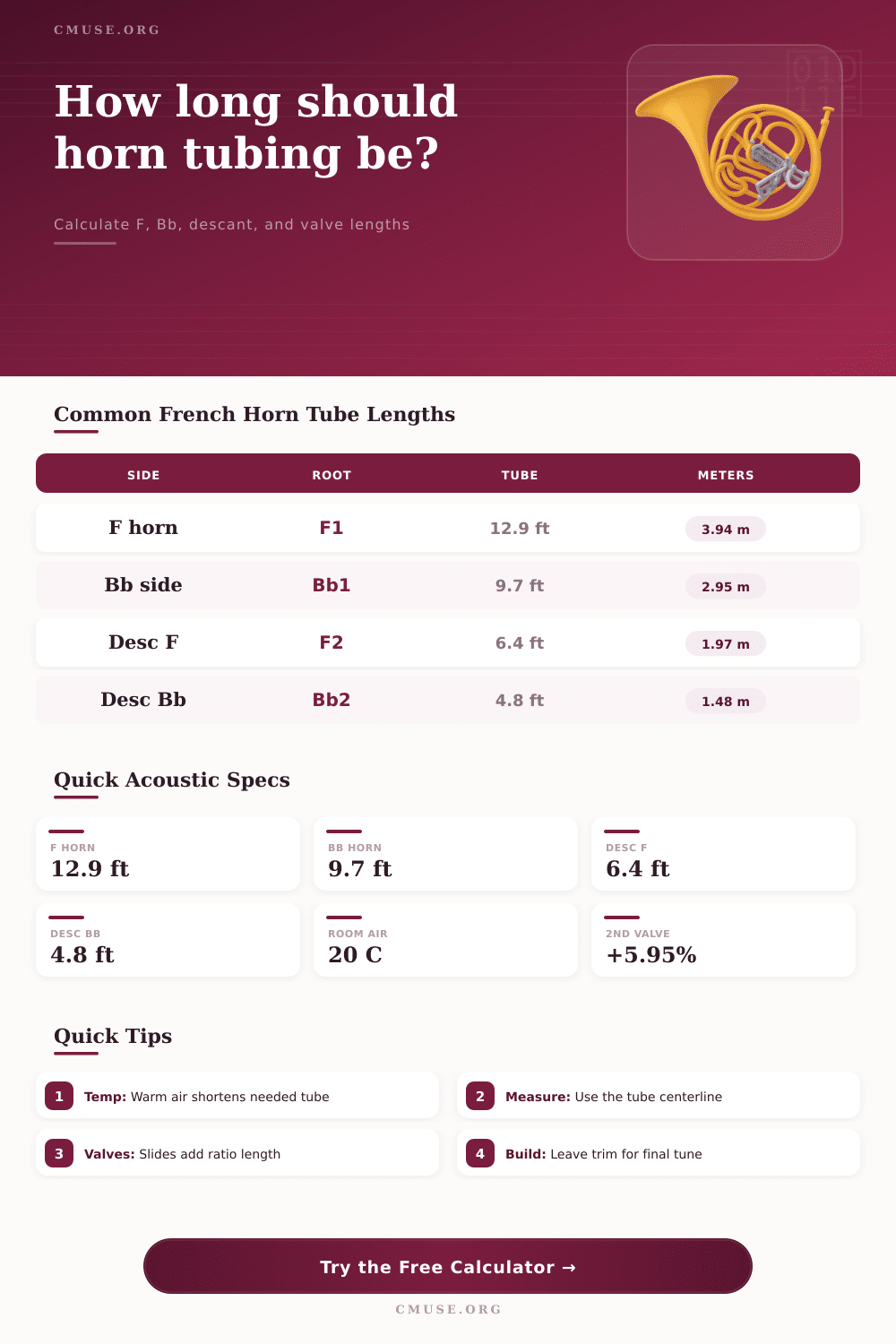
| Single F / double F side | F1 | 12.9 ft | 3.94 m | Standard orchestral F side |
| Bb side of double horn | Bb1 | 9.7 ft | 2.95 m | Agile upper register side |
| Descant F alto side | F2 | 6.4 ft | 1.97 m | High horn and descant work |
| Descant Bb alto side | Bb2 | 4.8 ft | 1.48 m | Highest compact side |
| Natural horn in E | E1 | 13.7 ft | 4.18 m | Historical crook comparison |
| Alto Eb horn | Eb2 | 7.2 ft | 2.21 m | Alto horn reference |
| Valve / Change | Semitone Move | Tube Ratio | Added Length on F Side | Added Length on Bb Side |
|---|---|---|---|---|
| 2nd valve | Down 1 | +5.95% | 9.2 in / 23.4 cm | 6.9 in / 17.5 cm |
| 1st valve | Down 2 | +12.25% | 18.9 in / 48.1 cm | 14.2 in / 36.2 cm |
| 3rd valve | Down 3 | +18.92% | 29.3 in / 74.3 cm | 22.0 in / 55.9 cm |
| 1+2 combo | Down 4 | +25.99% | 40.2 in / 102 cm | 30.1 in / 76.5 cm |
| 1+3 combo | Down 5 | +33.48% | 51.8 in / 132 cm | 38.8 in / 98.6 cm |
| F to Bb change | Up 5 | -25.08% | removes 38.8 in / 98.6 cm | reference side |
| Air Temp | Speed Of Sound | F1 Tube Length | Bb1 Tube Length | Practical Effect |
|---|---|---|---|---|
| 10°C | 337.4 m/s | 12.66 ft | 9.48 ft | Longer tube than warm room |
| 15°C | 340.4 m/s | 12.77 ft | 9.56 ft | Cool rehearsal room |
| 20°C | 343.4 m/s | 12.88 ft | 9.65 ft | Normal reference condition |
| 25°C | 346.5 m/s | 13.00 ft | 9.73 ft | Warmer air raises pitch |
| 30°C | 349.5 m/s | 13.11 ft | 9.82 ft | More slide pull likely |
| Allowance Item | Typical Range | Calculator Input | Why It Matters |
|---|---|---|---|
| Main tuning slide pull | 0.5 to 2.0 in | Slide pull field | Leaves room for ensemble pitch and room temperature |
| End correction reserve | 1 to 3 bore diameters | End correction field | Approximates bell, mouthpiece, and final trimming effects |
| F horn bore | 0.468 in common | Bore field | Controls the correction allowance when using bore diameters |
| Valve slide extra | 5.95% per semitone ratio | Valve interval field | Each lower chromatic interval needs proportional added tube |
The baton comes up. You stand in orchestra. It hits you that the room has warmed since we rehearsed and your pitch is slowy getting sharp. You feel stiffness around instrument and tightness in the intonation. Then that glorious F note turns into a squeak rather then a tone.
Brass instruments are far from static. Essentialy, they are long coiled tubes of air held inside some metal. When humidity or temperature changes, so too does the behaviour of that air. Knowing how to control that column distinguishes between an average player and one capable of standing up to a tuning fork anywhere.
How to Keep Your Horn In Tune
What it comes down to, however, is relationship between the physical reality of a horn and its acoustic length. With an open tube, the number you get from a theoretical calculation are perfect. In real life, however, there is valves that deflect airflows; bells that flare, and mouthpieces that cup air. All of these affect what engineers call end corrections.
In simple terms, they make instrument longer than it looks. Regardless of how far out you extend the slide, if you don’t allow for this your horn will sound sharp. The calculator above runs numbers for you including these slight physical realities. You’ll know precisely how much metal you need to reach that basic pitch given certain conditions. It removes guesswork from geometry, but understanding why these corrections occur allow you to trust the figures even when something go wrong in practice.
The other factor many new players don’t consider are temperature. The speed of sound change drastically depending on how warm it is. Therefore, the same actual tube will emit a note that’s higher pitched when warm compared than cold. So, the difference between a twenty degree celsius rehearsed hall and a swelteringly hot tent at a music festival can be significant. Playing an un-tuned horn at a gig after you have tuned it for cooler temperatures result in all notes being flat until you adjust the slide placements again. Alternatively, if you are warming up in a colder room, as breath warms the horn up, it will make itself sharp. That’s why having some excess length on your main tuning slide isn’t simply a luxury; it should of be there to account for the air within the tubing heating up.
These considerations also alter with change from an F side to a Bb side. The F side is much larger; sometimes measuring over 13 feet of coiled tubing, this mean it responds sensitively to subtle temperature fluctuations but is sluggish in its lower register. Conversely, the Bb side is tighter and shorter, responding more quickly to changes in embouchure while providing less leeway for tuning slide adjustments if they are pulled out too far.
In practice, many player consider these to be two distinct instruments, glued together, but they still has the same acoustic physics. When adjusting for a half-tone on the F side, there is much more tubing involved compared to that on the Bb side, as absolute length of the wave is greater. This difference is important for setting up valve slides accurately. They needs to be balanced across both sides of instrument.
The depth of mouthpiece and the size of bell also make a significant difference to the end correction value. A small, narrow-bored alto horn sound different from a large, wide-bore horn fitted with a deep cup mouthpiece. This is why it’s not possible to put one generic coefficient into the calculator and expect it to tune accurately for all models. You can change variables here so that the calculator suits the particular geometry of your instrument. You are matching the maths to the metal in front of you, if you like.
In conclusion, if there’s one thing about playing the horn, it’s that it’s always adjusting. There’s no set it and forget it. It responds to audience size, the room temperature, and the time of day. The list goes on. Once you understand the physics behind all this, its no longer you against your instrument. Now its you with your instrument. And you’ll anticipate the drift before it becomes an issue.
The next time the baton rises, you won’t be wondering if you’re going to be flat or sharp. Instead, you’ll already have pulled the slide back precisely enough to be right in the middle of the tone. From there, it’s a seamless performance instead of a potential disaster. This isn’t about hitting the note; it is about owning the space around the note. This way, no matter what happens in the room, your sound will stay steady and solid.