Trumpet Valve Length Calculator
Size 1st, 2nd, and 3rd valve tubing from the open bugle pitch, air temperature, bore, and chromatic valve drops
Calculation Breakdown
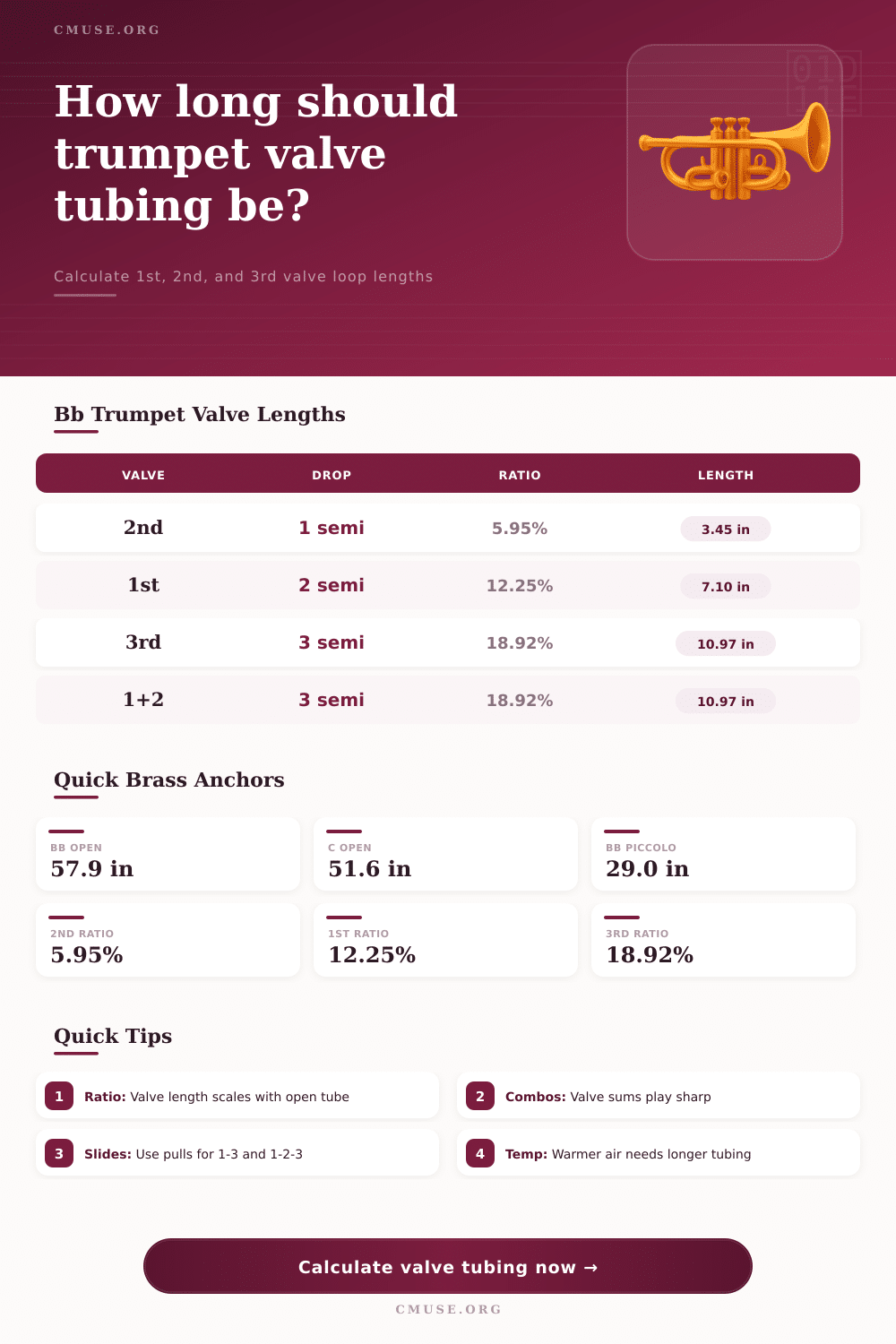
| Valve | Drop | Ratio to Open Tube | Cut Length | Metric Equivalent |
|---|
| Interval | Semitones | Length Ratio | Common Valve Use |
|---|---|---|---|
| Half step | 1 | 5.946% | 2nd valve |
| Whole step | 2 | 12.246% | 1st valve |
| Minor third | 3 | 18.921% | 3rd valve |
| Major third | 4 | 25.992% | 1st plus 3rd target |
| Perfect fourth | 5 | 33.484% | 1st plus 2nd plus 3rd target |
| Instrument | Open Pitch | Approx Open Length | Typical Bore |
|---|---|---|---|
| Bb trumpet | Bb2 | 57.9 in / 147.2 cm | 0.459 in / 11.66 mm |
| C trumpet | C3 | 51.6 in / 131.2 cm | 0.462 in / 11.73 mm |
| D trumpet | D3 | 45.9 in / 116.9 cm | 0.450 in / 11.43 mm |
| Eb trumpet | Eb3 | 43.4 in / 110.3 cm | 0.450 in / 11.43 mm |
| A piccolo trumpet | A3 | 30.7 in / 78.0 cm | 0.450 in / 11.43 mm |
| Bb piccolo trumpet | Bb3 | 29.0 in / 73.6 cm | 0.450 in / 11.43 mm |
| Combination | Nominal Drop | Required Total Length | Extra Needed | Slide Note |
|---|
| Type | Common Bore | Tubing Character | Length Caution |
|---|---|---|---|
| Medium-large Bb trumpet | 0.459 in / 11.66 mm | Standard modern reference | Use normal slide trim allowance |
| Large-bore Bb trumpet | 0.462 in / 11.73 mm | Slightly broader air column | Check tuning with chosen leadpipe |
| C trumpet | 0.462 in / 11.73 mm | Shorter bugle than Bb | Valve loops shrink with open length |
| Cornet | 0.460 in / 11.68 mm | More conical wrap path | Measure centerline through crooks |
| Flugelhorn | 0.413 in / 10.49 mm | Wider conical expansion | Use calculator as acoustic starting point |
Once you input your instrument specs the calculator do all of the work and you can spend less time guessing what coefficient to apply.
For trumpet players in particular there’s always some frustration if their low C sounds great by itself but then goes sour as soon as they touch first valve. Usually it has nothing to do with air support or how your embouchure sits on horn. It’s physics fighting back.
Why Trumpets Go Out of Tune
Brass instruments creates sound by tricking sound waves to stand still inside a tube. Each time you push a valve down to lower the pitch, you’re adding length to that tube. That added length must be exactly right, otherwise the note will sit sharp enough to ruin your tone. This really points back to what happens when combining valves.
If you’re most players, you will be familiar with the fact that the first valve reduce the pitch by a whole step and the second one by a semitone. You follow that through and think that two valves must reduces the note by a minor third; after all, that’s logical. That’s where the acoustics kick-in.
The first valve extend the length of main bore. The second valve loop adds its fixed length to a tube that has already grown longer from the first valve. It means that each subsequent valve add to the compound error. Low F or C commonly sounds out of tune even though the valves may well be correctly sized for single-note playing.
This equation is surprising because it’s so dependent off temperature. And that’s where the tool gets its information from you: the air temperature before it calculates. In warm air, sound travels faster. In colder air (a cool practice room or a cold concert hall), speed of sound decreases. A shorter path are needed to produce the same frequency. Warm air and warm bodies cause the trumpet to expand its effective length. Sound-wise, then, brass instrument isn’t as rigid as you may have thought. It breathes with the room.
Whilst bore size do affect the raw length calculation, which would of been correct if we used a standard Bb trumpet, its impact on the sound of the instrument makes it worth noting that it’s not as important than you may think. You will need to blow harder into a large bore trumpet for it to speak effectively. It also means the trumpet can warm up quicker from your body heat making fine tuning adjustments slightly more difficult. The calculator therefore allows you to enter the bore diameter of your own instrument so the result match your individual trumpet. This works whether you have a compact piccolo or a medium bore professional horn.
It helps advanced players and workshop technicians know exactly how much tubing to add or remove when maintaining their instruments. The valve combination problem has been dealt with over time with attempts at automatic solutions through compensation systems. Most current trumpets includes additional loops in the first and third valves that only connect when certain combinations is pressed. The purpose of these loops is simply to provide enough extra length to compensate for the sharpness caused by physics of parallel tubing.
If you know how far to pull your tuning slide, then you know whether or not your horn’s compensation system works as it should, and/or may need adjusting. This is also why you see players sometimes pull their tuning slide out on a compensated horn for low notes.
The trumpet then is both a work of engineering and art. As an engineer, you might possess the finest techniques imaginable. Yet, if the tubing measurements is out by two millimetres, you’ll struggle to make good intonation regardless of your efforts.
These figures provide a starting point that accepts the laws of acoustics whilst being realistic about the conditions under which we perform. They convert guesses into information. Once you know that the tube must be precisely three point four five inches for a semitone drop at room temperature, you’re no longer struggling against the instrument. Instead, you’re partnering with it. Sometimes your ears can deceieve you but not the numbers.