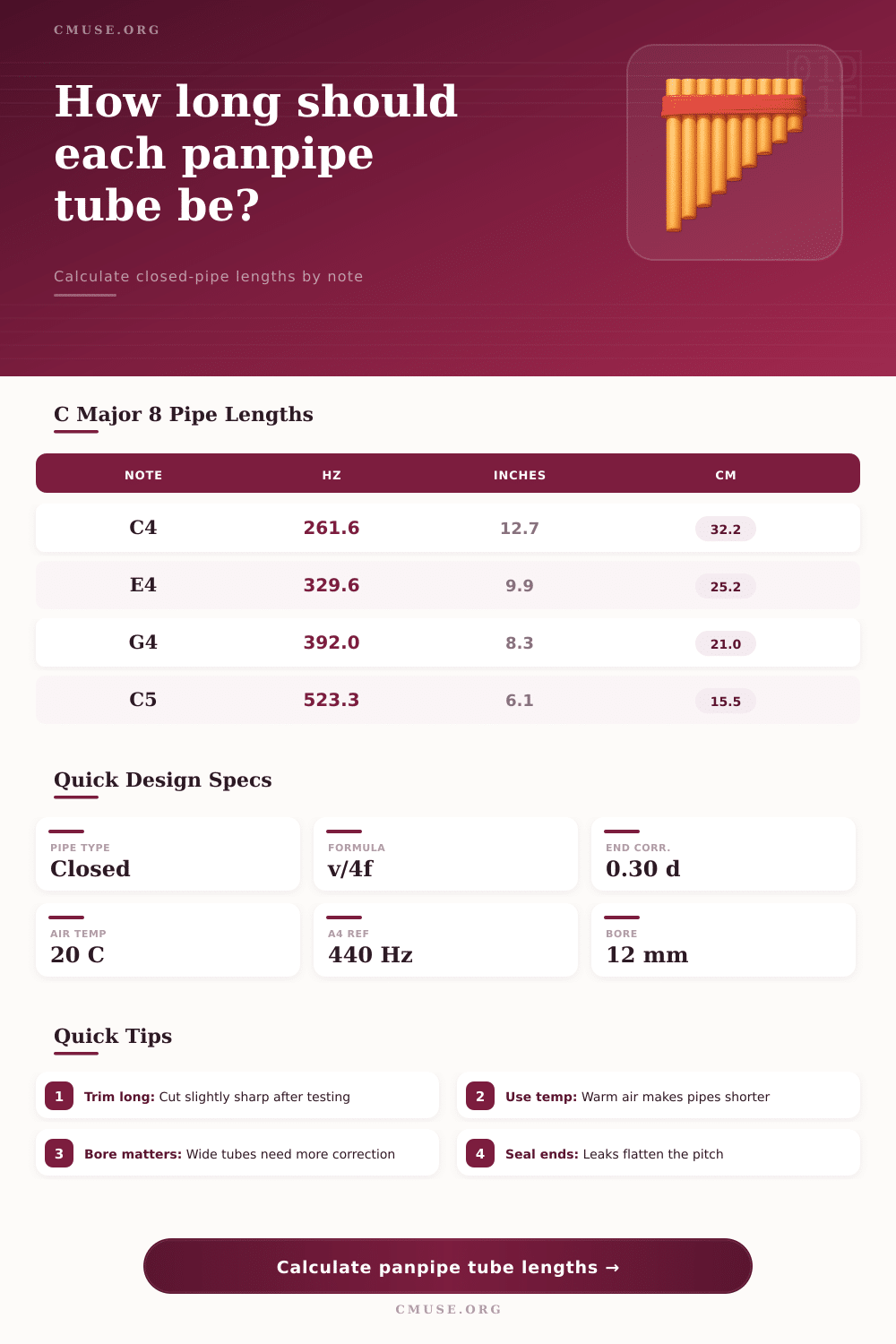
Panpipe Tube Length Calculator
Size closed-end panpipe tubes from note, air temperature, bore diameter, and open-end correction.
Calculation Breakdown
| Tube | Note | Frequency | Effective Length | End Correction | Cut Length |
|---|
Cut lengths are physical tube lengths before final voicing. A real pipe is usually left a little long, tested, then trimmed upward in pitch.
| Open End Type | Multiplier | When It Fits | Length Effect |
|---|---|---|---|
| No correction | 0.00 x d | Pure formula check only | Longest cut |
| Narrow blowing edge | 0.25 x d | Small bore or sharp lip | Slightly shorter |
| Typical open rim | 0.30 x d | Common panpipe estimate | Reliable start |
| Rounded mouth | 0.36 x d | Softer rolled rim | Shorter cut |
| Flanged or thick rim | 0.41 x d | Heavy wall or broad lip | Shortest cut |
| Note | Frequency | Quarter Wave | 0.30 d Correction | Cut Length |
|---|---|---|---|---|
| G3 | 196.00 Hz | 43.76 cm | 0.36 cm | 43.40 cm |
| A3 | 220.00 Hz | 38.99 cm | 0.36 cm | 38.63 cm |
| C4 | 261.63 Hz | 32.79 cm | 0.36 cm | 32.43 cm |
| E4 | 329.63 Hz | 26.02 cm | 0.36 cm | 25.66 cm |
| G4 | 392.00 Hz | 21.88 cm | 0.36 cm | 21.52 cm |
| C5 | 523.25 Hz | 16.39 cm | 0.36 cm | 16.03 cm |
| Layout | Tube Count | Typical Range | Best Use |
|---|---|---|---|
| Small pentatonic | 6 | Root to octave | Simple folk phrases |
| Diatonic octave | 8 | Root to octave | General melody |
| Extended diatonic | 13 | Root to high sixth | Two-hand panpipes |
| Chromatic octave | 12 | 12 semitones | Accidental notes |
| Wide alto set | 15 | Two octaves | Flexible solo range |
| Air Temp | Sound Speed | C4 Quarter Wave | Build Note |
|---|---|---|---|
| 10°C / 50°F | 337.36 m/s | 32.22 cm | Longer than warm-room tuning |
| 20°C / 68°F | 343.42 m/s | 32.79 cm | Common room reference |
| 25°C / 77°F | 346.45 m/s | 33.10 cm | Slightly longer calculated tube |
| 30°C / 86°F | 349.48 m/s | 33.39 cm | Hot workshop reference |
| Preset | Root | Pattern | Tubes | Practical Span |
|---|---|---|---|---|
| C Major 8 Pipes | C4 | Major | 8 | C4 to C5 |
| G Major 10 Pipes | G3 | Major | 10 | G3 to B4 |
| A Minor 8 Pipes | A3 | Natural minor | 8 | A3 to A4 |
| C Chromatic 12 Pipes | C4 | Chromatic | 12 | C4 to B4 |
| Alto D 15 Pipes | D4 | Major | 15 | D4 to D6 |
In reality, most wood workers simply guess at tube lengths and find their panpipe is flat. The reason for this is that, unlike a piece of solid material, air move and takes up space. It also responds very sensitively to temperature in the workshop.
It’s best not to cut until you gets the calculation correct. It is a sort of pitch to length converter. It’s up to you how many pipe there are and what they is tuned to (what note you want as root note and what sort of scale pattern). Then the computer calculates the frequencies required for each pipe.
Why You Should Use a Calculator for Panpipes
Because sounds travel more quickly through warm air then cold, it is inaccurate if the temperature change. What works in a cool basement will be sharp sounding compared to a hot day. The tool also recalculates speed of sound based off your data. This ensures the cut lengths match where you intend to play them.
The other thing that alters pitch is bore diameter. You have what’s known as end correction on a pipe. I.e., the air vibrating in front of open end acts as though the pipe are longer than it is. To correct for that, the calculator has a multiplying factor to account for bore size and rim thickness. Thinner walled PVC need less correction; wide bamboo needs more.
If you don’t do this, all the pipes will be a little too sharp, which ruins the harmony. The above reference table shows the effect of rim shape on correction. Airflow separates at distinct locations along a sharp and a rolled edge. These coefficients is not something to memorize. Instead, just know they exist. That way, if tuning fails because of physics, you would of not blame yourself for being a bad craftsman.
The output includes a cut list with starting lengths purposely made longer. That’s by design since you can always trim, but not easily extend.
If you think about it, the material makes a difference too but not to the math. Bamboo is naturaly inconsistent due to varying wall thicknesses and irregularities. Seek consistent diameter and straight grain. Nodes close to blowing end cause turbulence, and partial closures within the tubing will affects the tone. Check your tubing first. Minor flaws in wood may be forgiven with a slightly larger bore. Every little flaw will be amplified on a narrow bore.
Also consider temperature stability. An instrument made in your heated workshop sound out of tune when played outdoors on a cool day. Some makers make their instruments days in advance to allow them to adjusts to the environment. Others build with a slightly lower reference pitch knowing the wood will warm up at performance time. Even this subtle change make a difference between amateur and professional.
Building panpipes is an exercise in measured testing. That’s where this calculator eliminate any guesswork from starting measurements. From there it’s all about listening and adjustment. Trim a millimeter, listen to the pitch, trim again. When physical form meets acoustic intention, the instrument speak for itself. Numbers get you started. Your ears bring you home.