Bouzouki Scale Length Calculator
Check Greek, Irish, and octave mandolin scale lengths, bridge compensation, fret positions, and paired-course tension from one practical worksheet.
Presets load common bouzouki families and tunings; edit any value afterward for your instrument or build plan.
Scale Breakdown
| Course | Note | Gauge Pair | Single Tension | Course Tension | Scale Effect |
|---|
| Fret | From Nut | From Previous | Remaining Scale | Check Point |
|---|
| Instrument | Typical Scale | Common Tuning | Character |
|---|---|---|---|
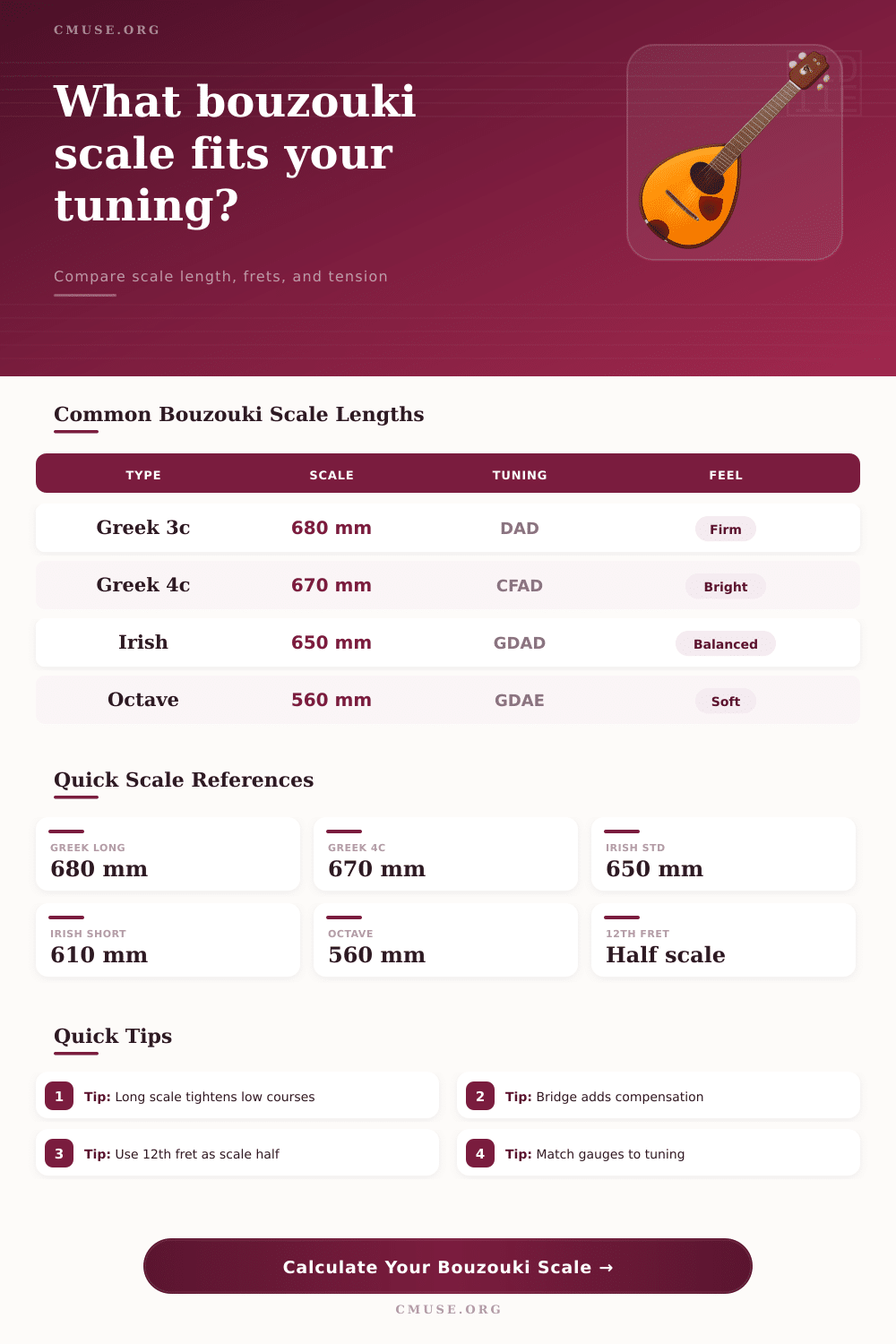
| Greek trichordo bouzouki | 670–700 mm / 26.4–27.6 in | DAD, doubled courses | Long, projecting, firm response |
| Greek tetrachordo bouzouki | 660–680 mm / 26.0–26.8 in | CFAD, 4 courses | Bright treble with strong bass |
| Irish bouzouki | 610–670 mm / 24.0–26.4 in | GDAD or GDAE | Open drones, balanced chord stretch |
| Octave mandolin | 530–585 mm / 20.9–23.0 in | GDAE | Softer reach, warmer attack |
| Long-scale cittern | 640–700 mm / 25.2–27.6 in | Open or fifths-based | Clear bass and piano-like sustain |
| Scale Choice | Best Match | String Feel | Fret Reach | Use When |
|---|---|---|---|---|
| 560 mm / 22.0 in | Octave mandolin | Lower tension | Compact | You need mandolin-like reach |
| 610 mm / 24.0 in | Short Irish | Moderate | Easy chord shapes | GDAD comfort matters most |
| 650 mm / 25.6 in | Standard Irish | Balanced | Familiar guitar-like span | You want open drones and clarity |
| 670 mm / 26.4 in | Greek 4-course | Firm | Longer stretch | Projection and bright attack matter |
| 690 mm / 27.2 in | Greek 3-course | Very firm | Wide first position | You want classic long-scale snap |
| Tuning | Courses | Typical Gauges | Scale Range | Notes |
|---|---|---|---|---|
| GDAD | 4 | .012 .016 .026w .042w | 610–660 mm | Popular Irish open tuning |
| GDAE | 4 | .012 .020w .032w .046w | 540–650 mm | Fifths tuning, wider tension spread |
| DAD | 3 | .011 .014 .032w | 670–700 mm | Greek trichordo layout |
| CFAD | 4 | .010 .014 .022w .030w | 660–680 mm | Greek tetrachordo layout |
| ADAD | 4 | .014 .018 .030w .046w | 630–670 mm | Low drone tuning, watch bass tension |
| Layout Point | Formula | What It Checks | Typical Tolerance |
|---|---|---|---|
| 12th fret | Scale / 2 | Primary octave location | Within 0.2 mm |
| Bridge scale line | Nut to saddle witness point | Speaking string length | Measured before compensation |
| Saddle placement | Scale + compensation | Room for intonation | 2–5 mm behind scale |
| Last fret | Equal temperament | Clearance to soundhole or body | Depends on design |
| First fret span | Fret 1 distance | Left-hand reach | Shorter is easier |
A bouzouki seems straight-forward. That is, until you try to tune it or build one. There’s a balance between tone production and comfort when playing an instrument. You want strings that ring out cleanly while not being too hard on your hands. This is mostly influenced by length of scale. Longer scales produce greater tension in the strings. This impacts string clarity and fret placement, which ultimately affects chord clarity. If you choose a scale length that is inappropriate for a bouzouki, you might spend weeks chasing intonation problems that are actualy structural issues.
Beginners tend to go by what they see on the internet. For an Irish person, that’s 650mm. For a Greek, it’s more like 680. Other considerations is not taken into account there. Scale length, pitch, and string gauge all affect string tension. Changing just one of these will make your instrument unplayable unless you also adjust the others to match. Moving from a short-scale travel bouzouki to a long neck Greek bouzouki will result in a stiff new instrument if you don’t change the strings too. The calculator above does that math for you immediately. The connection between three variables appears before you’ve even thought about cutting any wood or purchasing strings.
How to Tune and Build Your Bouzouki
Compensation can be problematic for amateurs. Half of the total scale length is at twelve fret mark. This is the home of that first octave. But the truth is music is not linear. As a string gets close to the body when fretted it will have some slight stretch. That stretch exerts a force on the pitch making it go sharp. To compensate luthiers slide the saddle a few millimeters backwards. Thicker strings stretch more under tension, so they need more compensation. You’ll see on the tool exactly how much the witness point should of be from the nut. It stops you from having to guess if your sharp intonation is by design or is a setup issue.
Number of strings The instrument family matter just as much as the raw numbers. On a Greek bouzouki, they frequently have 3-4 courses but these are all played together either in octaves or in unison. These will need different string gauges compared to Irish setup. An octave mandolin is tuned in fifths and this spreads the tension along the neck. When choosing a pre-set on an instrument being built to order, it anchors your expectations so you know what is normal to begin with and then you can tweak from there.
Adjusting the gauge or desired tension can show you what impact that has on overall load. The effect on structural integrity comes down to total tension. If there is too much tension, the instrument will eventually go out of alignment. Scale length changes fret spacing. Longer scale = wider space between frets in the first position; a bummer if you have little hands, but better for rapid runs in the upper positions. Shorter scale crowds those lower frets closer together, which simplifies chord shapes, but takes away some accuracy at the top end of the neck. The chart clearly displays distance and helps you visualize whether or not your hand span will fit the desired geometry.
There is no such thing as the right scale length. It is just the one that fits your physical limitations and musical goals. Stringing up something out of the norm can be challenging. Not all strings will fit a short scale. For example, you don’t want the heaviest set that fits because it won’t bend. But if you use lighter strings on a longer scale they’re floppy and sound weak. The trick is finding a middle ground where the tension feels consistent across all courses without making them too heavy or to light. Often this means going with hybrids or even mixing gauges based off scales. Then plug it in and you’ll see tension by course on the screen. Balance it from there. So if the high strings buzz but the lows drag the neck down, then you need to adjust accordingly. Your gauge doesn’t match your scale. Mess with the input till the numbers add up to your comfortablty zone.
There’s no such thing as a perfectly built or set-up bouzouki. There will always be some compromise between the need for perfect intonation, minimal hand fatigue, and maximum sound projection. Your job is to minimise the ones that are most important to you. Perhaps that’s due to the attack of strings for solo playing, or the ease of chord changes for traditional session work. Either way, it’s all about measurement, calculation, and then confirmation of the compensation required. If it makes sense on the drawing board, it usually does in practice too. Knowing where that twelve-fret mark realy resides is a good place to start.