Partial Capo Position Calculator
Test a partial capo fret, see which strings are raised, compare drone notes, and find the strongest fret for a target key.
Calculation Breakdown
| Fret | Open Tuning | Shape Center | Drone Tones | Fit |
|---|
| Pattern | Covered Strings | Typical Fret | Standard-Tuning Result | Main Use |
|---|---|---|---|---|
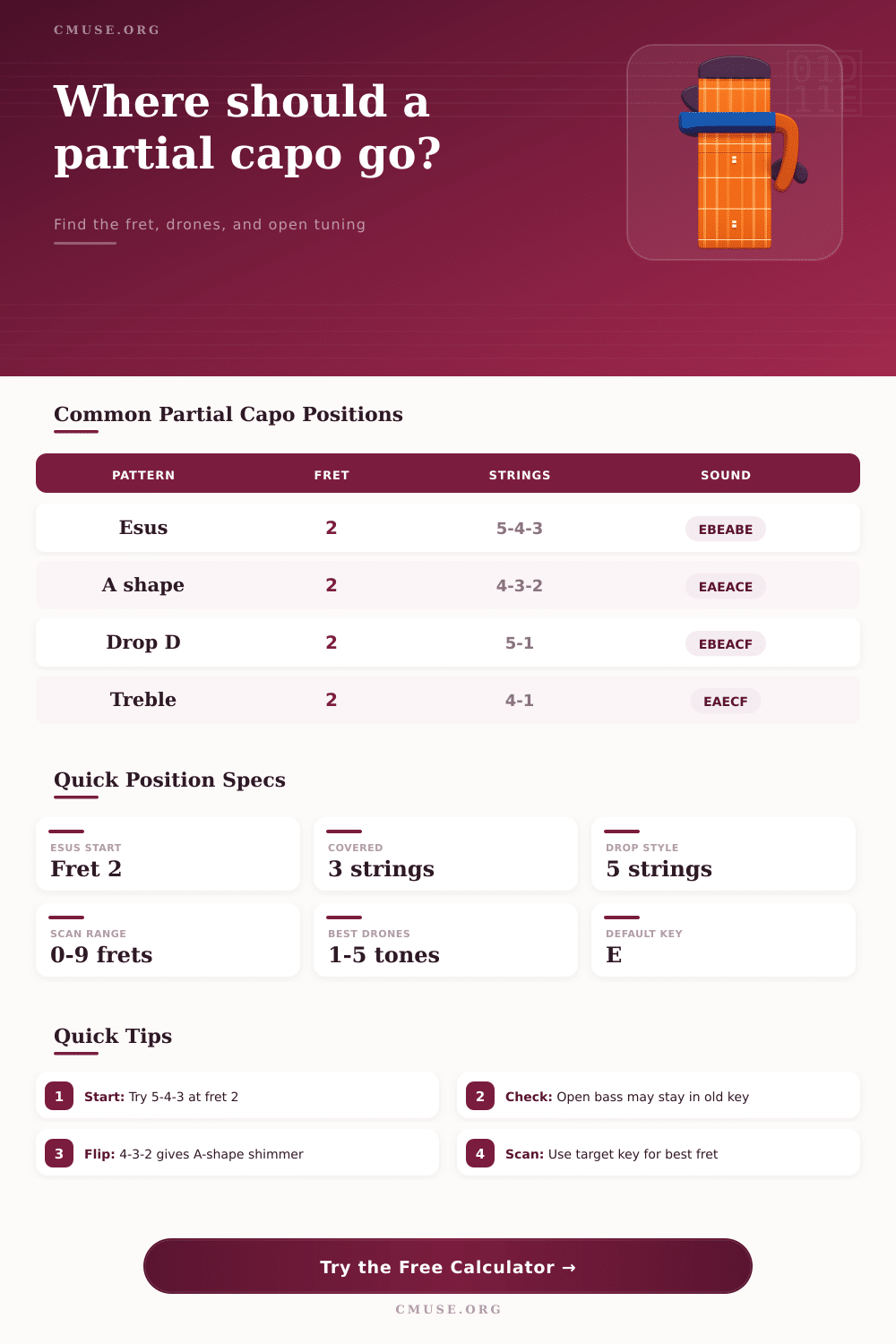
| Esus / DADGAD-style | 5-4-3 | 2 | E B E A B E | Suspended E drones |
| A-shape flip | 4-3-2 | 2 | E A E A C# E | Open A-family shimmer |
| Drop-style 5-string | 5-4-3-2-1 | 2 | E B E A C# F# | Low E drone under raised top |
| High-bass 5-string | 6-5-4-3-2 | 2 | F# B E A C# E | High E drone above raised bass |
| Treble 4-string | 4-3-2-1 | 2 | E A E A C# F# | Upper-register sparkle |
| Bass 4-string | 6-5-4-3 | 2 | F# B E A B E | Raised bass against open top |
| Shape Root | Fret 0 | Fret 2 | Fret 4 | Fret 5 | Fret 7 |
|---|---|---|---|---|---|
| E shape | E | F# | G# | A | B |
| A shape | A | B | C# | D | E |
| D shape | D | E | F# | G | A |
| G shape | G | A | B | C | D |
| C shape | C | D | E | F | G |
| Interval to Key | Sound | Score Role | Partial Capo Use |
|---|---|---|---|
| Root / octave | Stable | Strongest | Anchor bass or melody string |
| Perfect fifth | Open and consonant | Very strong | Great for folk and rock drones |
| Major or minor third | Chord-defining | Moderate | Works when the song mode is clear |
| Second or fourth | Suspended | Useful color | Classic Esus and DADGAD-style sound |
| Flat second, tritone | Tense | Low score | Use intentionally for color only |
| Preset | Base Tuning | Pattern | Fret | Target | Why It Works |
|---|---|---|---|---|---|
| Classic Esus Fret 2 | E standard | 5-4-3 | 2 | E | Low E and top E stay open |
| A Shimmer Fret 2 | E standard | 4-3-2 | 2 | A | A and E drones frame C# |
| Drop-Style E Drone | E standard | 5-1 | 2 | E | Low E remains un-capoed |
| Drop D Esus Color | Drop D | 5-4-3 | 2 | D | Low D stays as root drone |
| Baritone B Drone | Baritone B | 5-4-3 | 2 | B | Low B and top B stay open |
The use of a partial capo in folk music has given rise to the unique sound that comes from having some strings at their regular pitch while other string are raised into a drone string. This produces an even richer ring and wider sound different than ordinary chords, although it is hard to get the positioning just right as it can be dissonant.
What’s required here is something to try out your options before securing the device in place. It saves you from wasting time trying things out.
How to Use a Partial Capo Calculator
Partial Capos don’t obey traditional rules of transposition; this is the primary difficulty with them. You place a complete capo two frets higher and all strings will rise a full tone. They are still in the same key, just pitched higher. With a partial capo, this isn’t the case. It divides your guitar into two separate worlds of tuning at the same time. Strings underneath the capo leap forward to fit the changed pitch while open strings remain as written.
The result is a sort of hybrid tuning that can be beautiful, or chaotically so, depending on which way you direct the clamp. Typically most people begin with what’s known as the Esus pattern that clamps down on the A, D, and G strings at the second fret. Why? Well, it’s safe since those strings gives you a solid root note of E but let the other two open string ring out over the top, giving you an E major sound. But say you wish to try something a little darker like DADGAD or perhaps play in A major instead? Then you’ll have to adjust either the clamp or the selection of strings it covers.
That’s where this calculator comes into its own. You can quickly visualise these combinations so you can see exactly which notes will be ringing out before you strum. No more guessing about which fret might clash with your desired key.
The other input, which can easily be forgotten, is the tuning of your instrument. While a partial capo sounds completely different over standard E versus Drop D or Open G. Leaving an open low E open will create a totally different drone than leaving an open low D string open if you’re playing in Drop D. With this tool, you can switch back and forth through available tunings and observe the differences it makes with each chord. That’s important since so many moddern players use alternate tunings to increase their voicings and a partial capo increases those possibilities exponentially.
The tool helps you see which notes will ring out so you don’t have to guess if a fret will clash with your target key. So what’s the deal with drone fit? To get the idea, just think about what sounds right and what doesn’t. You want your open strings to fall on notes that is part of the key you’re playing in, such as the fifth, the third, or even the root note itself. When you try to play a major chord but instead find that one of the open strings has landed on a flat seventh or sharp fourth… well, that’s going to feel like tension… and not the kind you want. This table spells out which intervals help make it work and which cause messy clashes so you can tell where those cool suspended colors comes from.
The other thing is that position isn’t fixed, and when you move a partial capo around it can change things quite drastically harmonically. You get whole steps on the second fret. Seventh, you’re in another world of completely different modal sounds or minor keys. And then the scan feature lets you see across a range of frets until you get to the sweet spot where you’re getting those same chord shapes but the drone’s adding something else altogether. How high up the neck will you go and still have playable voicings? You might go further then you thought.
Partial capos are one of those strange tools for many guitar players who shuffle ’em all about and hope they land on something interesting. There’s nothing wrong with experimentation but knowing how it works speeds things up. You begin to learn its patterns: for example, if you cover the treble strings then you get a drone in the bass lines; lift the bass strings and you have a more jangly, lighter tone across the top end. That becomes arranging rather than just discovering at random.
But it’s about expanding your palette while keeping the technique simple. No need to learn them all. Just find a couple, or even one spot, that sounds like what you hear in your head when you think “shimmer. And then the math gets taken out of the tool, so you can spend more time feeling it, instead of guessing how it works.
From there, when you understand what strings move and don’t move, the sound is no longer a mystery but a choice. This makes an otherwise pretty accident a repeatable trick.