Intonation Offset Calculator
Convert a measured fretted pitch error into saddle travel, nut offset, screw turns, corrected scale length, and tuner tolerance.
Calculation Breakdown
| Measured Result | Saddle Correction | Nut Correction | Retune Step |
|---|---|---|---|
| Fretted note sharp | Move saddle back, away from nut | Move nut toward first fret | Retune open string down to pitch |
| Fretted note flat | Move saddle forward, toward nut | Move nut slightly away from first fret | Retune open string up to pitch |
| Within 1 cent | No mechanical move needed | No mechanical move needed | Confirm with a light touch |
| Error changes sign | Reverse half the last move | Reverse half the last move | Retest after settling |
| Instrument | Scale | 1 Cent Move | 10 Cent Move | Best Test |
|---|---|---|---|---|
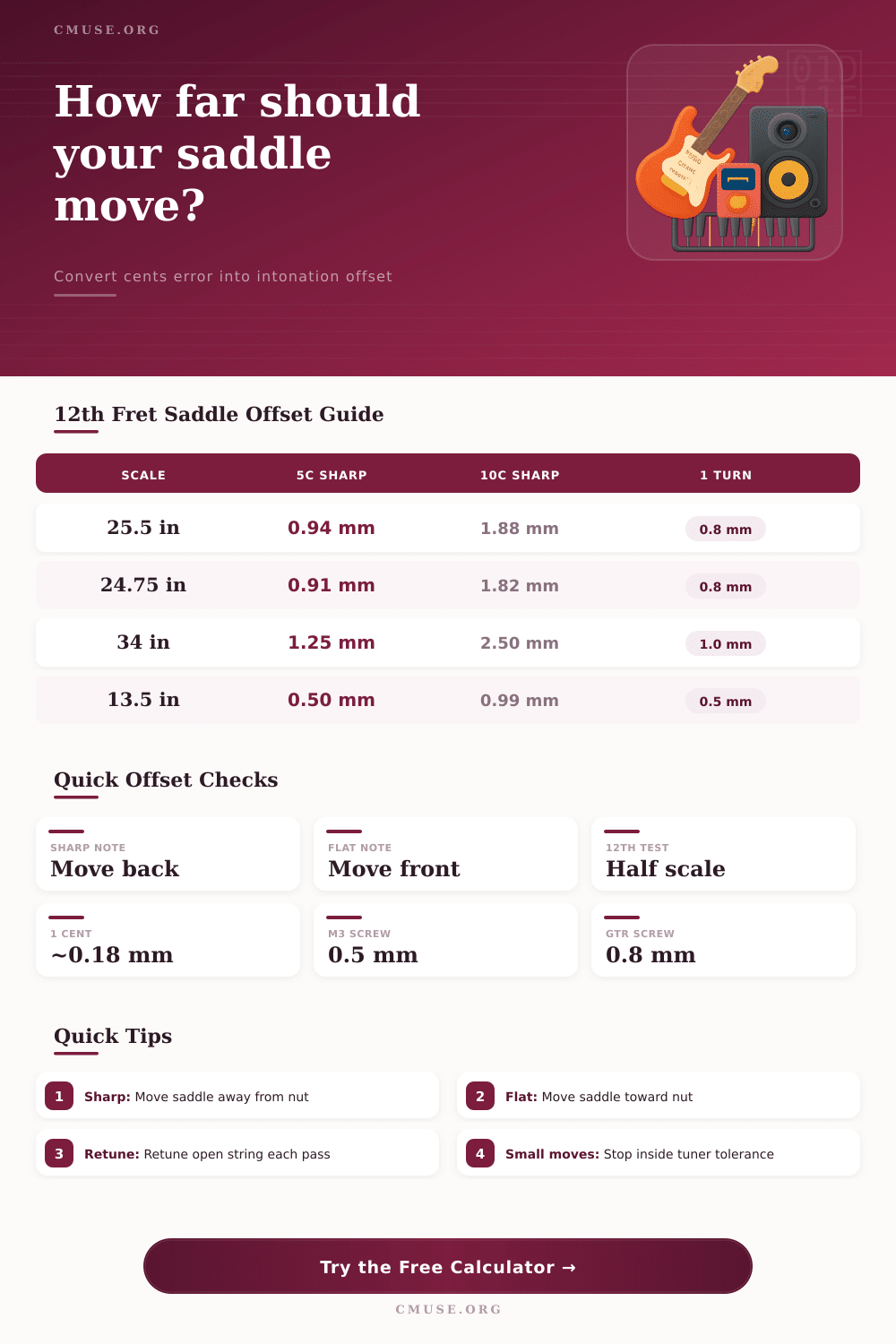
| Strat / Tele guitar | 25.5 in / 648 mm | 0.187 mm | 1.88 mm | 12th harmonic |
| Les Paul guitar | 24.75 in / 629 mm | 0.182 mm | 1.82 mm | 12th harmonic |
| Long-scale bass | 34 in / 864 mm | 0.250 mm | 2.50 mm | 12th harmonic |
| Baritone guitar | 27 in / 686 mm | 0.198 mm | 1.99 mm | 12th harmonic |
| Classical guitar | 25.6 in / 650 mm | 0.188 mm | 1.88 mm | 12th harmonic |
| Soprano ukulele | 13.5 in / 343 mm | 0.099 mm | 0.99 mm | 12th harmonic |
| Adjuster Type | Pitch / Turn | 1 mm Move | Typical Use |
|---|---|---|---|
| M3 metric screw | 0.50 mm | 2.00 turns | Tune-o-matic, import bridges |
| M4 metric screw | 0.70 mm | 1.43 turns | Bass and heavier saddles |
| 6-32 UNC screw | 0.79 mm | 1.27 turns | Many vintage-style bridges |
| 4-40 screw | 0.64 mm | 1.57 turns | Small bridge hardware |
| Floyd-style saddle | Manual slide | Measure travel | Lock, move, retune, repeat |
| Adjustment | Best For | Measurement | Watch Point |
|---|---|---|---|
| Saddle offset | 12th-fret intonation | Harmonic vs fretted note | Open string must be retuned |
| Nut compensation | Low-fret sharpness | Open vs 1st or 3rd fret | Nut slot height changes result |
| Bridge relocation | No saddle travel left | Average of all strings | Preserve break angle |
| Temperament choice | Sweetened setups | Target cents per string | Document the offsets used |
| Scenario | Pitch Error | Offset | Screw Turns | Status |
|---|
Intonation tends to be taught to guitarists as a matter of trial and error if playing a major chord up the neck. The problem occurs in the sound of the chord. It sounds out of tune because high E string is sharp, which creates a dissapears within the chord. You may attempt to correct it by using your allen key to turn the saddle adjustment screw. However, you might find little if any difference and wonder what you should of done differently. This can only lead to frustration because you were guessing rather than calculating how far and in what direction you need move the saddle.
How does this work? The basic physics are simple yet prone to misinterpretation. When you fret a string, you stretches it slightly. As that string stretch, the pitch go up. To fix this effect, you has to adjust the saddle further away from the nut to lengthen the speaking section of the string. Without factoring in this string stretch, all your chord will be sharp when played higher on the neck.
How to Fix Guitar Intonation
Luckily, you don’t have to memorize logarithmic equations; all you need to enter into the calculator are the scale length and the amount of error you want to correct. Begin by tuning your open string perfectly. Set a reference pitch by playing the string’s harmonic at the twelfth fret. It will divide the string in half while creating no additional tension on the string. Finally, place your finger firmly on the twelfth fret.
Is the tuner indicating that the fretted note is flat? Move the saddle forward. If it is sharp, you need to move the saddle back. You’re moving the saddle back. Where many players err here is determining how far to adjust. On a twenty-five-inch scale, a six-cent mistake means almost one whole millimeter of movement. It sounds like a small amount, but it is actualy several complete turns of the smallest adjustment screws found on most bridge. For instance, if you use a bridge from overseas that’s not fine-threaded or something old, like a vintage-style bridge that uses coarse thread, then the tool will convert those numbers to how far it’s supposed to be moved in terms of how many turns of the screw are required.
Let’s say you have an adjuster that’s got 0.8 millimeters of movement for every turn. Instead of just blindly turning the thing until the tuner lights up, you’ll now be able to dial in exactly how much it need to be moved. It also takes the kind of strings you’re tuning into account. Plain steel strings aren’t going to move the same way wound strings does. A classical guitar that has nylon strings have its own special stretch properties too. So the tool considers all of these things and makes adjustments so its output matches your actual instrument.
This leads me to the other error: failing to re-tune the open string following each change. Each time you adjust the saddle, you alter the tension on the string and the open note’s pitch lower. So when you’re comparing the old pitch against the new fretted position, your numbers will not reflect reality. Before repeating this step, you’ll need to tune the open string to pitch. Then, check the fretted note a second time. The second pass is typically a lot less than the first as most of the correction occur during the first pass. It’s tedious, but this repeating approach are the only way to get true intonation.
You’re only going to be able to bend that saddle as far back as it goes, too. At some point, you’ll either hit edge of your bridge plate or reach the end of your adjustment screws and turning it won’t do anything else. It’s time for a new nut position or maybe a taller saddle in those situations. Fortunately, there’s a travel check built into the calculator which tells you when what you want is beyond the physical limits of the hardware you’ve got. This way, you avoid stripping threads while chasing a cent of accuracy that your bridge simply can’t provide.
In short, it is all about balance. What sounds best may not be perfectly moddern mathematically accurate written down, particularly when transitioning from one type of chord to another, such as from an open to a barred chord. For some, small compromises are made so they can play up and down the neck more comfortabley on the guitar. Your ear decides when to stop and the calculator shows you where the exact target is. With this knowledge, the amount of movement required to change a particular pitch comes into control, instead of the instrument fighting back against you. That previously fatal six cent error now becomes a twist of a dial. No longer guessing, you’re adjusting confidently, aware of every click of the screw and how it will impact the sound emerging from the amp.