Gut String Tension Calculator
Estimate natural gut string tension from speaking length, pitch, diameter, density, and pitch standard.
Calculation Breakdown
| Gut Type | Density | Tension Effect | Typical Use |
|---|---|---|---|
| Plain natural gut | 1.30 g/cm³ | Baseline | Violin family, lute, harp |
| Rectified gut | 1.31 g/cm³ | Very close to plain | More uniform diameter sets |
| Varnished gut | 1.28 g/cm³ | Slightly lighter | Moisture-protected trebles |
| High-twist gut | 1.25 g/cm³ | Lower tension at same size | Flexible upper strings |
| Loaded gut | 1.75 g/cm³ | Higher tension at same size | Lower pitches without huge diameters |
| Heavy loaded gut | 2.10 g/cm³ | Much higher mass | Bass strings and short scales |
| Scenario | Scale | Pitch | Diameter | Typical Tension |
|---|---|---|---|---|
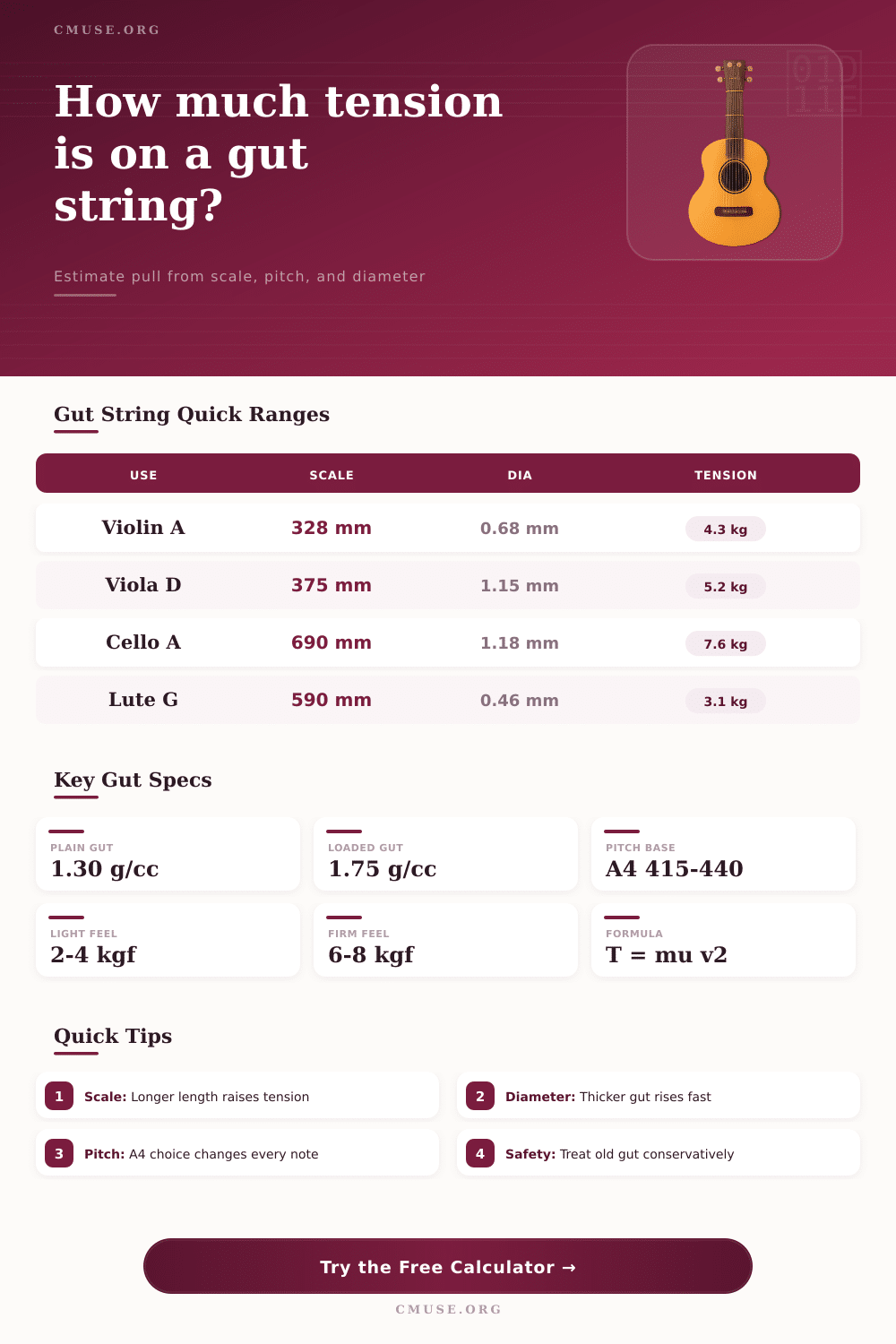
| Baroque violin A | 328 mm | A4 at 415 | 0.68 mm | About 4 kgf |
| Baroque viola D | 375 mm | D4 at 415 | 1.15 mm | About 5 kgf |
| Baroque cello A | 690 mm | A3 at 415 | 1.18 mm | About 7 kgf |
| Classical guitar E1 | 650 mm | E4 at 440 | 0.72 mm | About 7 kgf |
| Renaissance lute G | 590 mm | G4 at 440 | 0.46 mm | About 3 kgf |
| Lever harp C | 350 mm | C4 at 440 | 0.90 mm | About 4 kgf |
| Note | Frequency at A4 415 | Frequency at A4 440 | Common Gut Role |
|---|---|---|---|
| G2 | 92.50 Hz | 98.00 Hz | Low lute course |
| C3 | 123.47 Hz | 130.81 Hz | Cello C, oud bass |
| G3 | 185.00 Hz | 196.00 Hz | Violin G, lute course |
| D4 | 276.96 Hz | 293.66 Hz | Viola D, violin D |
| A4 | 415.00 Hz | 440.00 Hz | Reference pitch |
| E5 | 621.92 Hz | 659.25 Hz | Violin top pitch |
| Single String Tension | Feel | Best Context | Check Closely |
|---|---|---|---|
| 1.5–3.0 kgf | Very light | Lute trebles, delicate courses | Buzzing or weak response |
| 3.0–4.8 kgf | Light to normal | Violin-family gut trebles | Pitch stability after stretch |
| 4.8–7.0 kgf | Medium | Viola, guitar, harp mid strings | Bridge and top movement |
| 7.0–10.0 kgf | Firm | Cello upper strings, strong guitar trebles | Older instruments and pegs |
| Over 10 kgf | High | Special bass or long-scale setups | Seek instrument-specific limits |
Silence is a unique sound, particularly when it come suddenly in the form of a snapped gut string. It reminds us that we’re working with stressed biology. Adjusting an instrument’s tuning are all about finding balance between physical forces and delicate animal intestine. Knowing how hard your strings pull on wood can be the distinction between a good note or one that isn’t so good…or not at all.
Tension is something most of us leave as a mystery. We think, “This string is too hard” or “too soft,” and then adjust it until it feels right without ever wondering why. Enter the calculator (above) which takes care of all the math when you enter your pitch standard and scale length. No more guesswork with conversions and coefficients.
Why Gut Strings Snap
But where the calculator realy pays off is knowing what these inputs mean. Diameter and density are the variables that raises or lower tension. Pitch is what you’re aiming for. And scale length becomes the fixed anchor since you can’t alter the space between nut and bridge without rebuilding the instrument.
This is where many of us go awry. A thicker string sound lower in pitch, and its tension also increase as the square of its diameter. So a doubling of thickness equate to a quadrupling of the pulling force. A small error in estimating the gauge of a plain gut string can push tension from four kilograms into eight. On a baroque violin or a lute, this added weight risk cracking the scroll or warping the top. This is not a good position mechanically speaking.
Another factor is density which is disregarded by today’s steel strings. Plain natural gut can be very different than rectified, ranging from varnished to wrapped in metal windings. As the table of references show, loaded guts are like thicker material but in a smaller package. They’re used where a thick string isn’t required to produce lower pitches. But the consequence is increased mass per millimetre. This means greater tension must be applied to achieve the same note then would be the case with a thinner plain gut. Substituting a loaded A string for a plain one without consulting the figures could of overdo the load on your instrument’s soundboard.
This also have an impact on structure. The fact that you might choose to play at A440 rather than A415 is more than a matter of style or period accuracy: it’s a structural consideration. As the pitch rises, so too does the amount of tension placed on each string. On a short scale instrument, those strings is already under great strain and that twelve percent rise in pull soon becomes a real issue. Many earlier instruments was designed to play with reduced tension. If forced into current concert pitch without reinforcement of the neck, they will gradually be damaged beyond repair. However, it may take years before the effects show themselves.
Age and humidity are factors also. Since the gut absorbs moisture, it swells a little (lowering its pitch) and then tightens when it dries again. That’s one reason that calculated tension is not fixed, it’s a snapshot of what’s happening right now. And this varies with environmental conditions, playing in a wet outdoor festival is very different from in a dry recording studio.
The calculation is based off a perfect straight string but real gut has inconsistencies and twists. So regard the outcome as an informed guess and not an exact engineering specification.
Balance is key. To get a good sound out of it and make the bridge work, you need some tension but too much could cause the bridge to fail. It’s all about the balance of diameter, density and scale. If you respect this then you can have control over how well it is set up. A tight string feels right underneath your fingers, not limp and not like a piece of piano wire.
Once you understand the forces at work, you will find you don’t guess as much when tuning, but just listen. You no longer fear the snap; instead, you trust the balance. This gives you that quiet confidence that makes playing gut so rewarding.