Fluorocarbon String Tension Calculator
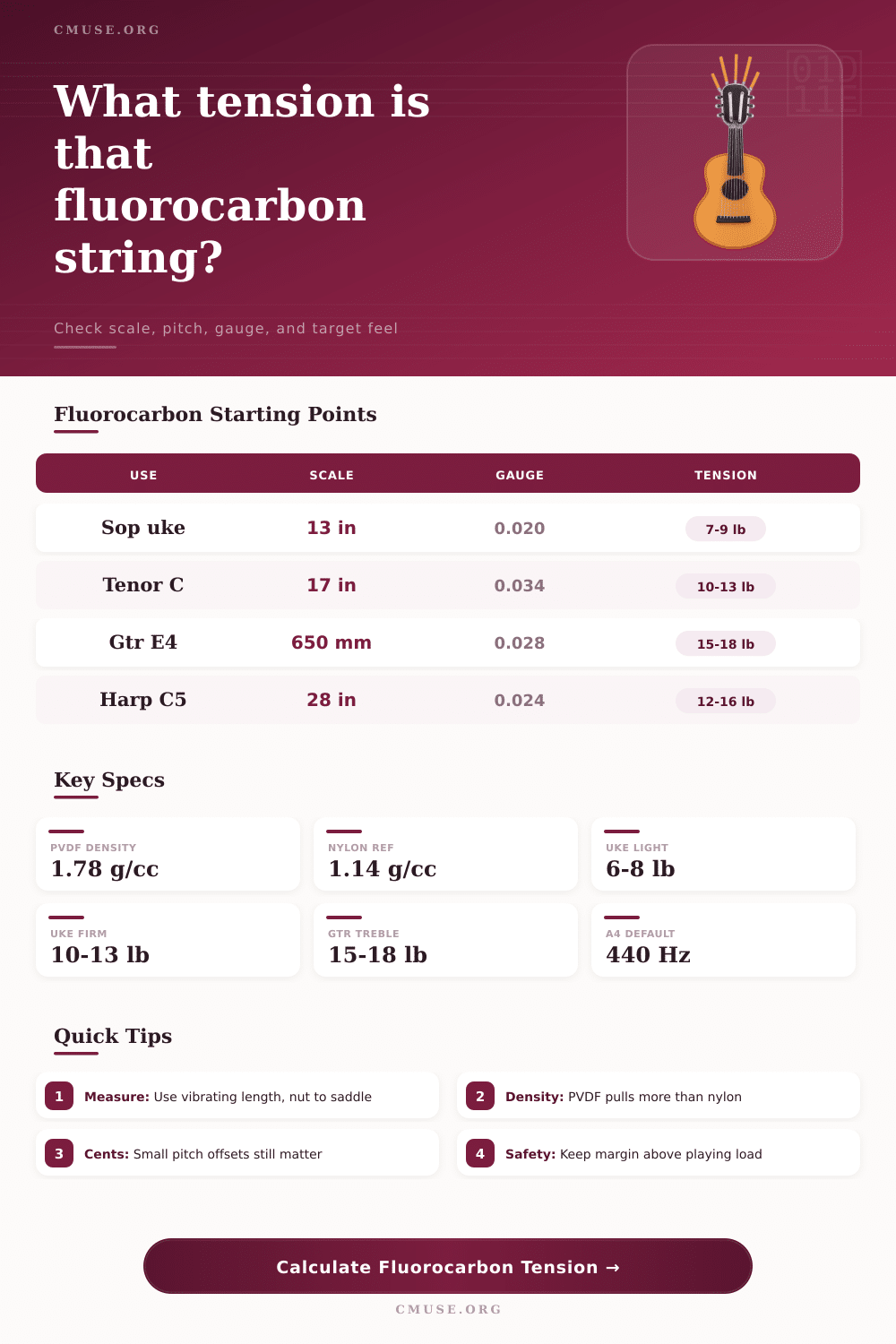
Estimate plain fluorocarbon string tension from vibrating length, pitch, diameter, and PVDF density, then find the gauge needed for a target feel.
Calculation Breakdown
| Material | Density | Typical Use | Practical Note |
|---|---|---|---|
| Clear PVDF fluorocarbon | 1.78 g/cc | Ukulele, classical trebles | Higher tension than nylon at the same diameter |
| Polished PVDF fluorocarbon | 1.77 g/cc | Smooth trebles | Nearly identical pull to clear PVDF |
| Warm-tone PVDF fluorocarbon | 1.76 g/cc | Ukulele sets | Slightly lower tension than dense PVDF |
| High-density fluorocarbon | 1.80 g/cc | Small harp, firm trebles | Small diameter can still pull firmly |
| Carbon composite treble | 1.70 g/cc | Classical guitar trebles | Lower estimate than pure PVDF |
| Clear nylon reference | 1.14 g/cc | Nylon comparison | Needs larger diameter for the same pull |
| Diameter In | Diameter Mm | Common Role | Typical Range |
|---|---|---|---|
| 0.018 | 0.46 | Very light high A or high G | Short scale, high pitch |
| 0.020 | 0.51 | Soprano ukulele A4 | Light to medium feel |
| 0.022 | 0.56 | Tenor ukulele high G | Medium feel |
| 0.026 | 0.66 | Ukulele E4 or baritone E4 | Medium to firm feel |
| 0.028 | 0.71 | Classical guitar E4 | Normal treble tension |
| 0.033 | 0.84 | Classical guitar B3 | Normal treble tension |
| 0.041 | 1.04 | Classical guitar G3 | Firm plain treble |
| Instrument / String | Scale Length | Pitch | Starting Diameter | Expected Feel |
|---|---|---|---|---|
| Soprano ukulele 1st | 13 in / 330 mm | A4 | 0.020 in / 0.51 mm | Light to medium |
| Concert ukulele 2nd | 15 in / 381 mm | E4 | 0.026 in / 0.66 mm | Medium |
| Tenor ukulele 3rd | 17 in / 432 mm | C4 | 0.034 in / 0.86 mm | Medium firm |
| Tenor ukulele high G | 17 in / 432 mm | G4 | 0.022 in / 0.56 mm | Medium |
| Classical guitar 1st | 25.6 in / 650 mm | E4 | 0.028 in / 0.71 mm | Normal treble |
| Classical guitar 2nd | 25.6 in / 650 mm | B3 | 0.033 in / 0.84 mm | Normal treble |
| Classical guitar 3rd | 25.6 in / 650 mm | G3 | 0.041 in / 1.04 mm | Firm treble |
| Single-String Pull | Metric Pull | Feel | Common Use |
|---|---|---|---|
| 5 to 7 lb | 2.3 to 3.2 kgf | Soft | Short-scale ukulele trebles |
| 8 to 10 lb | 3.6 to 4.5 kgf | Light medium | Soprano and concert ukulele |
| 10 to 13 lb | 4.5 to 5.9 kgf | Medium firm | Tenor ukulele fluorocarbon |
| 14 to 18 lb | 6.4 to 8.2 kgf | Firm treble | Classical guitar or small harp |
| 19 to 24 lb | 8.6 to 10.9 kgf | Very firm | Long scale or high projection setups |
| Quantity | Formula | Input Units | Why It Matters |
|---|---|---|---|
| Frequency | A4 times 2^((MIDI - 69) / 12) | Hz | One octave doubles string tension if diameter and length stay fixed |
| Area | pi times diameter squared / 4 | square meters | Thicker fluorocarbon adds mass quickly |
| Linear mass | density times area | kg per meter | Heavier material raises tension at the same gauge |
| Tension | linear mass times (2 L f)^2 | newtons | Core string equation used by luthiers |
Before you even try plucking some fluorocarbon string you should of be aware of how it feels on your fingertips. It’s got a certain heaviness to it, which directly equates to greater tension per diameter then the traditional nylon strings. For this reason, changing from one to the other without changing the gauge size will lead to either a feeling of stiffness in the neck or lack of clarity in tone.
Once you understand the variables involved, it is simple math to see what has changed, yet finding the sweet spot are more than just guessing. Knowing the relationship between scale length, material density and pitch will help you reach that place where the instrument sings back to you instead of resisting your touch.
Why String Tension Matters
The length vibrate. It’s not the entire length of the strings from peg to post, but just the speaking portion from saddle to nut. Get this one wrong and everything else you calculate after it will also be wrong. You’ll notice that a soprano uke has a shorter scale than a tenor, which means that when you tune both instruments to the same pitch, the same gauge of string will sound noticeably looser on smaller instrument.
The tool above do all of this for you. It spares you from having to swap units around and ensures that your inputs match the standard physical equations used for these calculations. It converts your raw measurements into pull force so that what you have are real numbers instead of vague ideas about how something feel tighter or looser.
The second big variable here is density. Fluorocarbon is much heavier on a per cubic cm basis than nylon. The calculator use the proper density coefficient and adjusts the linear mass when you choose your material. Why does this matter? The amount of mass moving along with your vibration creates tension. And tension is directly proportional to the frequency of vibration. In other words, more dense = harder to make vibrate at a given frequency.
For example, if you’re accustomed to nylon gauges, expect fluorocarbon to be a bit stiff when using same diameter. Generally speaking, you have to go down in diameter to account for fluorocarbon’s increased weight due to its material composition.
The table on the page show standard ranges for most instruments. It’s a decent sanity check if your calculated results feel too extreme.
String tension is a balancing act between how well it plays vs. How well it projects. For example, higher-tension strings will generally sound louder and hold a note longer (good if you’re performing live music), yet they can be harder to finger and put more strain on the neck of your instrument. On the other hand, lower tension strings is easier to bend but won’t project as loudly if you pluck them really hard.
With the calculator, you can see where you’d have to go up/down in gauge to achieve whatever tension you want. For example, if you like a medium-feeling string on high-G tenor, you will see if you should move down one size. This is not a huge change, but it is a noticeable improvement in tone and comfortly.
There is another consideration here, and that’s material variation. Depending on the fluorocarbon blend and treatment, some fluorocarbon strings might be polished or otherwise changed to change their sound. These subtleties will also change the density of the fluorocarbon. However, the calculator take that into consideration because it gives you options to compare the pure PVDF version to other variants like carbon composite or even warmer toned versions. This means you can get as detailed as needed without assuming all synthetics is the same. Instead, you’ll have accurate control to fine-tune your setup to match the type or brand of string you’re using.
So what’s all this talk of string tension? In the end, it’s as much about feel as it is physics. While those numbers are a place to start, ultimately it’s your fingers and ears making the decision. Take the calculated gauge, and adjust up or down by thousandths of an inch till you’re happy with how balanced the instrument sounds. It’s not so much a question of having one perfect number, as it is knowing the relationships between mass, length, and pitch.
When you have that dynamic figured out, changing strings becomes a conscious act instead of a random experiment. You’re able to control how responsive your instrument will be to your playing, and make sure it feels just the way you want it to in your hands.