Temperament Error Calculator
Compare a note's tempered pitch against equal temperament, just intonation, Pythagorean tuning, meantone, or another practical reference.
Choose the tonic first when comparing non-equal temperaments. Just, Pythagorean, and meantone intervals are calculated as scale degrees above the selected tonic.
Calculation Breakdown
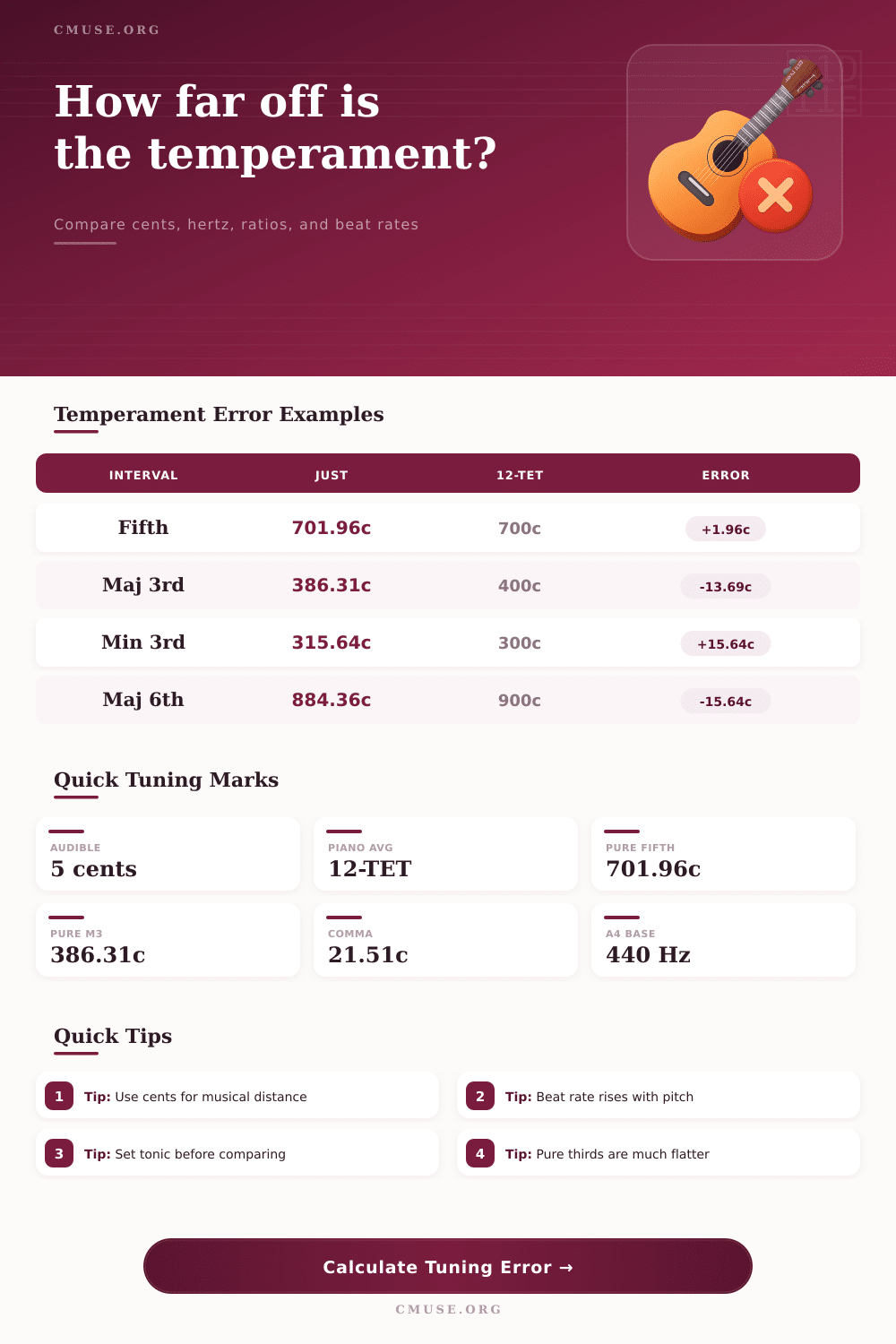
| Interval | Just Ratio | Just Cents | 12-TET Cents | Error |
|---|---|---|---|---|
| Minor second | 16:15 | 111.73 | 100 | +11.73 |
| Major second | 9:8 | 203.91 | 200 | +3.91 |
| Minor third | 6:5 | 315.64 | 300 | +15.64 |
| Major third | 5:4 | 386.31 | 400 | −13.69 |
| Perfect fourth | 4:3 | 498.04 | 500 | −1.96 |
| Perfect fifth | 3:2 | 701.96 | 700 | +1.96 |
| Major sixth | 5:3 | 884.36 | 900 | −15.64 |
| Temperament | Fifth Size | Major Third | Best Use |
|---|---|---|---|
| 12-TET | 700.00c | 400.00c | Modern keys |
| 5-limit just | 701.96c | 386.31c | Single tonic |
| Pythagorean | 701.96c | 407.82c | Open fifths |
| Quarter-comma meantone | 696.58c | 386.31c | Pure thirds |
| Werckmeister III | Varies | 390 to 408c | Baroque keys |
| 19-EDO | 694.74c | 378.95c | Alternate EDO |
| Preset | Tonic | Target | Main Error |
|---|---|---|---|
| C major third, just vs 12-TET | C | E4 | −13.69c |
| C perfect fifth, just vs 12-TET | C | G4 | +1.96c |
| C minor third, just vs 12-TET | C | E♭4 | +15.64c |
| Pythagorean major third | C | E4 | +7.82c |
| Meantone major third | C | E4 | −13.69c |
| 19-EDO perfect fifth | C | G4 | −5.26c |
| Error Range | Pitch Effect | Typical Context | Action |
|---|---|---|---|
| 0 to 2 cents | Very small | Fine tuning | Usually acceptable |
| 2 to 5 cents | Noticeable to trained ears | Unison work | Adjust if exposed |
| 5 to 10 cents | Clearly colored | Chords, pads | Check temperament choice |
| 10 to 16 cents | Strong temperament color | Just thirds | Intentional in context |
| 16+ cents | Obvious mismatch | Wrong tonic or note | Recheck settings |
There’s something wrong with your sound but you can’t put your finger on what it is. The notes are correct and in the right keys, but the sound doesn’t ring true. Instead, it is wobbly and somehow muddied. That’s the ghost of tuning theory haunting your ears.
Nowadays we live in a world where twelve tone equal temperament rule everything. This system makes all intervals slightly out of tune, but it allows easy changes between keys. From jazz improvisations to chart hits on the radio, it does nearly everything but it isn’t perfect. For those who work with historical keyboards or make retro sounds, awareness of the imperfections will help you make sense of error margins. And it’ll explain why a just intonation major third sound warm whereas the equal temperament one feels somewhat tense.
Why Your Music Might Sound Wobbly
When you enter your desired interval and reference pitch into the calculator (above), it spits out the result for you. You don’t have to wrestle the ratio of frequencies and logarithms yourself anymore. One thing to understand best here is how the option of comparison vs source temperament figures into this.
You will notice what happens when you pick a major third in pure just intonation. When you compare it to usual equal tempered background, there is an approximate thirteen cent difference. Sounds small on the page, but remember that humans are only able to detect changes in pitch down to five cents in ideal circumstances. Thirteen cents isn’t a slight tweak: it’s a noticeable change in colour. It’s enough to make one chord feel right while another feels off even if none of the notes is sharp or flat compared to A440.
Where theory meets reality is in beat rate. Depending on which of the partials you choose it will calculate how many times per second the interference pattern peak. In other words, if you’re tuning a piano by ear then you would be listening out for these beats. When they fade away and slow down, you are in pure-land; when they speed up, you are moving toward equal temperament. This can is increased depending on what you choose for the harmonic in the calculator as the frequency difference increases at higher pitches.
For those interested in filter tracking in virtual analog synthesis, or indeed any kind of physical instrument maintenence, keep this in mind. Temperament errors are frequently not bugs, but features. Many folks think that more precise is always better, but that isn’t true. If you want a synth patch emulating an old Juno from the ’80s and you get all the oscillators tuned perfectly to equal temperament it may sound sterile. Just adding a little bit of detension in a few cts. It can add that thick pulsing quality that defines the sound of that time period.
It’s largely about knowing exactly what you’re measuring. This isn’t a mistake to fix, this is a choice of acoustic texture. Other historical temperaments such as Werckmeister III or meantone present other trade-offs. For example, meantone produces amazingly pure thirds which are heavenly sounding when playing in keys with fewer flats or sharps. But they also make the fifths narrower making any chord containing lots of accidentals harshly out of tune. This was Bach’s dilemma and he composed the Well-Tempered Clavier to try to find a system that would cover all keys but not be unplayable.
If your musical style tends towards staying in one key for extended periods then just intonation will give you clarity that is impossible with equal temperament. If you modulate frequently then equal temperament are safe. Tolerance is also relative to context. The processing chain can smooth over small tuning discrepancies when placed in a dense mixture with heavy amounts of compression and reverb. That five-cent difference could of been lost completely in the noise floor of an already busy chorus track. But in a dry, sparse acoustic recording it will scream for your attention. Listen to the interval in context, not simply what you see on the screen.
Ultimately, this is about making compromises. It’s about improving one system over another. There isn’t a perfect system; there are only systems that has been made better for various things. With the help of the calculator, you get to measure these compromises so that you make decisions intentionally instead of accidently. You get to know exactly how far off-pitch something is and let your ear embrace dissonance as an instrument.
The next time you pluck out a chord that sounds ever-so-slightly off, consider that maybe it wasn’t a mistake after all. Maybe it was the sound of a different mathematical truth vibrating in the air.