Wolf Fifth Calculator
Find the rough closing fifth, circle drift, comma size, and key risk for equal, Pythagorean, meantone, and irregular temperaments.
Calculation Breakdown
| Step | Fifth | Size | Error | Pitch Class | Status |
|---|---|---|---|---|---|
| Run the calculator to fill this table. | |||||
| Temperament | Ordinary Fifth | Wolf / Closure | Best Use |
|---|---|---|---|
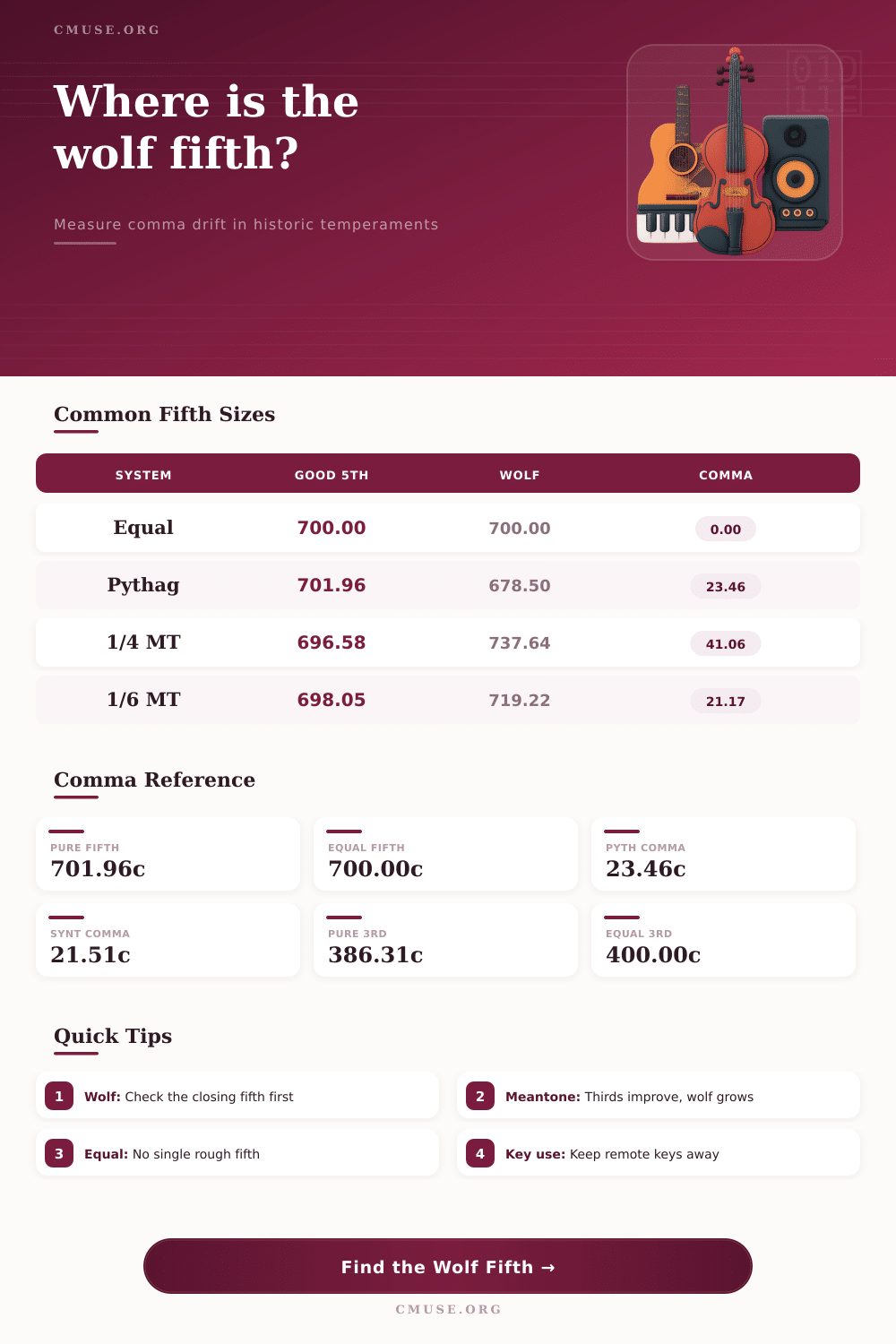
| 12-tone equal | 700.000 cents | No single wolf | All keys equally usable |
| Pythagorean | 701.955 cents | About 678.495 cents | Melodic fifths and fourths |
| 1/4-comma meantone | 696.578 cents | About 737.637 cents | Pure-ish major thirds in close keys |
| 1/6-comma meantone | 698.371 cents | About 717.909 cents | Milder meantone color |
| Vallotti-style | Mixed 696 to 702 cents | Distributed | Well temperament key color |
| Werckmeister-style | Mixed 696 to 702 cents | Distributed | Baroque organ and clavier |
| Item | Cents | Ratio | Why It Matters |
|---|---|---|---|
| Pure fifth | 701.955 | 3:2 | Reference consonant fifth |
| Equal fifth | 700.000 | 2^(7/12) | Every fifth is narrowed by 1.955 cents |
| Pythagorean comma | 23.460 | (3/2)^12 / 2^7 | Gap after stacking 12 pure fifths |
| Syntonic comma | 21.506 | 81:80 | Used to temper meantone fifths |
| Pure major third | 386.314 | 5:4 | Goal of quarter-comma meantone |
| Equal major third | 400.000 | 2^(4/12) | Modern keyboard compromise |
| Wolf Location | Safer Keys | Risky Keys | Listening Check |
|---|---|---|---|
| G# to Eb | C, F, G, D | Ab, Eb minor, B major | Remote triads beat strongly |
| Ab to Eb | C, G, D, A | Ab, Db, Eb minor | Enharmonic spellings disagree |
| B to F# | C, F, Bb, G | B, F#, C# | Sharps become the color edge |
| Distributed | Most keys | No single broken key | Color changes gradually |
| Preset | Good Fifth | Closure Fifth | Severity |
|---|---|---|---|
| Preset comparison loads with the calculator. | |||
The intervals sounds like a siren wailing from within a piano case, and you know that there’s a wolf fifth present even before you’ve seen it. Your jaw tightens rather then relaxes to its rhythmic pulsing. Elsewhere on the scale, keyboard builders and tuning theorists treated this interval as cost of getting pure harmony. It’s a simple but brutal tradeoff.
You may be able to have perfectly tuned major thirds in C, F, and G, or you can play in B major without sounding like a broken music box, but you normaly can’t do both. Once you specify what your temperament model will be, the calculator does all the math for you. You don’t need to know or even care about how it calculates everything.
Why the Wolf Fifth Happens
It keeps tabs on number of cents’ worth of accumulated error as you ascend circle of fifths. If you choose a tuning system such as quarter-comma meantone, then you’ve simply opted to bury the mathematical IOU somewhere or other. You’ll find that choosing to make the thirds sound sweeter results in twelfth fifth stretching out hugely to complete the loop.
This interval then becomes the wolf and it incorporates the Pythagorean comma… The remainder from the fact that twelve pure fifths never quite total up to an exact seven-octave span. To understand what I mean by this you need to think for a moment on how music would of been performed prior to adoption of equal temperament. Composers like Bach wrote music to use different colors found from key to key, rather than assuming they could perform equally well in each of the twenty-four keys.
A composition in D major for example would be bright and clear whereas one in F# minor would have a dark tense feel to it. Keys that contained the wolf fifth was either avoided altogether in the period or only rarely used. Play a free-modulating jazz standard from today using a historically tuned instrument and you’ll encounter the wolf and maybe regret your decision not to stick to equal tuning.
The interesting thing about the tool’s inputs is that they allow you to model those historical decisions, change size of the ordinary fifths and witness the shift in the closure error. Decrease the comma deduction from a quarter down to a sixth and thirds get less pure while the wolf diminishes. Some tuners actualy prefer the third-comma or fifth-comma system as a result since it presents a sort of middle ground where harmony can be explored somewhat further without compromising too much consonance.
The calculator demonstrates this balance in action with its real-time visualization of the drift around the circle. When you toggle over to a well-tempered preset such as Werckmeister or Vallotti, you will see how error gets spread across the keyboard so that no one fifth is a monster, yet each key also has a unique flavor.
Most people ask why equal temperament solves this problem when it doesn’t solve it; it simply spreads it out. Under twelve-tone equal temperament, each fifth become two cents narrower in value. Each interval carries exactly the same amount of error so there’s no individual wolf interval, just a spread of shared errors across all intervals. What happens then is that we can use all the keys, but none of them are pure.
If you listen carefully, an equal tempered major third will beat very slightly against the harmonic series. It has a sharp, edgy sound. This is compared to the rich warmth of a pure meantone third based off fifths and the comma. What emotional feel do you wish your instrument to have and what sort of music do you play? That is the question that determines which preference prevails.
Be sure to listen to your output for what it calls the “worst-key” area as you test these tunings; this indicates where it expects most dissonance in the chosen tuning. In fact, you may find when tuning a harpsichord or an organ for a particular concert programme, it can be clever to put the wolf into a key not being played that night. It’s a centuries-old pragmatic approach by tuners.
With this tool, you don’t need to guess or try and remember which keys is likely to be problematic. There is no free lunch in the world of physics and ultimately, that is what temperament means. You might get uniformity with spread out errors, or pure thirds with wolves, but not both perfect at the same time.
That wolf fifth shows us that we humans invent our own musical systems that come close to nature’s harmonics. The best way to know what you’ve opted to emphasize in your tuning is to listen for that beat.