Comma Pump Calculator
Estimate how much a just-intonation pump drifts after repeated cycles, then compare the raw comma with common temperament absorption.
Comma Pump Breakdown
| Cycle | Signed Drift | Pitch Ratio | Frequency Offset | Beats Per Second |
|---|
| Comma | Exact Ratio | Decimal Ratio | Size | Typical Pump Source |
|---|---|---|---|---|
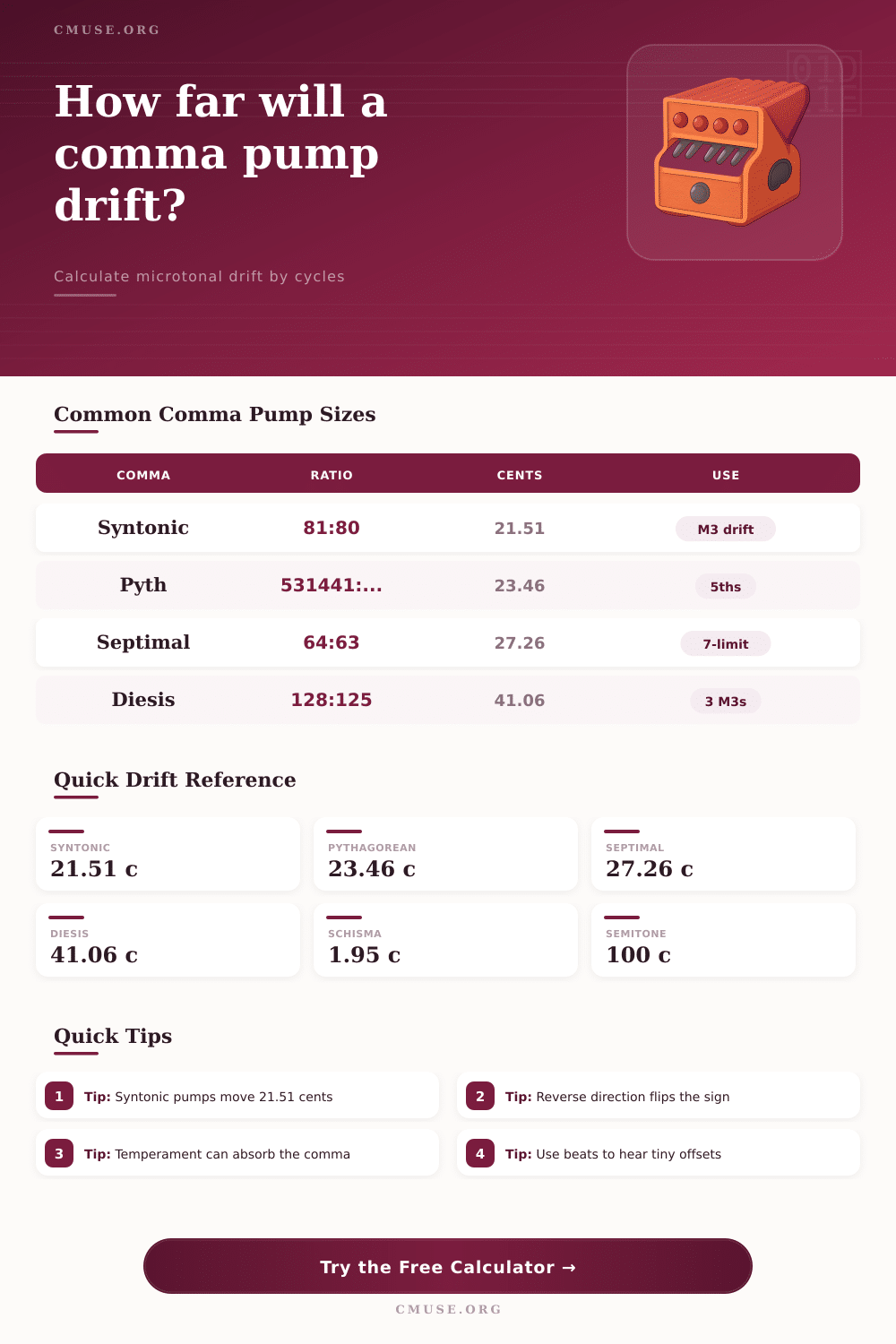
| Syntonic comma | 81:80 | 1.012500 | 21.506 cents | Four fifths vs two octaves plus a just major third |
| Pythagorean comma | 531441:524288 | 1.013643 | 23.460 cents | Twelve pure fifths compared with seven octaves |
| Septimal comma | 64:63 | 1.015873 | 27.264 cents | Seven-limit harmonic paths resolving to the same pitch name |
| Diesis | 128:125 | 1.024000 | 41.059 cents | Three just major thirds compared with one octave |
| Schisma | 32805:32768 | 1.001129 | 1.954 cents | Difference between Pythagorean and syntonic comma residues |
| Temperament Setting | Absorbed | Net Syntonic Pump | Effect | Useful When |
|---|---|---|---|---|
| Pure just intonation | 0% | 21.506 cents | Full audible drift | Modeling exact harmonic ratios |
| Quarter-comma correction | 25% | 16.130 cents | Smaller pump residue | Testing partial comma tempering |
| Half correction | 50% | 10.753 cents | Subtle but measurable offset | Comparing compromise tunings |
| Fully tempered out | 100% | 0.000 cents | Loop closes exactly | Checking a temperament relation |
| Route | Main Ratio Compared | Expected Comma | Calculator Use | Result Focus |
|---|---|---|---|---|
| 4 fifths vs just M3 | (3:2)^4 / (4:1 x 5:4) | 81:80 | Syntonic pump | Major-third drift |
| 12 fifths vs octaves | (3:2)^12 / 2^7 | 531441:524288 | Pythagorean pump | Circle closure error |
| 7-limit dominant chain | 64:63 residue | 64:63 | Septimal pump | Bluesy 7-limit offset |
| 3 just major thirds | 2:1 / (5:4)^3 | 128:125 | Diesis pump | Augmented triad closure |
| Notated same-note loop | Any chosen ratio | Custom | Score analysis | Cumulative drift |
| Net Drift | Musical Size | At A4 Offset | Audibility Cue | Action |
|---|---|---|---|---|
| 1 cent | Very small | 0.25 Hz | Slow beating | Usually acceptable |
| 5 cents | Small | 1.27 Hz | Clear shimmer | Check exposed unisons |
| 10 cents | Noticeable | 2.55 Hz | Pitch color changes | Retune or temper |
| 21.5 cents | Syntonic comma | 5.50 Hz | Strong beating | Treat as pump drift |
| 100 cents | Semitone | 26.16 Hz | New pitch class | Rewrite or modulate |
To start, you hit note C then rise in a perfect succession of fourths (fifths), but as you attempt to complete the loop, you end up landing flat. It sounds magical but it’s simply your ear being tricked by some math. Musicians refer to that tiny gap as a comma pump. If you circle around too many times, all those commas adds up and pure intonation becomes a distant memory.
Using the calculator above take care of that for you so you don’t need to guesstimate how far off you’ll be after a dozen loops. One problem that commonly arises is so-called syntonic comma, which exist within the major triad itself. That is quite large at approximately twenty-one cents. Remember that we are talking about pitch shifts here that can be as small as five cents in quiet listening environments. So each time you tune up or down a semitone without tempering, you introduce audible sharpness into resulting unison.
How to Control Musical Drift and Stay in Tune
To most players this feels like something is wrong even though they cannot yet put their finger on what it is. The resolution of the chord isn’t clean anymore. Once you know how much it has drifted, you can choose to retune it live or just accept the beating as part of sound texture.
What happens when you use the tool to choose a pump route? You then test your chosen harmonic series against equal temperament base and will hear whichever one of these two is selected. For example, if you use seven octaves or twelve fifths, you will hear the Pythagorean comma. This is slightly larger than syntonic comma.
Why does this matter? Depending off the period of history being looked at, groups was tuned differently as some favoured pure fifths while others favoured pure thirds. Selecting the septimal option includes the number seven. What this do is add a quality that is completely missed by standard just intonation. You may not notice this in a pop song but in experimental or folk music, the change are significant in terms of it’s impact on the harmony.
It’s here that the theory and the practicalities meet: temperament absorption. Purely in terms off just intonation, there is no absorption at all. Each time the cycle repeats, you absorb the whole weight of the comma to your accumulating error. But in reality, we tend to perform with some kind of tempered tuning that will distribute that error elsewhere.
That is to say, if you make intervals slightly narrower this will reduce the percentage of absorption and therefore what proportion of the drift goes unnoticed. A value of twenty-five percent mimics a quarter-comma meantone system that was common in the Baroque period for its sweetness on the third. If you fully temper it out then the loop closes without any error which is good for theoretical purposes but not often how live instrument play.
Changing whether the drift is positive or negative sets its direction. It seems obvious now but really alters your thought process around retuning. When you’re drifting sharp, you pull your pitches down to regain tune. When you’re drifting flat, you push them up. This can be extremely important if you have to play with another player who’s using a fixed-pitch instrument such as a synthesizer or a piano. You don’t want to let the comma go on building and building until it eventually sounds like an entirely different note. The tool shows you precisely where that point occur.
Now it’s time to cross over from abstraction into physics: Frequency offsets convert these abstractions cents into real life Hertz. On a frequency counter, a cent shift of one is hardly perceptible, but move up to the higher notes and that same percentage change covers a wider range of hertz. That is because the relationship between pitch and frequency isn’t linear, which is why high register instruments sounds like they’re going out of tune quicker then lower ones.
In the results above, the beat rate column indicates how often per second the waves pass through one another. It is an audible clue as to when you risk getting dangerously close to being out of tune. Counting cycles in your head and adjusting pitch by ear in real-time is something most people greatly overestimate themselves at. You should of practiced this more.
In fact, knowing ahead of time that four cycles of a syntonic pump will pull you almost two semitones sharp is useful as it allows you to avoid discovering this in the middle of performing. This allows you to decide which pieces are suitable for performance or plan your modulation path.
The point isn’t to remove all the commas. That’s impossible. But rather, we control them and apply them to help the music rather than sabotage it. Once you realize where the cracks in the tuning system are, you stop trying to blindly patch them. Rather you begin to design intentionaly around them.