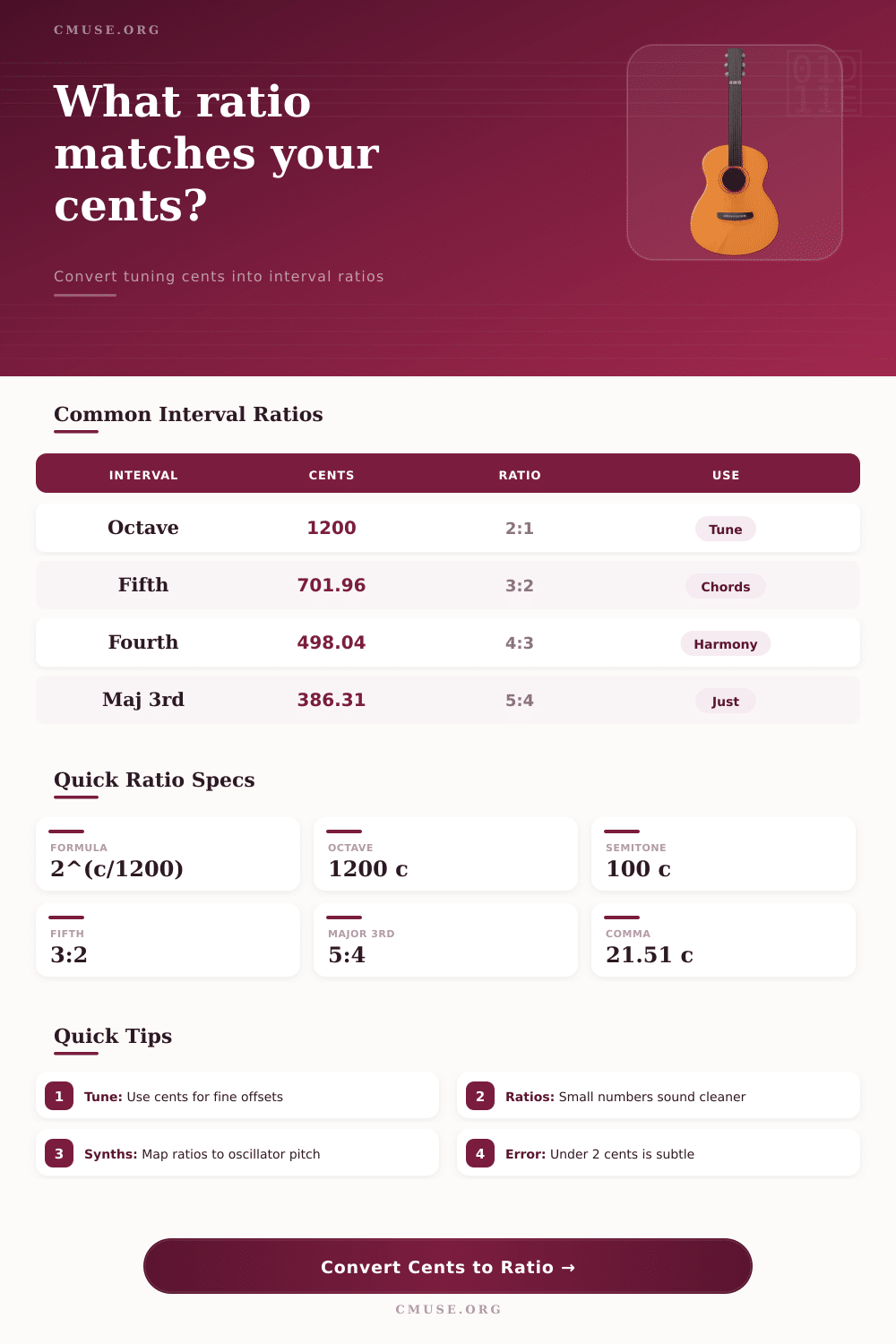
Cents to Ratio Calculator
Convert musical cents to frequency ratios, ratios back to cents, and tuning offsets into real frequencies for instruments, synths, and temperaments.
Calculation Breakdown
| Interval | Ratio | Cents | 12-TET Difference |
|---|---|---|---|
| Minor second | 16:15 | 111.731 | +11.731 cents |
| Major second | 9:8 | 203.910 | +3.910 cents |
| Minor third | 6:5 | 315.641 | +15.641 cents |
| Major third | 5:4 | 386.314 | -13.686 cents |
| Perfect fourth | 4:3 | 498.045 | -1.955 cents |
| Perfect fifth | 3:2 | 701.955 | +1.955 cents |
| Minor seventh | 7:4 | 968.826 | -31.174 cents |
| Octave | 2:1 | 1200.000 | 0.000 cents |
| Semitones | Name | Cents | 12-TET Ratio |
|---|---|---|---|
| 0 | Unison | 0 | 1.000000 |
| 1 | Minor second | 100 | 1.059463 |
| 2 | Major second | 200 | 1.122462 |
| 3 | Minor third | 300 | 1.189207 |
| 4 | Major third | 400 | 1.259921 |
| 5 | Perfect fourth | 500 | 1.334840 |
| 7 | Perfect fifth | 700 | 1.498307 |
| 12 | Octave | 1200 | 2.000000 |
| Name | Ratio | Cents | Why It Matters |
|---|---|---|---|
| Syntonic comma | 81:80 | 21.506 | Just major third correction |
| Pythagorean comma | 531441:524288 | 23.460 | Circle of fifths gap |
| Septimal comma | 64:63 | 27.264 | Seven-limit adjustment |
| Schisma | 32805:32768 | 1.954 | Tiny temperament error |
| Quarter tone | 2^(1/24) | 50.000 | 24-TET microtone |
| Task | Best Input | Best Output | Recommended Limit |
|---|---|---|---|
| Strobe tuner offset | Cents | Hz and cents | 32 denominator |
| Synth oscillator tuning | Ratio | Cents and frequency | 64 denominator |
| Microtonal scale design | Cents | Nearest fraction | 128 denominator |
| Temperament analysis | Frequency pair | Cents difference | 256 denominator |
| Choir or ensemble tuning | Just ratio | Cents from equal | 32 denominator |
If you tune a piano alongside another instrument like a violin, for example, you will likely hear how an interval sounds slightly differant. It’s not a mistake; it’s that small amount of friction that is the sound of two conflicting mathematical systems fighting for possession of the same set of keys. One system splits octave up into twelve equally sized pieces while the other use whole number ratios that nature naturaly gravitates towards.
The calculator is positioned smack bang in the middle of this tug-of-war as it sits between the physical world of frequency ratios and more abstract world of cents.
Why Your Music Sounds Out of Tune
Musical intervals, on the other hand, are measured using units called cents. Cents are logarithmic. One hundred of them is a semitone if your tuning system are equal tempered. Each interval you step up from there increase (or decreases) the frequency by the same amount. This allows you to tune synthesizer or transpose music with confidence. You can know the change will be equally correct in any context.
But cents are arbitrary too. The reason something sounds dissonant or consonant is in its ratio. Two frequencies forms an interval. The relationship between them is expressed as a simple whole number ratio, like three to two. This is simplest way to create that particular interval. Your cent value becomes a decimal multiplier and the tool hunts around for the nearest simple fraction it can find that has the same value.
You’ll notice that the number you’re controlling with this search is denominator limit. You can set the limit low, perhaps to thirty-two or sixty-four, which means that if you put it at 64, for instance, the calculator would of spit back at you something like five-to-four (5:4) as a ratio of a major third. That’s useful because five to four is a chord we can easily hear and recognize as sounding stable, like a major third. In fact, that’s exactly how our ears have learned to hear such a harmonically simple relationship between notes.
But let’s say you turn that denominator limit way up to 256. The tool may be able to produce a complicated fraction that almost perfectly matches your desired number of cents. However, those numbers are now so huge that they become meaningless when trying to specify what we think of as a musical interval. Here, you’ve sacrificed precision for clarity, which is usually the opposite of what you’d expect when you’re tuning an instrument or crafting a scale.
There’s also another level of physical reality added when we consider frequency conversion: whereas frequency is absolute, pitch is relative. That means that a major third at a hundred ten hertz will land in quite different place on the waveform from one at four hundred forty hertz. This tool multiplies the base frequency by the derived ratio to make that happen. Knowing precisely how many Hz separate two frequencies is key if you’re synthesizing a sound that uses multiple oscillators detuned from each other to add thickness or a chorusing effect; otherwise, you run the risk of having them out of phase which can result in a hollow, thin sound. It turns an abstract interval into a concrete signal path.
The results also change because Just intonation favors pure fifths and thirds over other intervals. The Pythagorean tuning is locked into perfect fifths but makes major thirds sharp and slightly stretched. So you can turn on/off these reference systems in the calculator and view how close your desired interval is to each standard. This is handy if you want to explore historical performance practice or create your own temperaments, spreading the errors onto less significant notes while making the main chords sound sweeter.
While there is always a temptation from people to go down the exact number of cents route, I have found most people aren’t aware their ears has a threshold and below two cents they are rarely perceptible in a mixed situation with other instruments and reverb from the room. It’s normally a complete waste of time chasing a mathematical perfection as the objective isn’t that at all. It’s about musical coherence.
You might be wondering why your guitar sounds out of tune compared to a piano, patching up a modular synth, or tuning a choir. In every case, it comes back to balancing these figures against each other. You begin with an idea of how you think the interval should sound and then you check whether the math matches that expectation. Then you fiddle around until the ear is happy. The calculator will do the maths for you while you concentrate on the music.