Equal Power Crossfade Calculator
Find gain A and gain B in dB at any fade position, check the constant-power sum, compare equal power against equal gain, and convert the crossfade length into samples
Full Calculation Breakdown
| Position | Gain A dB | Gain B dB | Power Sum |
|---|---|---|---|
| — | — | — | — |
| Position | Gain A (dB) | Gain B (dB) | Power Sum |
|---|---|---|---|
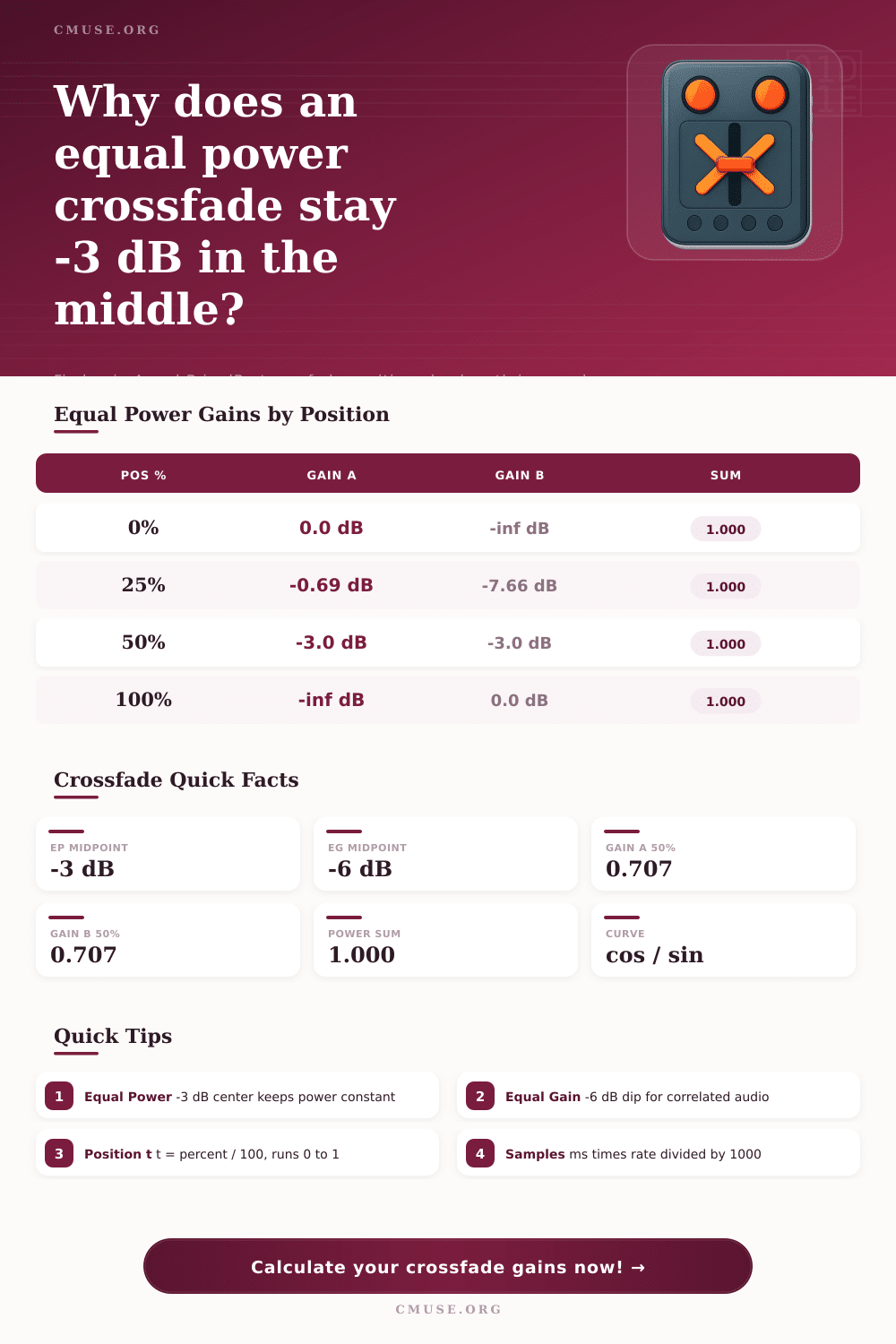
| 0% (start) | 0.00 dB | -∞ dB | 1.000 |
| 25% | -0.69 dB | -7.66 dB | 1.000 |
| 50% (mid) | -3.01 dB | -3.01 dB | 1.000 |
| 75% | -7.66 dB | -0.69 dB | 1.000 |
| 100% (end) | -∞ dB | 0.00 dB | 1.000 |
| Curve | Gain (50%) | Level (dB) | Power Behaviour |
|---|---|---|---|
| Equal Power (cos/sin) | 0.707 | -3.01 dB | Constant power |
| Equal Gain (linear) | 0.500 | -6.02 dB | Dips for correlated |
| Logarithmic | 0.578 | -4.77 dB | Steeper mid taper |
| Constant Power Goal | 0.707 | -3.01 dB | gA²+gB² = 1 |
| Duration | 44.1 kHz | 48 kHz | 96 kHz |
|---|---|---|---|
| 10 ms | 441 | 480 | 960 |
| 50 ms | 2205 | 2400 | 4800 |
| 100 ms | 4410 | 4800 | 9600 |
| 500 ms | 22050 | 24000 | 48000 |
| 2000 ms | 88200 | 96000 | 192000 |
| Note Value | @ 120 BPM | @ 128 BPM | @ 140 BPM |
|---|---|---|---|
| 1 Beat (1/4) | 500 ms | 469 ms | 429 ms |
| Half Bar (2 beats) | 1000 ms | 938 ms | 857 ms |
| 1 Bar (4 beats) | 2000 ms | 1875 ms | 1714 ms |
| 2 Bars (8 beats) | 4000 ms | 3750 ms | 3429 ms |
| 4 Bars (16 beats) | 8000 ms | 7500 ms | 6857 ms |
I bet you’ve mixed two tracks together and experienced a volume drop. The song you mix works fine by itself; it’s great sounding… until you mix it into another song and hear it get quieter. That’s not something wrong with your ears, nor is it anything wrong with how you’re moving your faders. It’s a math issue.
Humans experience time as being linear, which is why most people use a linear transition. You move out halfway along a path, and you’re in the center. Sound isn’t like that. Energy and amplitude are related through squaring, meaning that combining levels cause a loss of 6 dB at the midpoint of a linear cross fade. This results in a perceptible decrease in loudness.
Why Your Mix Gets Quiet
Sine and cosine solve it by creating an equal power curve. They both have squared gains that always sum to one. As one fades in, the other fades out. The combined level of sound energy remain constant throughout. There’s no place for a dip in mix as that would go against physics.
The trigonometry involved in calculating the powers can be done on a calculator. What comes back are figures for amount of gain held by each channel at every instant. That turns the ideas of curves into real numbers of samples and dBs. That precision is important if you’re writing code for a piece of software or hardware. Accuracy trumps intuition there.
To get most from these tools you need to know what they’re feeding them. The position percentage shows where you are on fade timeline. Zero percent means gain A is at full volume while gain B is silenced. Fifty percent mean both are set to minus three decibels. This figure is significant: It’s a linear gain of approximately 0.707. If you take this value and square it, then add the same to itself, you’ll find it equals one. In other words, power stays unchanged.
A linear equal gain fade places both signals at minus six decibels at halfway mark. Add those together and you have half power, a gaping hole in mix that you can hear.
How these fades work on digital platforms depends on both duration and sample rate. Five-hundred milliseconds of crossfading audio has more or fewer samples depending on whether it’s rendered at ninety-six kilohertz or forty-four point one kilohertz. This allows the tool to translate time into raw numbers of samples (indices), important when working with waveforms or writing audio plugins. It handles the translation from perceived time to digital storage.
Fades synced to a DJ set make this dynamic quite significant. If you’ve ever heard a four bar fade at one hundred forty beats per minute, it might feel rushed. That same four bar fade at one hundred twenty beats per minute can be a long blend perfectly suited for ambient music. Phrasing your fade to fit the structure of the music avoids any jarring cuts for the listener.
Another option that exists, though it is not as widely used in typical mix situations, is using logarithmic curves. Logarithmic curves offer a faster transition at the end points of the fade by nature. It will minimize overlapping yet also smooth out the transition.
Deciding whether to use linear, equal gain, or logarithmic fades comes down to how correlated your audio is. If you’re dealing with uncorrelated audio such as different drum sounds/instruments, etc., then equal power should works fine. But if you’re dealing with correlated mono stems (crossfades), or you’re crossfading identical loops, then an equal power fade may result in phase problems. There’s no gain compensation to overcome this. A linear fade could of the better option here so that it properly cancels phases without keeping things loud.
In the end, it’s all about making it seamless. That moment should feel more like shifting from one texture to another then a rise or fall of volume. Knowing something about gain curves and power summation give you that option to dial in the difference between the two. It is an engineering answer instead of just guesswork.
The next time you mix two songs together consider the energy under each fader. Keep in mind that at the three dB down point, the middle of your mix will be as strong as the left or right sides.