Tremolo Rate Calculator
Convert BPM and note divisions into LFO rate in Hz, period in ms, cycles per bar and the matching note value for perfectly tempo-synced tremolo
Full Calculation Breakdown
| Note Division | Division Factor | Rate (Hz) | Period (ms) |
|---|---|---|---|
| Whole note (1/1) | 0.25 | 0.50 Hz | 2000 ms |
| Half note (1/2) | 0.5 | 1.00 Hz | 1000 ms |
| Quarter note (1/4) | 1 | 2.00 Hz | 500 ms |
| Dotted eighth | 1.333 | 2.67 Hz | 375 ms |
| Eighth note (1/8) | 2 | 4.00 Hz | 250 ms |
| Eighth triplet | 3 | 6.00 Hz | 167 ms |
| Sixteenth (1/16) | 4 | 8.00 Hz | 125 ms |
| Thirty-second (1/32) | 8 | 16.00 Hz | 62.5 ms |
| Rate (Hz) | Period (ms) | Period (s) | Feel |
|---|---|---|---|
| 0.5 Hz | 2000 ms | 2.000 s | Very slow swell |
| 1 Hz | 1000 ms | 1.000 s | Slow pulse |
| 2 Hz | 500 ms | 0.500 s | Gentle throb |
| 4 Hz | 250 ms | 0.250 s | Classic tremolo |
| 5.5 Hz | 182 ms | 0.182 s | Surf shimmer |
| 8 Hz | 125 ms | 0.125 s | Fast chop |
| 12 Hz | 83 ms | 0.083 s | Helicopter |
| Style / Feel | Typical Rate | Shape | Notes |
|---|---|---|---|
| Slow swell / ambient | 0.5–1.5 Hz | Sine | Soft volume waves |
| Vintage amp tremolo | 3–6 Hz | Triangle | Fender-style throb |
| Surf / spaghetti | 5–7 Hz | Sine | Shimmering pulse |
| Helicopter / chop | 8–12 Hz | Square | Hard on/off gate |
| Stutter / glitch | 10–16 Hz | Square | Rhythmic gating |
You turn your amp knob and suddenly your clean tone is all choppy. It feels like your modulation doesn’t match the track; it doesn’t feel the rhythm. Math will save your mix here. Tremolo is time based signal processing that should of be matched to the grid to sit in the pocket. Players mostly just guess at frequency but never land on a musical note division when they do. Suddenly, instead of a steady beat, the rhythm wobbles and drifts out of sync after two bars, creating a muddy rhythmic conflict. That’s because at its heart it’s about translating tempo to frequency. How many beats per minute? Fine. What are low-frequency oscillators talking about? Hertz. A single Hertz is one cycle per second. That doesn’t immediately match how you think about sixteenth notes or quarter notes.
Use the calculator up top: Feed in your BPM plus the note division you want (i.e., 4/4 = quarter note), and it spits back out the exact Hz needed to sync perfectly. It even provides the period. In milliseconds, which can come in handy when you need to dial in time instead of rate on some hardware gear. Understanding those two numbers makes it easier not to feel frustrated when adjusting something until it sounds like it fits but still won’t quite lock down.
How to Match Tremolo Speed to Your Song Tempo
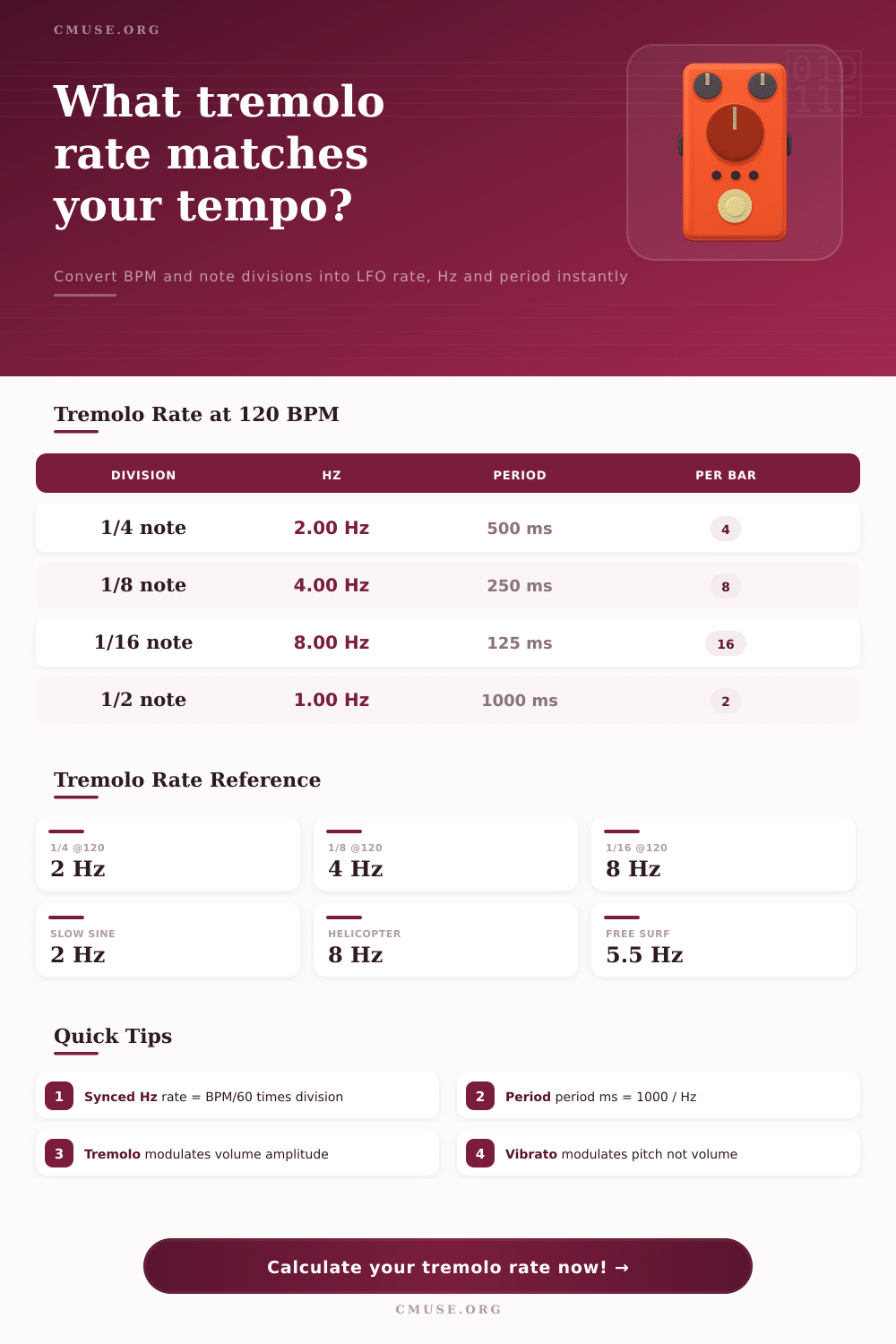
Take 120BPM, a typical tempo for rock or pop. Here we’re looking at a quarter-note tremolo operating exactly at 2 Hz. In other words: two swells per second, just enough of a pulsating heartbeat beneath your guitar part to provide some motion without calling too much attention to itself. Stepping down to an eighth-note division doubles this number (4 Hz). The pulse quickens to create a sense of urgency. It also provides a driving energy that moves the song ahead. This is the sweet spot for classic pop rhythms or vintage surf rock; here, the tremolo feel present but never overbearing.
Move it to sixteenth notes and we’re at 8 Hz. That’s where things flip. The speed becomes fast enough that the modulation starts to sound choppy. It sounds almost staccato, like aggressive indie guitar tones or helicopter effects. Here’s where the shape of your LFO comes into play again. Though a sine wave still sounds relatively smooth, a square wave start to produce hard on-off gating that carves right through the mix.
The table on the page shows this well for standard divisions. You can see how rapidly the Hertz add up as you divide the note down by half. Remember, when the note gets twice as fast its frequency doubles. Because of this, even slight changes in division sound very different than our ears. Beyond just the rate considerations, there is also the issue of depth and shape. Although the tool is centered around time, it’s the interaction between the amplitude and the LFO that gives the tremolo its character. If the LFO uses a sine wave, you get a smooth swell; a triangle wave will be a little more mechanical as it has a linear ramp up to maximum volume. Square waves chop the signal fully off in the troughs of their cycle and are thus designed to be rather harsh. You could work out the ideal 5.5 Hz for some shimmering effect, but then choose to pair it with 100 percent depth using a square wave and lose all sustain. The rate gets you into the room, but the depth and shape decide how comfortabley you’re going to be there.
Last but not least: What’s the difference between vibrato and tremolo? They are both timed using the exact same math (LFO). However, one is modulating pitch while the other is modulating volume. A 2 Hz rate sounds like a gentle pulse when applied to volume but a slow warble on pitch. Knowing where one ends and the other begins helps you adjust your effect to add to the music instead of distracting from it. You can float free with an ambient wash or sync to a click. Knowing how frequency relates to time will make your wobbles intentionally musical rather than just random. The math has your back so the rhythm never gets sloppy.