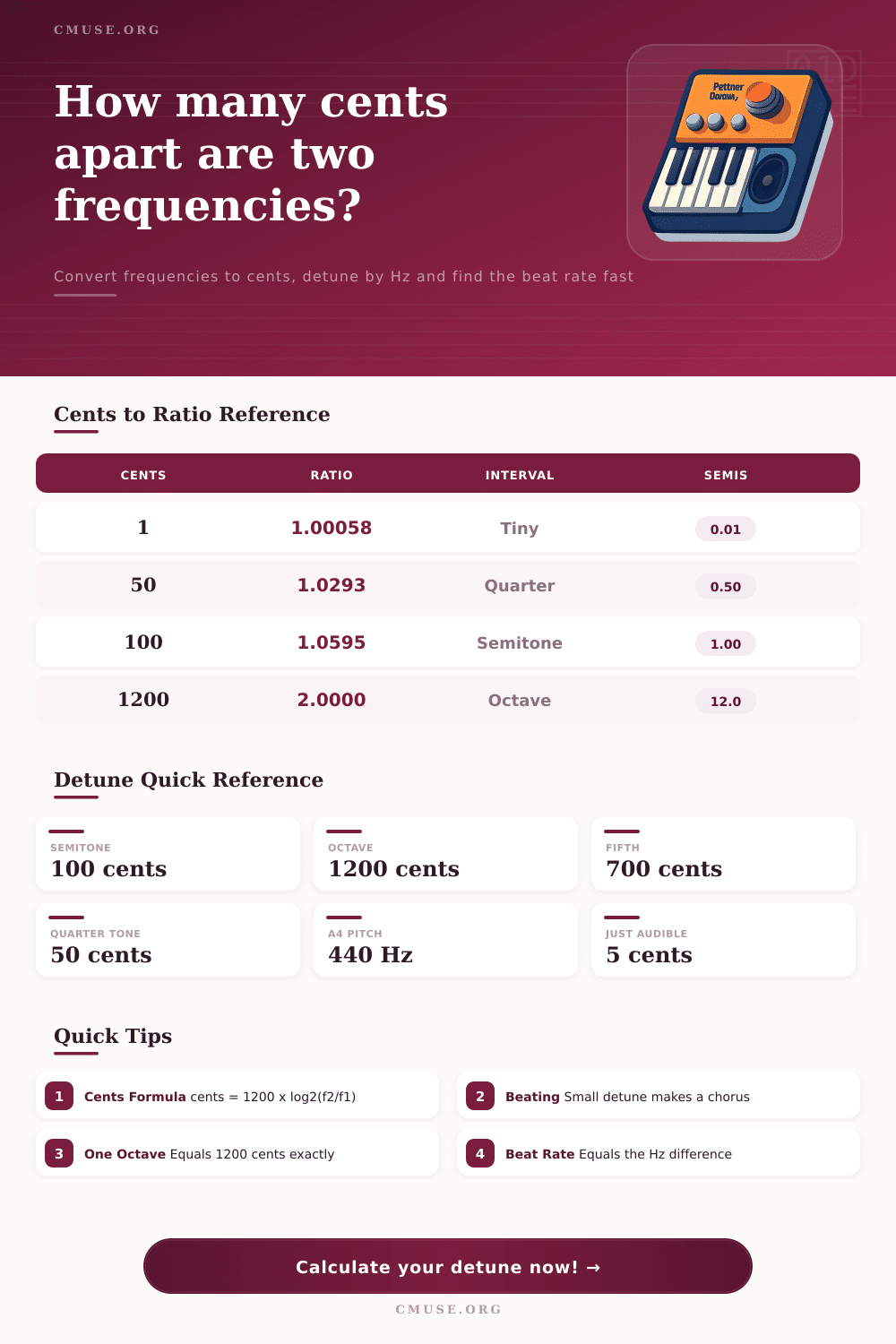
Detune Cents Calculator
Convert between two frequencies and cents, detune any base note by a chosen number of cents, and reveal the resulting Hz, ratio, beat rate and nearest note
Full Calculation Breakdown
| Cents | Frequency Ratio | Interval | Semitones |
|---|---|---|---|
| 1 | 1.000578 | Imperceptible | 0.01 |
| 10 | 1.005793 | Slight detune | 0.10 |
| 50 | 1.029302 | Quarter tone | 0.50 |
| 100 | 1.059463 | Semitone | 1.00 |
| 700 | 1.498307 | Perfect fifth | 7.00 |
| 1200 | 2.000000 | Octave | 12.00 |
| Pair | Hz Difference | Beat Rate | Cents Apart |
|---|---|---|---|
| 440 vs 441 | 1.00 Hz | 1 beat/sec | 3.93 cents |
| 440 vs 442 | 2.00 Hz | 2 beats/sec | 7.85 cents |
| 440 vs 443 | 3.00 Hz | 3 beats/sec | 11.76 cents |
| 440 vs 445 | 5.00 Hz | 5 beats/sec | 19.56 cents |
| Detune | New Frequency | Hz Difference | Beat Rate |
|---|---|---|---|
| -25 cents | 433.69 Hz | -6.31 Hz | 6.31 beats/sec |
| -10 cents | 437.47 Hz | -2.53 Hz | 2.53 beats/sec |
| -5 cents | 438.73 Hz | -1.27 Hz | 1.27 beats/sec |
| +5 cents | 441.27 Hz | +1.27 Hz | 1.27 beats/sec |
| +10 cents | 442.54 Hz | +2.54 Hz | 2.54 beats/sec |
| +25 cents | 446.40 Hz | +6.40 Hz | 6.40 beats/sec |
| Interval | Cents | Semitones | Ratio |
|---|---|---|---|
| Just audible | 5 | 0.05 | 1.0029 |
| Quarter tone | 50 | 0.50 | 1.0293 |
| Semitone | 100 | 1.00 | 1.0595 |
| Whole tone | 200 | 2.00 | 1.1225 |
| Perfect fifth | 700 | 7.00 | 1.4983 |
| Octave | 1200 | 12.00 | 2.0000 |
Often people comment on how a recording of a voice or instrument has life compared with another that seem flat. The reason isn’t often related to pitch accuracy. Sometimes too good an intonation can make performance seem sterile. It is the small imperfection that bring warmth.
In detuning we do this by placing voices or oscillators out just a few cents away from each other. Then they begins to interfere with each other, creating patterns that our brain interpret as texture. That’s the beating effect and makes one thin tone become rich and resonant.
Why Detuning Makes Sounds Better
Remember that human hearing doesn’t register pitch in linear steps. We hear logarithmically. To describe very small change in frequency musicians use cents to measure these tiny changes. A cent is equal to one-hundredth of a semitone. This makes it an ideal unit to describe small changes.
What about too much detune? How much is too much? There are helpful benchmarks. Fifty cents is a quarter tone. In other words, if you’ve shifted a note by fifty cents, then you’ve moved it up or down a quarter tone. You’ll notice this change and it will be distinct. Often it’s used in microtonal or Middle Eastern music, but it’s still a deliberate musical decision rather than an accident.
A hundred cents and you’re jumping a whole semitone on the piano keyboard. Now we’re not talking about detuning at all. Now we’re playing a different note altogether.
Once you enter your frequencies into calculator it does the math for you, saving you from guessing at logarithmic conversions. It converts abstract ratio into cents so you can actualy hear what you’re doing before committing it to recording. By definition there’s an unchanging relationship between cents and frequency ratio. The relationship is such that a doubling of frequency (one octave) is exactly twelve-hundred cents. From this constant we can precisely compare intervals from anywhere within the range of human hearing. A perfect fifth is about seven-hundred cents. It gives all of us common language, connecting musicians who think in terms of keys with engineers who think in hertz.
What you’re doing when you’re dialling in a chorus effect on your synth patch is moving around with these cents, creating some sort of movement. Chorus effects typically detune their voices by plus or minus ten to twenty cents. That is a sweet spot because it is wide enough to add depth and width but narrow enough to keep the notes locking together. Go further out than that and it begins to fall apart into mud.
Another important idea linked directly to this equation is what’s called beat rate. Two closely pitched tones will cause their combined amplitudes to pulsate at a speed proportional to their relative frequency. The closer together the two pitches, the slower the pulse or “beat”. So if we have one voice pitched at 440 Hz and another at 441 Hz you’ll perceive a single beat once every second. That results in a slow throbbing sensation. If instead of 440 you change one of those voices to 445, you increase the size of the gap and get a much faster beating sound. Below, the tool shows both the number of cents apart the two voices are and the beat rate which gives you a clue about how rhythmic the detune will be. A tiny detune could end up sounding thickened but stable whereas a bigger detune would introduce an audible pulse that sounds like a low-speed tremolo. With some understanding of this relationship between time and pitch distance you can make your sound design more purposeful.
These rules are best understood within the context of what they mean. For instance, small cent changes are far less effective at detuning a low frequency bass than detuning a high lead synth since our ear is more receptive to phase problems at the lower end of our hearing range. Very wide-spreading low sounds may cancel each other and steal life from your mix. Higher frequencies however can be spread further apart with no loss of definition.
The reference tables in the tool provide some common intervals (octaves, semitones etc.) that can give you something tangible to anchor your mental estimates around. You don’t need to learn all the ratios. However, knowing that a change of 5 cents is about the limit of what we can hear could of helped you set reasonable goals. It is a little thing, but it will add up if you want a truly professional result.
So in the end, that’s what detuning is all about, controlled chaos. It has enough variety to add some space and life, but still enough cohesion and definition. It’s the math that gives the structure; it’s the ear that makes the last call. Begin with slight changes, then carefully listen as it alters the sound’s interaction and texture. Don’t forget: Perfect pitch isn’t always the quest. Magic sometimes lurks in the space between the notes, waiting for you to nudge it alive.