Release Tail Calculator
Convert release time into samples, find the time to decay to any dB threshold, compute RT60-style tails and lock compressor or envelope release to your tempo – all from one panel
Full Calculation Breakdown
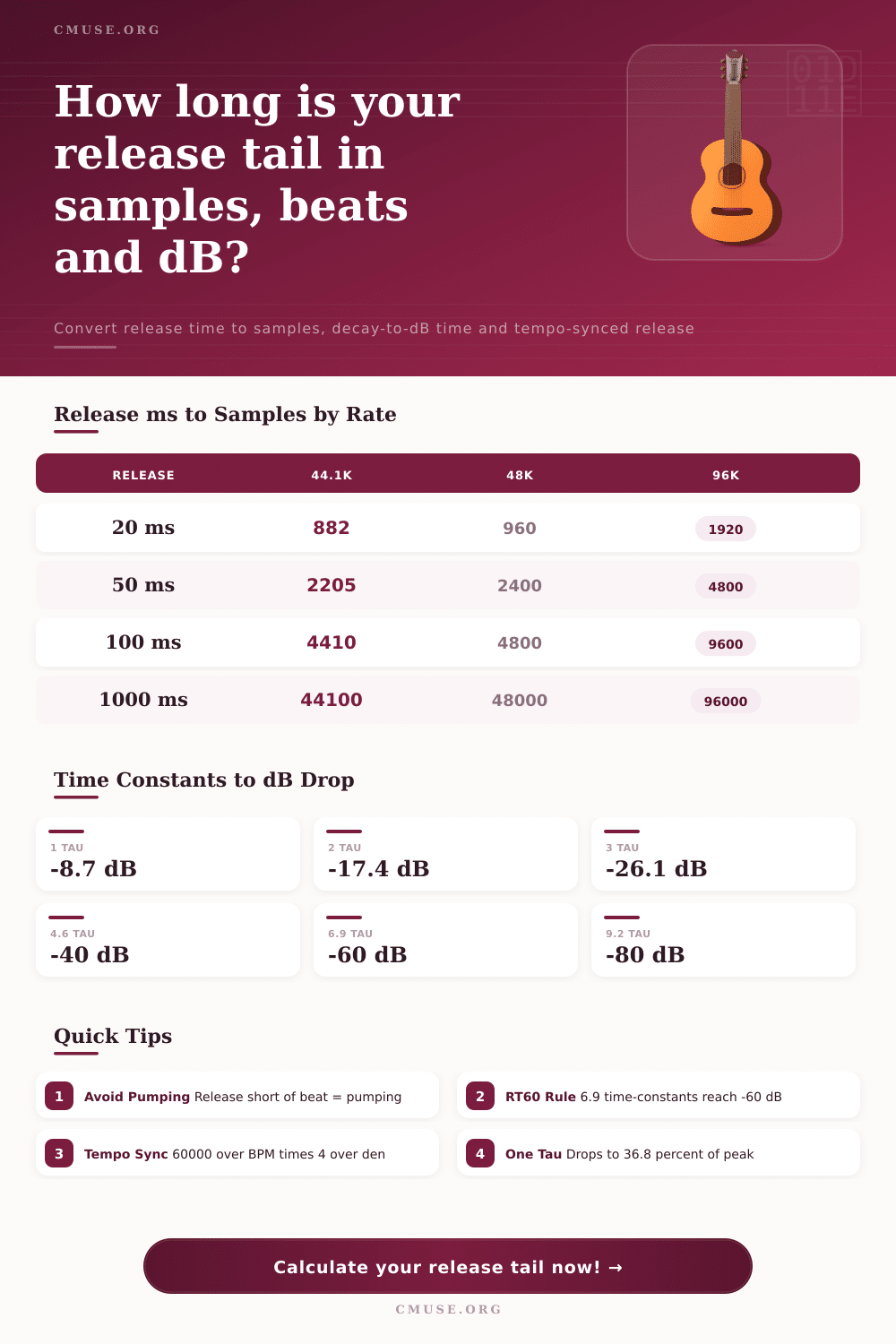
| Release ms | 44.1 kHz | 48 kHz | 96 kHz |
|---|---|---|---|
| 10 ms | 441 | 480 | 960 |
| 20 ms | 882 | 960 | 1920 |
| 50 ms | 2205 | 2400 | 4800 |
| 100 ms | 4410 | 4800 | 9600 |
| 500 ms | 22050 | 24000 | 48000 |
| 1000 ms | 44100 | 48000 | 96000 |
| 2000 ms | 88200 | 96000 | 192000 |
| Time-Constants | Level Remaining | dB Drop | Reaches |
|---|---|---|---|
| 1 tau | 36.8 % | -8.69 dB | One e-fold |
| 2 tau | 13.5 % | -17.37 dB | Audible decay |
| 3 tau | 5.0 % | -26.06 dB | Mostly gone |
| 4.6 tau | 1.0 % | -40.00 dB | -40 dB floor |
| 6.9 tau | 0.1 % | -60.00 dB | RT60 tail |
| 9.2 tau | 0.01 % | -80.00 dB | Silent |
| Note Value | Factor 4/den | Release ms | Tail Beats |
|---|---|---|---|
| 1/1 Whole | 4.0 | 2000 ms | 4.000 |
| 1/2 Half | 2.0 | 1000 ms | 2.000 |
| 1/4 Quarter | 1.0 | 500 ms | 1.000 |
| 1/8 Eighth | 0.5 | 250 ms | 0.500 |
| 1/16 Sixteenth | 0.25 | 125 ms | 0.250 |
| 1/32 Thirty-2nd | 0.125 | 62.5 ms | 0.125 |
| Marker | Formula | Result | Use |
|---|---|---|---|
| 1 tau | e^(-1) | 36.8 % | One time-constant |
| -60 dB | 6.9 × tau | 0.1 % | RT60 tail length |
| Samples | ms × SR / 1000 | Integer | Buffer sizing |
| Sync | (60000/BPM)×(4/den) | ms | Tempo lock |
The reason is compressor instability, where release time isn’t riding on the rhythm but fighting against it. What is end of a gain reduction envelope? Where does it go? Not nowhere, but in a clash with acoustic environment, the digital sample grid and next transient sound in the mix. A millisecond guess won’t cut it; you have to comprehend what a millisecond represent in terms of music, time, data points and dB drop. All that’s left for you after entering your desired release time, is for the calculator to do the math (above). No need to convert units, no need to guess at coefficients.
That leaves only one question: What sort of tail are you seeking? Do you want a snappy attack followed by a glued-together drum bus? Or something more like letting a pad swell into the mix? This is key distinction because digital audio is discrete and not continuous. How long is sound audible before it is hidden by background noise or next beat starts?
How to Choose the Right Release Time
For example, think about sample rate conversion. Your ear hears good chunk of time when a hundred milliseconds are released. That’s exactly four thousand four hundred and ten separate pieces of information at a rate of forty-four thousand one hundred hertz. Go up to ninety-six kilohertz and suddenly there is almost ten thousand samples being processed during that same hundred-millisecond span.
If you’re writing a plugin, it converts this immediately so you know what kind of load an algorithm will have or how long it takes to fill a buffer. But even if you don’t code, you may simply want to understand the amount of precision your dealing with in your DAW settings. A small detail, yes, but having high-resolution audio provide far greater control over decay curves.
Linear decay is not exponential. First, it’s not linear; it drops off exponentially, falling fast at first and then hanging on forever in theory. Instead, engineers describe how long it takes with something called a tau, a time constant. Tau describes how much energy remains one tau later which is around thirty-seven percent.
That’s why the release knob gets missed: we guess at where to set it based off the idea that “fifty milliseconds” should of been as good as gone, right? Wrong. Fifty milliseconds later the sound will have only diminished by about eight point seven decibels. If you want the sound to reduce by sixty decibels, essentially silence for most practical purposes, it will take almost seven time constants to get there. The table on the page spell it out nicely. That typical RT60 tail takes six point nine time constants.
Tempo synchronization is where music stops being just physics and starts feeling like a groove. At one twenty beats per minute, that’s a quarter note of five hundred milliseconds. A compressor release set to four hundred milliseconds would recover by then before the next beat hits. That would make the gain audibly pumping up and down between the hits. The accordion effect I talked about earlier create chaos. It sounds thin and nervous.
Here’s the catch. What are you really measuring? If you want the release to follow the beat in time (breathe with the track), you will sync the release on the grid. At one hundred and twenty BPM, a half-note release lasts one thousand milliseconds. This provides enough time for the gain reduction to relax before next measure arrives. To do the math: divide 60,000 by your tempo and multiply that number by the note value you select for your release. It is simple math, but it alters emotional weight of the mix. The compressor becomes part of the rhythmic fabric instead of an outside processor choking off the mix’s dynamics.
And finally, listen to what happens at the end of the note. Is there a controlled release? Or do you hear washing out into next transient? It’s your ears that will make the decision in the end, but these numbers get you started. Whether it’s a snare drum or vocals, knowing how many samples long your tail is allows you to trust your settings. You begin to shape rather than fight the plugin. Don’t forget, the space between the notes is every bit as important as the notes themselves. Treat it the same way.