Ritardando Tempo Calculator
Work out the exact duration of a gradual slow-down, its average effective BPM, the tempo change and the timing of every beat as the music decelerates from a faster start tempo to a slower end tempo
Full Calculation Breakdown
| Beat # | BPM at Beat | Beat Duration (ms) | Cumulative Time (s) |
|---|---|---|---|
| Press Calculate to generate the per-step ramp. | |||
| Term | Meaning | How It Changes | Typical Use |
|---|---|---|---|
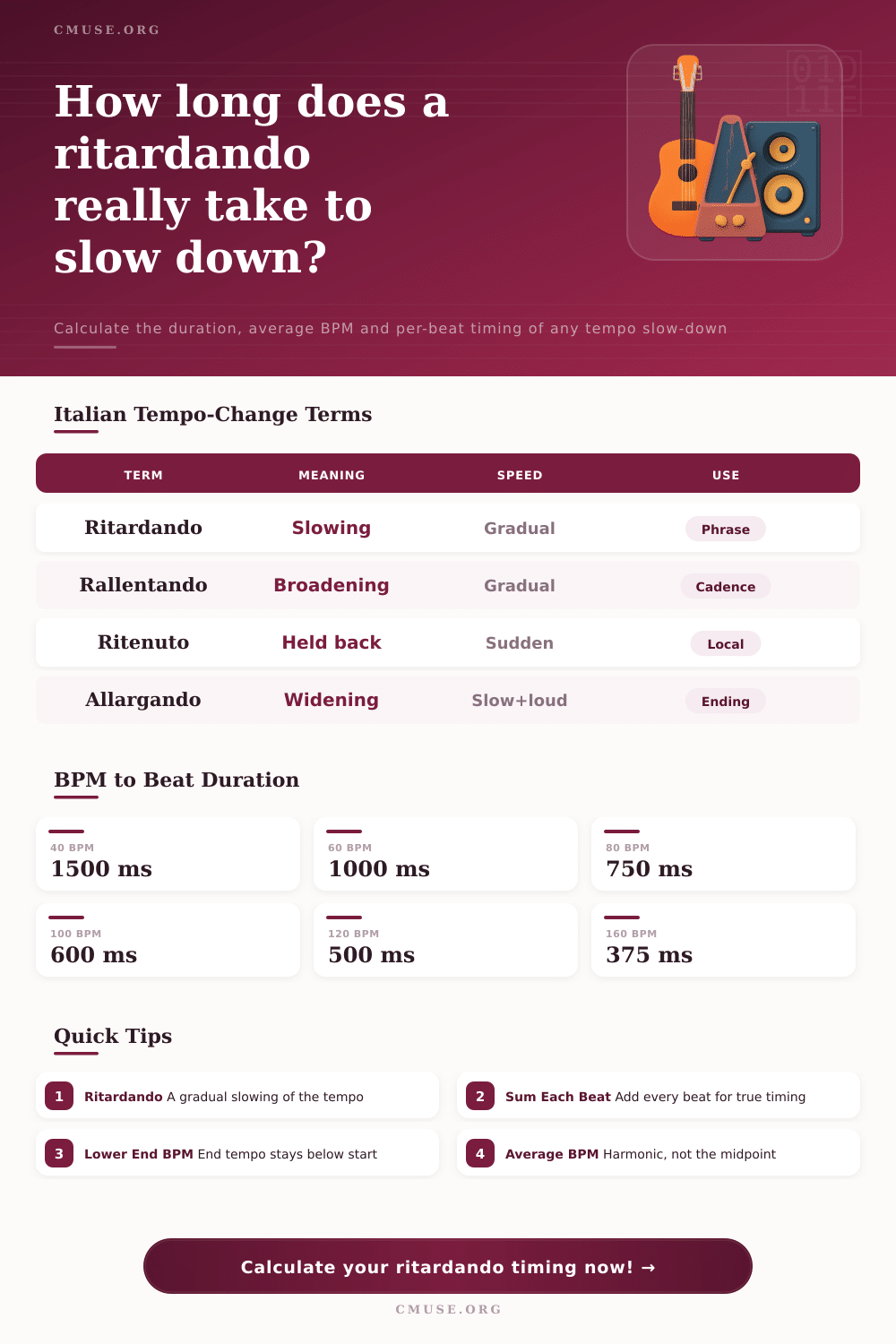
| Ritardando (rit.) | Gradually slowing | Smooth, progressive | End of a phrase or piece |
| Rallentando (rall.) | Gradually broadening | Smooth, often louder | Approaching a cadence |
| Ritenuto (riten.) | Held back / slower | Sudden, immediate | A single held moment |
| Allargando | Broadening & growing | Slower and louder | Grand final bars |
| Calando | Dying away | Slower and softer | Fade-out endings |
| Accelerando (accel.) | Gradually speeding up | Opposite of rit. | Building tension |
| BPM | Beat Duration (ms) | Beat Duration (s) | Feel |
|---|---|---|---|
| 40 | 1500 ms | 1.500 s | Grave / very slow |
| 50 | 1200 ms | 1.200 s | Largo |
| 60 | 1000 ms | 1.000 s | Larghetto |
| 72 | 833 ms | 0.833 s | Adagio |
| 90 | 667 ms | 0.667 s | Andante |
| 120 | 500 ms | 0.500 s | Moderato / Allegro |
| 160 | 375 ms | 0.375 s | Vivace / fast |
| Start → End | Span (beats) | Avg BPM | Total Duration |
|---|---|---|---|
| 120 → 60 | 8 | 83.3 | ~6.36 s |
| 140 → 70 | 16 | 96.9 | ~11.10 s |
| 100 → 80 | 16 | 89.3 | ~10.84 s |
| 90 → 50 | 8 | 67.3 | ~7.39 s |
| 72 → 48 | 8 | 58.7 | ~8.39 s |
| 80 → 40 | 8 | 57.7 | ~8.51 s |
At first glance, a ritardando appears straightforward. There it is on the score; you must slow down. However, in reality its somewhat fiddly. While most players will trust their ‘feel’ for this (fine if you improvise) it doesn’t help when trying to synchronize things or work out how long it should of take. That vague feeling of gradually slowing down won’t work if you are sequencing or playing with others in a band.
So what’s the solution? Enter the Ritardando Calculator. Simply enter starting tempo followed by ending tempo and the calculator does the rest. No more guessing at how long that transition will take in real time. It calculates the journey, not just start and end points.
How to Plan Your Slowing Down
So the basic idea with all this is that a ritardando are not a tempo in and of itself. It’s a ramp. From a given start point, you go somewhere else (over some number of bars or beats) at some speed, which we know are going to change. So the input becomes important to figure out what curve of that ramp looks like. How many beats do I want to use? What speed am I dropping?
In a situation where I’m asking you to drop from 120BPM to 60BPM over eight beats, well, let’s look at the math: We can see instantly how long those eight beats should collectively last. Will it be an easy ‘average’? No. Because time isn’t like that. As the tempo decreases, so too does the lengths of each subsequent beat. And therefore, longer beats account for more of the overall time then the earlier ones. Summing up duration of each individual beat gives us a more accurate picture than simply dividing the span into an imagined midpoint. This is why most folks who attempt to eyeball this process end up missing the mark.
It makes a difference when you understand what kind of curve to use. If it’s a linear ramp it will reduce the BPM by a fixed amount per each beat. That sounds like a mechanized thing, it sounds even and totally in control. With an exponential ease, it more closely mimics how things in the real world slow down due to gravity or friction. At first it slows down quite rapidly but as it approaches the final tempo, it hang there longer until finally arriving. This makes all the difference if you want something to dramatic accelerate or decelerate. Does it sound natural if slowed smoothly? Does it feel jarring if it is suddenly dropped? The tool allows you to switch back and forth from model to model to hear which best fits your musical intent. Basically, you’re selecting the curve or straight-line path that happens along same timeline.
The reference tables that appear on page put the numbers into common music terms. Ritardando indicates a slowing down generally towards the end of a phrase; rallentando indicates a broadening that can include raising the dynamic level. Ritenuto is far more abrupt: a hold-back interrupting the flow not easing into it. It helps knowing whether you need to slow down subtly or make a statement. In many cases, it’s best to have a gentler curve and a wider span as end of a ballad typically invites this, enabling the silence to breathe before the last note subsides. A dramatic climax may involve a steeper drop and a shorter span, creating the tension that resolves suddenly to stillness.
Another thing that throws folks for a loop is the average BPM. If you divide (120 + 60)/2, you get 90 as your answer. But, when calculating rhythms, we use what’s called the harmonic average. That will come out to something less than 90. Why? Rhythmic accumulation is measured by duration rather than frequency. The longer it take for something to happen, the more “weight” it has toward the total duration. Without factoring this into your arrangement, you’ll find yourself with something that either feels rushed at the end or runs long. The breakdown the tool offers also shows these per-step durations in a clear way. Exactly how many milliseconds does each beat last and how do they contributes to the overall time of the passage?
So in conclusion, precision is not against the creative process but instead underpins it. Once you know when to expect a change, you can confidently insert dynamic swells, accents, or harmonic changes. What happens? You no longer fight against time once you start working with it. Whether you are arranging tracks on a digital audio workstation, playing in a jazz combo, or conducting an orchestra, having the figures gives you clarity over your artistic decisions. It’s often just being aware of when the next breath occurs that makes all the difference between a crisp change or a muddled slow down. Then once the timing is established, the feel will follow. And finally, this measured assurance lets the music breathe precisely how you intend.