Balanced Tension String Calculator
Choose gauges so every string pulls the same tension — even feel, smoother bends, and no more outlier G string
Per-String Breakdown
| String | Note | Target lb | Balanced Gauge | Standard Gauge | Standard lb |
|---|
| Note | MIDI | Frequency (Hz) | Common Role |
|---|---|---|---|
| B1 | 35 | 61.74 | 7-string low B |
| D2 | 38 | 73.42 | Drop D / D Std 6th |
| E2 | 40 | 82.41 | Standard low E |
| A2 | 45 | 110.00 | 5th string |
| D3 | 50 | 146.83 | 4th string |
| G3 | 55 | 196.00 | 3rd string (outlier) |
| B3 | 59 | 246.94 | 2nd string |
| E4 | 64 | 329.63 | High E |
| Set | Gauges | Highest String | Lowest String | Spread (lb) |
|---|---|---|---|---|
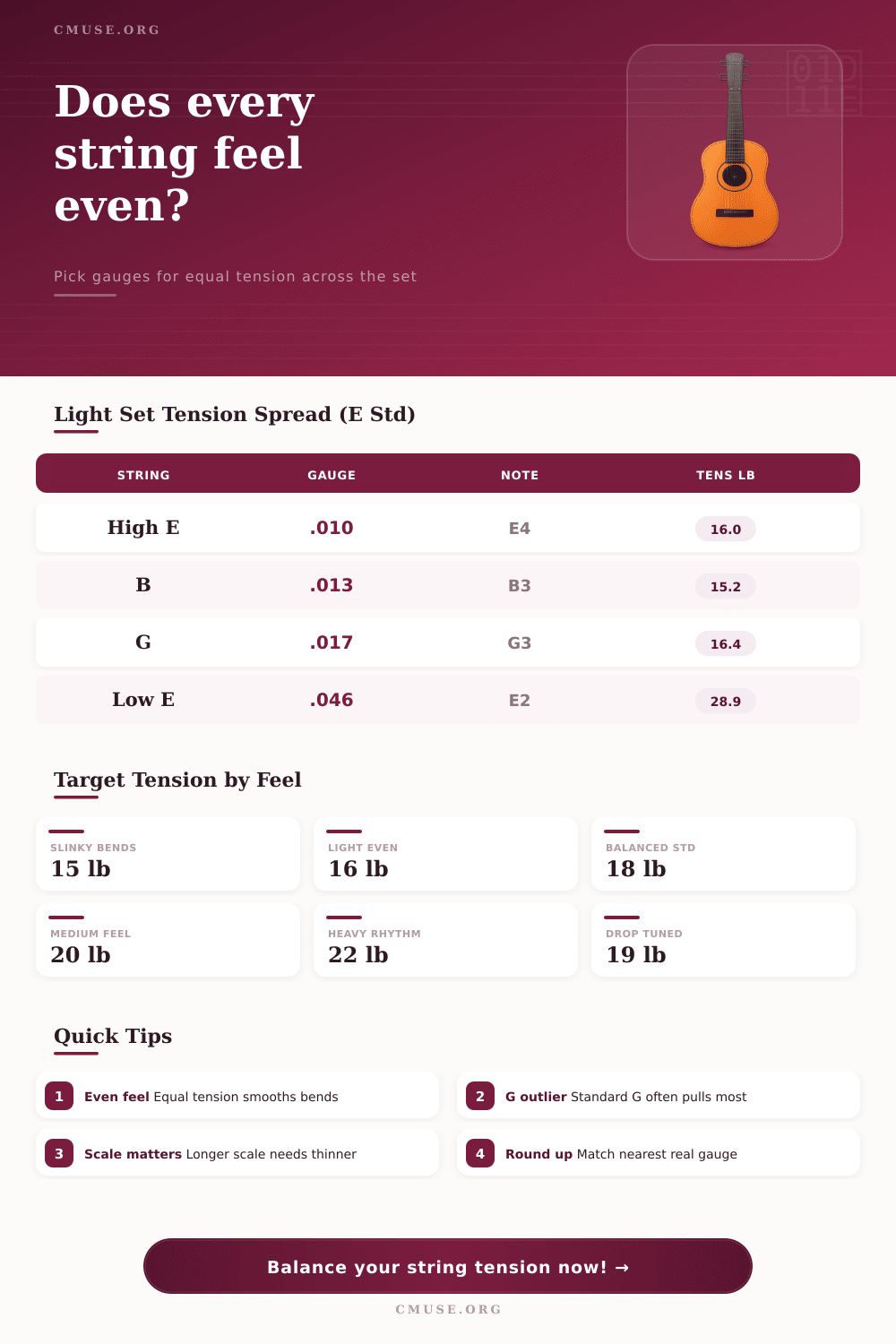
| Light 10-46 | .010 .013 .017 .026 .036 .046 | D3 .026 (~29 lb) | B3 .013 (~15 lb) | ~14–16 |
| Medium 11-49 | .011 .014 .018 .028 .038 .049 | D3 .028 (~33 lb) | B3 .014 (~18 lb) | ~15–17 |
| Heavy 12-54 | .012 .016 .024 .032 .042 .054 | G3 .024 (~38 lb) | E4 .012 (~23 lb) | ~15–18 |
| Style | Target lb | Feel | Best For |
|---|---|---|---|
| Slinky lead | 14–15 | Easy bends | Blues, solos |
| Light even | 16–17 | Balanced light | Pop, indie |
| Standard balanced | 18–19 | All-round | Rock, versatile |
| Medium | 20–21 | Firm attack | Rhythm, jazz |
| Heavy rhythm | 22–24 | Tight, loud | Drop tuning, metal |
If you pay attention to the way your fingers feels on the B string versus the G string when you’re bending, you’ll find your hand wants to pull harder on the G string. Why? Because the B string feel loose and the G string feels stiff. It is not because there’s anything wrong with your technique; this isn’t a lack of skill. It’s physics. Factory sets are geared towards manufacturing convenience rather than ergonomic consistency. Usually the third string will be somewhere between wound and plain construction, which cause a spike in tension and throws off your muscle memory as you change from one string to another.
The trick is balancing the tension by making gauge of each string equal so they all pull equally on the neck. That’s what turns it from a bunch of random wires into one voice. There is some pretty complicated math involving material density, pitch frequency, and scale length. The tool above does that math for you to recommend a custom set that evens out that curve. All you have to do is decide if you want it to feel lighter or heavier.
Why Your Guitar Strings Feel Different and How to Fix It
Begin by selecting the desired tension on each string. Tension per string will determine how stiff or slinky the entire set is going to be. Fifteen pounds per string is like a slinky guitar perfect for open, easy-to-vibrate vibratos and blues licks. Bump it up to twenty-two pounds and you’re in tight rhythm territory; chords remains articulate even when heavily strummed. Sweet spots falls somewhere around eighteen to nineteen pounds. That’s plenty of tension to avoid unwanted buzzes but not so much as to require superhuman fingers.
This all has to do with scale length. With a longer neck, you have to apply more tension to get that same gauge of wire up to pitch. So that set of standard gauges might be too loose when you go from Gibson to Fender. That’s where this variable comes into play in the calculator. You tell it what type of instrument you’re playing, what key it’s tuned to, and it’ll adjust the suggested diameters based off your input.
Why generic recommendations don’t work. A.010 high E string on a twenty-five inch scale feels totally different than one on a twenty-point seven-scale baritone. Geometry counts more, and material matters too, but not as much. Nickel-plated steel is lighter than stainless. So if you like the brighter sound but need an even feel, just use thinner gauges. The system consider density when it calculates everything. This means switching from nickel to stainless on an electric, or bronze for acoustic, won’t suddenly make the neck rigid.
Run this calculation and look at per-string breakdown. Chances are you’ll notice a drastic change in the gauge of the G string from what came stock. While its neighbor may rest at fifteen pounds, factory strings tend to draw nearly twenty on the G string. Depending on what you’re trying to achieve, balancing out might call for a.016 or even a wound.015. That’s right, thinning down that third string actualy seems counter intuitive, but that’s what cures the stiffness. The comparison chart provided below shows the extreme lopsidedness common with these sets off the shelf.
Don’t be afraid to go custom If you purchase packs, it’s easy to think you’re limited to matching sets. If you want to emphasize feel over packaging convenience, then custom is the way to go. You’ll quickly notice how inconsistent normal packs are once you’ve experienced a balanced set. Your bending accuracy improve because you no longer need to adjust for varying resistance.
Frequency and tuning guides are supplied by company in the form of a set of reference tables. These will check your input against your desired outcome. For example, if you drop down to D standard, you must use a heavier gauge on the lower strings. This keeps them in proportion with the higher ones to retain tension balance. Failure to do so result in floppy basses and tense trebles. The system balances everything out across the range.
In the end, however, it should of be that your guitar becomes as much an extension of your arm as anything else. And you won’t have to puzzle it out each time you try to play a new chord. You won’t have any more distracting physical elements to smooth over. You can phrase instead of struggle against the instrument. Complex passages becomes easier when the mechanics are expected. The feel is key, even then. If all the strings pull in the same direction, your hands just follow the music.