8 String Tuning Calculator
Find your low F# note, frequency and per-string tension, then dial in the right low-string gauge and scale
Per-String Breakdown
| String | Note | Freq (Hz) | Gauge (in) | Tension (lbs) |
|---|---|---|---|---|
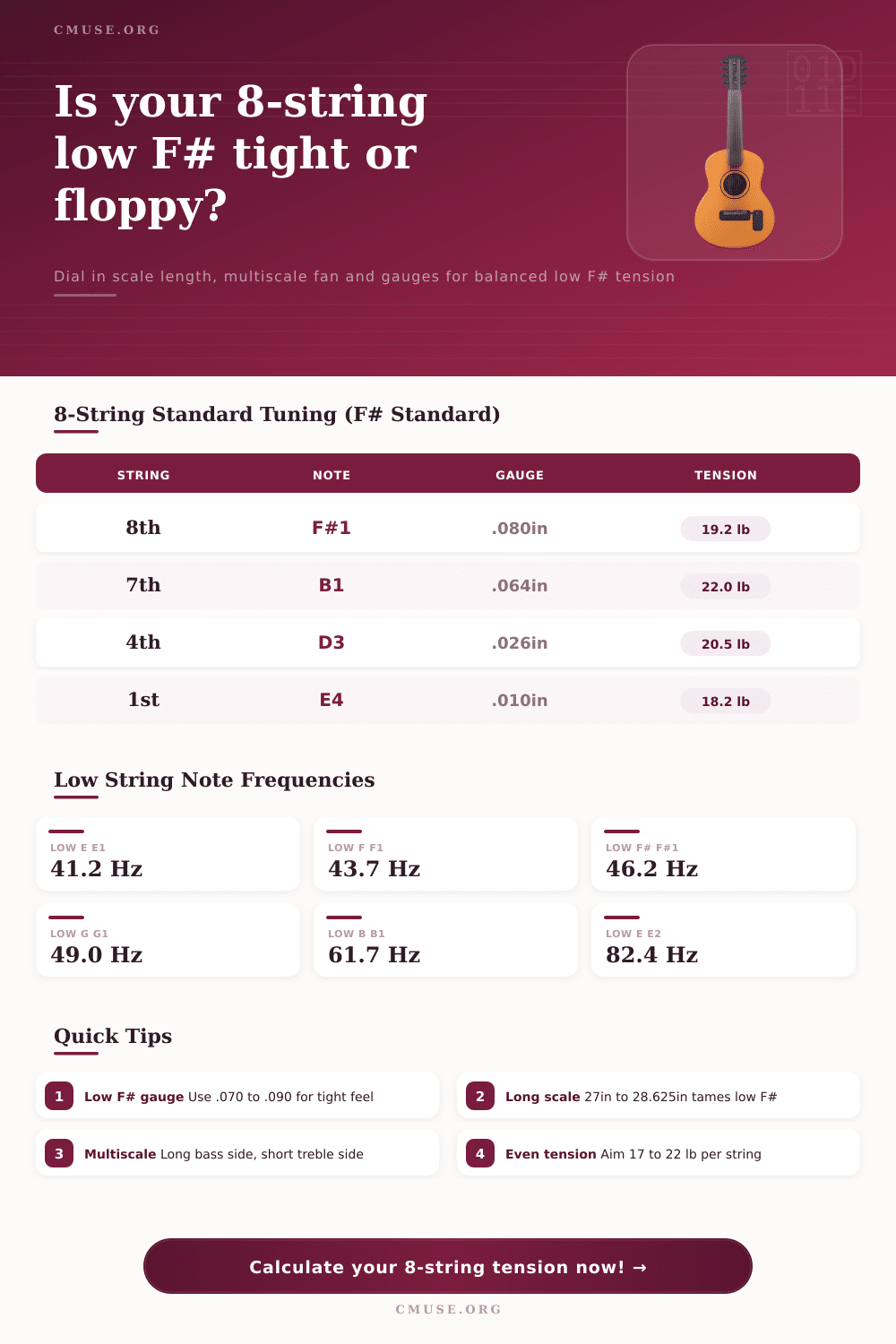
| 8th (low F#) | F#1 | 46.25 | .080 | 19.2 |
| 7th | B1 | 61.74 | .064 | 22.0 |
| 6th | E2 | 82.41 | .046 | 20.2 |
| 5th | A2 | 110.00 | .036 | 22.0 |
| 4th | D3 | 146.83 | .026 | 20.5 |
| 3rd | G3 | 196.00 | .017 | 18.6 |
| 2nd | B3 | 246.94 | .013 | 17.3 |
| 1st | E4 | 329.63 | .010 | 18.2 |
| Tuning | 8th (Low) | Strings 7 to 1 | Typical Scale |
|---|---|---|---|
| F# Standard | F#1 | B1 E2 A2 D3 G3 B3 E4 | 27 to 28.625in |
| Drop E | E1 | B1 E2 A2 D3 G3 B3 E4 | 27 to 28.625in |
| E Standard | E1 | A1 D2 G2 C3 F3 A3 D4 | 28 to 30in |
| F Standard | F1 | A#1 D#2 G#2 C#3 F#3 A#3 D#4 | 27 to 28.625in |
| Drop D# | D#1 | A#1 D#2 G#2 C#3 F#3 A#3 D#4 | 27in plus |
| F# Multiscale | F#1 | B1 E2 A2 D3 G3 B3 E4 | 25.5 to 28.625in fan |
| Scale Length | Light Feel | Balanced Feel | Tight Feel |
|---|---|---|---|
| 25.5in (short) | .080 | .086 | .090 |
| 27.0in | .074 | .080 | .086 |
| 28.0in | .072 | .077 | .082 |
| 28.625in | .070 | .075 | .080 |
| 25.5 to 28.625 multiscale | .070 | .075 | .080 |
| Note | MIDI | Freq (Hz) | Common Use |
|---|---|---|---|
| D#1 / Eb1 | 27 | 38.89 | Drop D# 8-string |
| E1 | 28 | 41.20 | Drop E / E Standard low |
| F1 | 29 | 43.65 | F Standard 8-string |
| F#1 / Gb1 | 30 | 46.25 | F# Standard 8-string |
| G1 | 31 | 49.00 | G tuned 8-string |
| B1 | 35 | 61.74 | 7th string of 8-string |
| D3 | 50 | 146.83 | 4th string reference |
When you tune an eight-string guitar down to F# standard and then pluck that lowest string it can cause a certain degree of panic. Instead of a clear note, what you hear is a slap of wood and loose cable. The pitch of the low F1 are around 46 Hertz. Playing a steel string on a traditional 25.5-inch scale is a physical challenge. You’re asking a thin piece of metal to be both tight enough to articulate fast riffs while vibrating slowly enough to create sub-bass frequencies.
Most players assume solution must be using heavier strings. Weight alone though will rarely solve this problem. The real cause is more often then the geometry of the instrument itselfs. After plugging in what tension you’re looking for (and scale length) it does the math so you don’t have to guess at whether something’s physicaly possible.
How to Set Up Your Eight-String Guitar
Then you input distance from the nut to the bridge for the treble strings. If you have a multiscale neck like many fan fret guitars do these days, you also input the distance for the longest string on the bass side. From there, it assumes you want nickel wound strings or maybe stainless steel ones and just uses the standard gauges as a starting point. Then it spits out the tension each string create in pounds. It also flags the imbalance.
So if your high E string reads twenty-five pounds and your low F# registers fifteen, you’ve got a twisted looking-for-something-to-do neck that doesn’t feel good when you bend or fret any of those strings. You don’t necessarily want the same tension throughout, but something that’s balanced so no single string feels like it will snap or flopping during a bend.
So what does all this mean in terms of a usable instrument? It’s important to understand how scale length works into the equation. Tension is a product of pitch, gauge, and vibrating length. In other words, if you tune down two whole steps from standard (E to F#), the frequency has decreased substantialy. The only way to maintain similar tension would be to use a thicker string, or stretch out the scale.
Eight-strings have a current benchmark of a twenty-seven inch scale, which still offers adequate leverage to tighten-up those bottom strings while not going so far as to require excessively bulky gauges that is difficult to fret easily. Moving up to a twenty-eight-point-six-two-five inch scale gives us added clarity. However, it also presents some new ergonomic issues with our hand stretches. Multiscale designs excel here by being able to deliver the best of both worlds.
The treble side is kept short enough so you can play comfortabley with leads, but they add additional length on the bass side to tighten up the low F#, which is great because it’s a compromise that honors both the anatomy of your fingers as well as physics of sound. A final factor is what material the strings are made of. Although we often think of this in terms of tone, it also make a difference in the tactile experience of playing the instrument.
At the same exact pitch and gauge, a string made of stainless steel will be denser and consequently harder than one made of nickel-plated steel. So if a stiff feel is something you’re okay with and you like a crisp attack, stainless may be the way to go. But if you like a bit more “give” and a warmer tone, stick with nickel or coated strings. The calculator’s tension reading takes all of this into account when calculating densities. This ensures the tensions shows as real-world values instead of an average across all materials.
Also, do you want your left hand pressed hard against the fretboard? While heavier tension provides better sustain and intonation, it also tires your hands over time. It’s always a give-and-take between accuracy and comfort.
While we tend to focus on tuning the lower strings, many players… And builders, forget about balance of the higher ones. A set with a tight low F# and a floppy high E is just as problematic as one where everything is too stiff. Before it becomes a structural problem, use this tool’s per-string breakdown to identify the imbalance. Ideally, you want the average tension to feel uniform throughout the neck; typically this will fall somewhere between seventeen and twenty-two pounds per string.
When one string seems much looser, or tighter. Than the rest, tweak the gauge up or down until you find the sweet spot at which point the curve will level off. It makes all the difference in going from being able to play an instrument to feeling like you know how to play it.
In conclusion, tuning an eight-string isn’t so much about getting it “just right” as it is understanding how each variable, string length, mass, and corresponding pitch, is related. Moddern technology helps you see those variables in action, yet ultimately, it’s the ear that makes the call. Begin with suggestions from the calculator and adjust them to match how you play.
Too muddy on the low end? Consider increasing either gauge or scale length. Consider reducing both gauge and scale length. Too slack? Increase either (or both) of the above. No one formula fits all. Only your own tone and hand shape will do. It takes time and some experimentation, and it’s an iterative process.
But when you do find that magical spot in which all strings speak equally well, the wider neck feels more like an extension of yourself rather than a liability. And it’s worth every moment of fiddling (pun intended) to measure and adjust for that clearness. You should of checked the math before playing.