Baritone Tuning Calculator
Find string tension, frequency and recommended gauges for any baritone scale length and low tuning
Pick a real baritone setup to auto-fill the form and calculate instantly.
Per-String Breakdown
| String | Note | Freq (Hz) | Gauge (in) | Tension (lbs) |
|---|---|---|---|---|
| Run the calculator to populate per-string results. | ||||
| Scale Length | Style | Best Tunings | Feel |
|---|---|---|---|
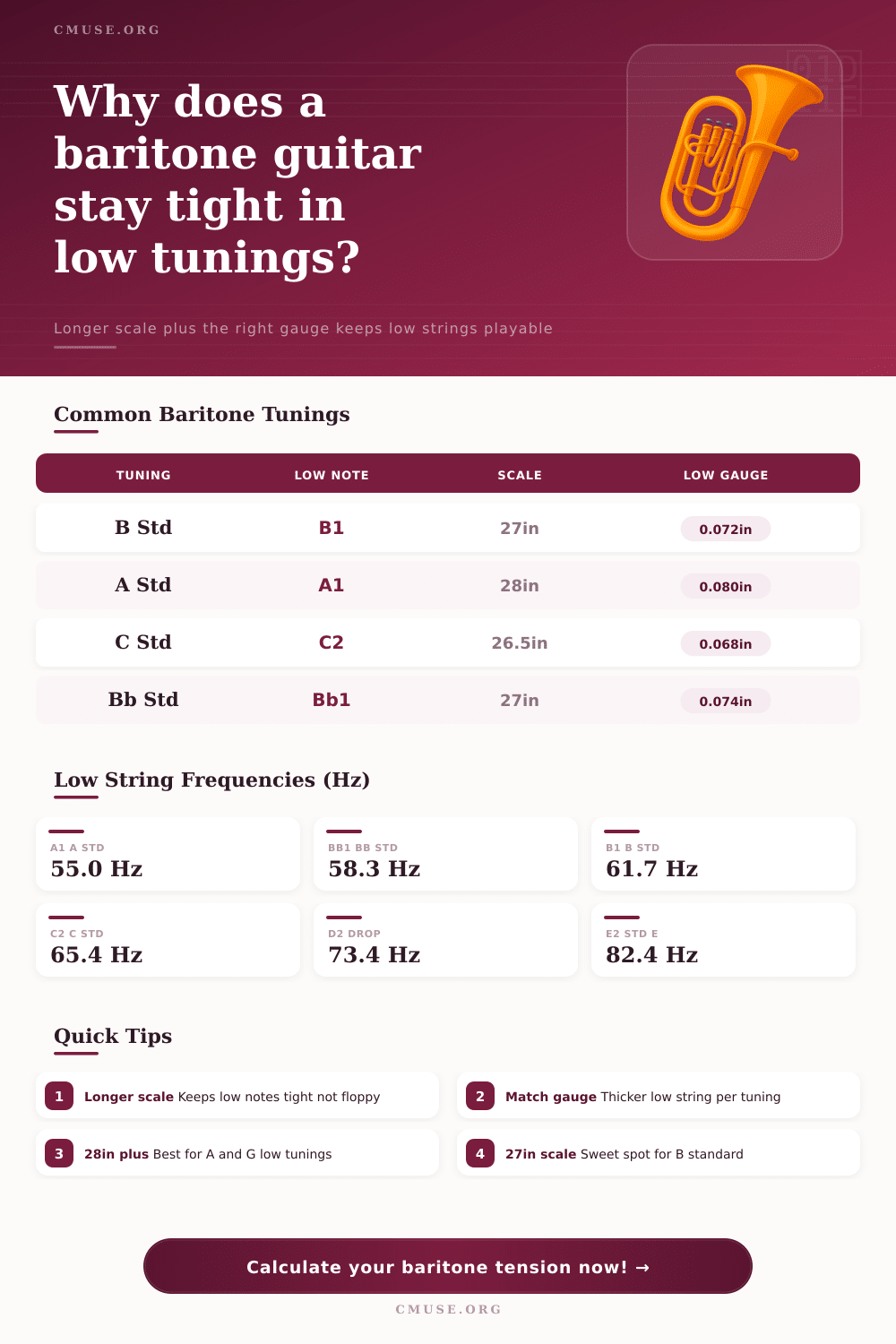
| 26.5in | Short baritone | C / C# standard | Closer to standard reach |
| 27in | Common baritone | B standard, Drop A | Tight low end, easy reach |
| 28in | Extended baritone | A / Bb standard | Very stable low strings |
| 28.625in | Long baritone | A standard, Drop A# | Stiff, defined low notes |
| 30in | Bass baritone | A standard, octave low | Near-bass tension and tone |
| Tuning | Low to High | Low Note Hz | Typical Scale |
|---|---|---|---|
| C Standard | C2 F2 A#2 D#3 G3 C4 | 65.41 Hz | 26.5in |
| B Standard | B1 E2 A2 D3 F#3 B3 | 61.74 Hz | 27in |
| Bb Standard | Bb1 Eb2 Ab2 Db3 F3 Bb3 | 58.27 Hz | 27in |
| A Standard | A1 D2 G2 C3 E3 A3 | 55.00 Hz | 28in |
| Drop A | A1 E2 A2 D3 F#3 B3 | 55.00 Hz | 27in |
| Drop G# | G#1 D#2 G#2 C#3 F3 A#3 | 51.91 Hz | 28in |
| Tuning | Low Note | 27in Gauge | 28in+ Gauge |
|---|---|---|---|
| C Standard | C2 | 0.064-0.068in | 0.062-0.066in |
| B Standard | B1 | 0.068-0.074in | 0.066-0.072in |
| Bb Standard | Bb1 | 0.070-0.076in | 0.068-0.074in |
| A Standard | A1 | 0.074-0.084in | 0.072-0.080in |
| Drop A | A1 | 0.072-0.080in | 0.070-0.078in |
| Drop G# | G#1 | 0.076-0.086in | 0.074-0.082in |
When you take that same baritone guitar, your notes will actualy sing instead of just fluttering. Why? Because your string aren’t singing, they’re fluttering. That’s because baritones aren’t simply big guitars with weird strings. Instead, they are instrument built to maintain reasonable tension as you lower the pitch. Your low strings doesn’t go floppy and muddy; they stay tight and clear.
The physics is simple, yet many players has an issue buying a long-scale instrument without knowing why that scale make a difference. Below B standard, the string is simply not long enough to stretch properly on a typical 25.5″ guitar. Adding a heavier gauge will help but at some point, the string becomes too inflexible to pluck, bend, or fret well.
How to Pick the Right Strings for Your Baritone Guitar
By extending length of vibration into a baritone, you’ll typically find yourself somewhere closer to 27 inches but sometimes as much as 30 inches if you’re really going for those bassy tones. That added span require the string to be pulled tighter to produce an equivalent note to one on a shorter guitar. A tighter string mean better sustain and a clearer attack. It is a tiny mechanical adjustment, but it totally alters the sound and feel of instrument in your hands.
Once you know what gauge you want to tune your baritone guitar to (and what scale length), you can enter those variables into the calculator above that does all the work for you. Plug it in, and it’ll spit out the recommended gauges for each string as well as their resulting per-string frequency. And no, you don’t necessarily need to remember this coefficient stuff. You simply need to see that material density, nickel-plated steel versus phosphor bronze; affects string tension and thus which gauge works best at any given pitch.
For instance, if you like about 22 pounds of tension-per-string, you’re looking for something in the sweet spot. The string feels responsive, but it isn’t impossible to bend. Neck is stable enough.
When it’s time to pick out a new bass at this length (i.e., 27-inch vs 28-inch), your hand size and how far you want to tune become the deciding factors. If you plan on playing in B standard or drop A tunings, then 27 inches is ideal. For many, this scale allow for comfortablely playing with a little extra tension needed for chords in the lower registers.
But once you begin to drop into A standard or below, you may find thick strings a bit too slack on a shorter scale. At that point, going up a half inch to 28 inches or longer can help stretch the lowest note, such as G# or A string, into place nicely against the frets. Your left hand now has a bit of push back as it pushes down onto the string. This add more definition to the tone, keeping it tight and out of the muck when digging in hard for rhythms.
The type of string also matters more then many people know. A nickel plated string is lighter than a stainless steel string. So if both were the same diameter, the string would be tuned to a higher pitch and thus have greater tension. Changing string types without changing your expectation for gauge may result in a drastically different feeling different than what you’re used to. This tool takes that into account when comparing strings of different densities. It shows how something like a steel set might feel compared to a phosphor bronze set on your particular scale. It eliminates the guesswork involved in trying out different strings.
The mistake many players make is assuming that if it’s a long guitar then it must be a baritone. That isn’t quite true. To get a baritone you want a longer scale but also a matched string set tuned to handle the reduced tension limits. If you put regular light strings on a 30-inch neck they will create a crazy amount of tension that will hurt you or at least cause your neck to warp. If you use heavy gauges made for a baritone on a short neck, there is no way it will ever produce the correct pitch. It’s about balancing the three things: target pitch, string gauge, scale length.
This is where those presets comes into play. They provide a starting point. From there, you can tweak each input to suit your preferences, such as tighter strings for aggressive picking or looser tension for easier bending. The caveat here is to maintain consistency within the set. Nothing good comes of having a low E that’s too tight and a high B that’s too loose. You’ll be all over the place on the neck in terms of playing technique.
In conclusion, getting a baritone guitar set up properly comes down to achieving the right balance between it feeling like part of your arm versus something cumbersome to lug around. With the string tension dialed-in, the lower strings will sing clearly, no more blurring into confusion. You’ll still have plenty of body to the tone while retaining playability. Keep in mind that having a longer scale require heavier strings to maintain tension. When you get the right combination, the guitar won’t fight back; it will sing for you.
You should of used heavy gauges.