Saddle Compensation Calculator
Dial in guitar intonation with per-string saddle setback from action, gauge & scale.
Geometry Breakdown
Estimates use a geometric stretch model and are approximate; always verify with a tuner.
| String | Gauge (in) | Type | Setback (mm) | Setback (in) |
|---|
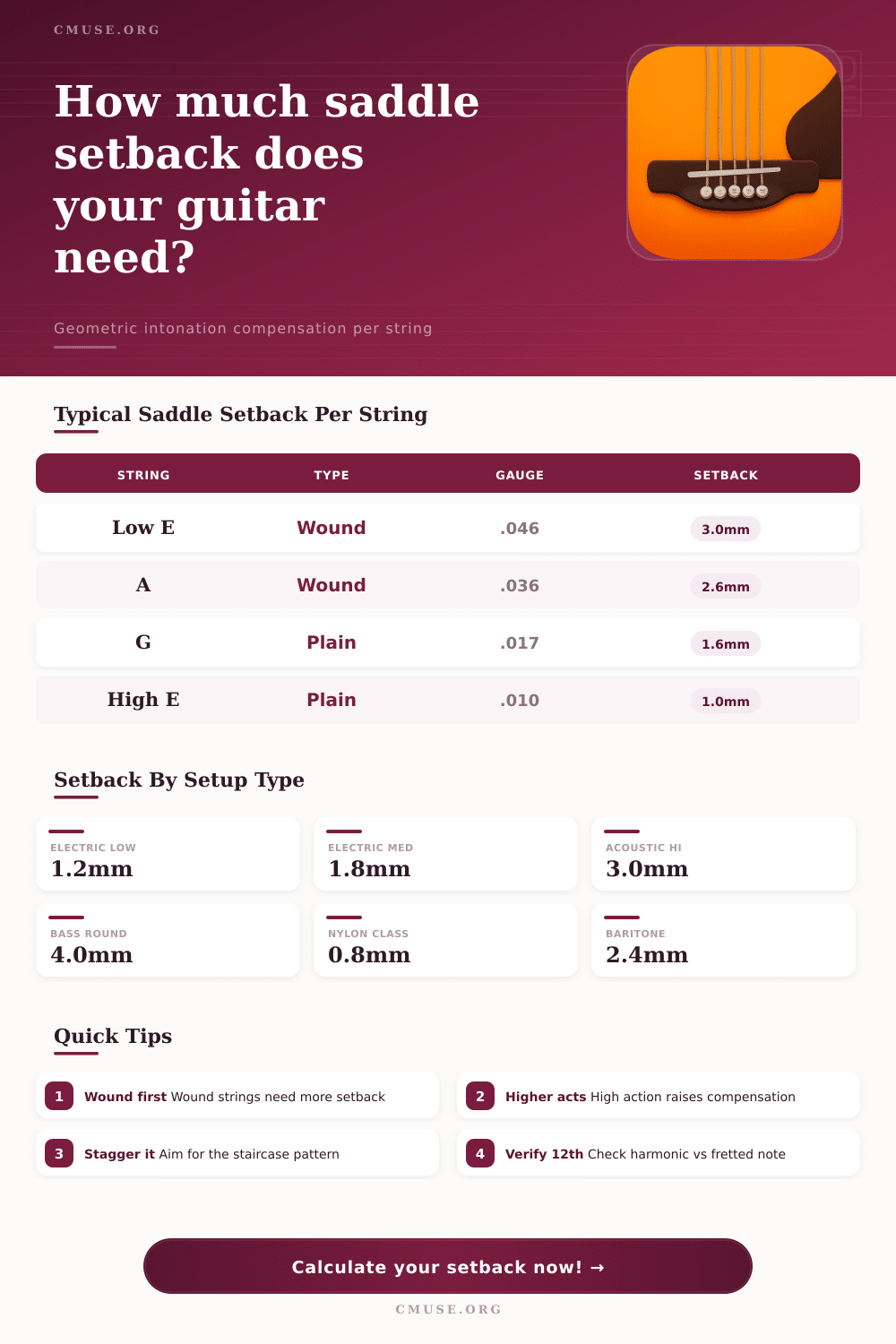
Notice the classic "staircase" pattern: wound bass strings sit further back than the plain treble strings.
| String Class | Example Gauge | Typical Setback | Notes |
|---|---|---|---|
| Plain treble | .009–.013 | 0.8–1.6 mm | Least compensation |
| Plain mid (G) | .016–.018 | 1.4–1.9 mm | Often the trickiest plain string |
| Wound mid (D) | .024–.028 | 2.0–2.6 mm | More mass, more stretch |
| Wound low (A/E) | .036–.046 | 2.6–3.4 mm | Largest setback |
| Setup Style | Action @ 12th (mm) | Action @ 12th (in) | Feel |
|---|---|---|---|
| Electric low | 1.2–1.6 mm | .047–.063" | Fast, shred-friendly |
| Electric medium | 1.8–2.2 mm | .071–.087" | Balanced all-round |
| Acoustic standard | 2.4–2.8 mm | .094–.110" | Strong projection |
| Acoustic / slide high | 3.0–4.0 mm | .118–.157" | Buzz-free, slide-ready |
| Action @ 12th | Approx Cents Sharp | Audibility | Setback Trend |
|---|---|---|---|
| 1.0 mm | ~3–5 cents | Subtle | Low |
| 2.0 mm | ~8–14 cents | Noticeable | Moderate |
| 3.0 mm | ~18–28 cents | Clearly sharp | High |
| 4.0 mm | ~30–45 cents | Very sharp | Maximum |
Cents figures are model approximations for a typical mid-string and scale; gauge and tension shift the exact value.
Intonation problems are something all guitarist will run into sooner or later. You can get the open strings in perfect tune and cleanly play a G major chord on the twelfth fret, however it sounds like you’re playing along with a slightly out of tune piano.
This isn’t because your ears are beginning to fail; it’s simply a matter of guitar geometry that fight for accurate pitch. When you press a string down onto a fret it increase its tension and therefore pitches it higher. If the string isn’t corrected, then the note played will be noticeable sharp. The correction to this problem is called saddle compensation which move the contact point further back. This extends the string so as to cancel effect of the stretch. It is a small physical change but it makes the difference between correct intonation or not.
How to Fix Guitar Intonation
This does require some math, but you don’t need graph paper, a protractor, or other tools. On the page, there’s a calculator that figures out the geometry for you. It models the string’s path along the fretboard when fretted compared to It compares the string’s path along the fretboard when fretted to its ideal open length. Its ideal open length.
First, you enter in your scale length; the distance from your nut to the saddle. This sets baseline against which everything else gets calculated. Next, enter in your action height at the 12th fret. This one is critical, as most folks completely ignore it. The taller the strings ride above the fretboard, the farther they has to stretch to get to their metal resting place. That added stretch causes an increased pitch error which requires a larger setback at the saddle. If you’ve got a setup designed for aggressive strumming or slide playing, you’ll need much more compensation than somebody who plays with low-action setup.
Gauge of strings has just as much impact on this equation. The heavier or thicker the string, the stiffer it will be and therefore harder to bend than the thinner strings. Because of this stiffer nature, the string stretch more under finger pressure when fretted, requiring a greater setback to reset the pitch. That’s what causes the saddle to never dissapears straight across. Instead, it resembles a stair step where each successive string get stepped back further as it gets thicker.
This happens because the bass strings are wound. They have more mass and therefore more stiffness which makes them want to jump up higher on the spike when fretted. Conversely, the treble strings (plain steel) is thin and elastic so they sit furthest to the front. Knowing this gives you an instant tell on a bad saddle. If yours had been sanded flat across all six location, your guitar would of never played in tune beyond the 5th fret.
These variables can be adjusted on the fly, so you can tweak them and view the effect it has on the mathematics. For example, hold the gauge steady but increase the action height. See what happens as necessary setback increases. Then move up to a heavier gauge at the same height. See the difference? It also displays the pitch error in cents, which helps to understand just how off-pitch your guitar is going to be if not compensated for. Three cents may not seem like much until you’re performing or recording alongside other players who take notice. Then three cents sounds muddled.
That’s how most luthiers work: by trial and error, adjusting the saddle and listening for the sound of the fretted note against the harmonics of the 12th fret. If you’re not sure where to start though, it can be maddeningly slow. The calculator gives you a starting point that’s typically within a millimeter or two of the finished position. Fine tuning from there will involve micro-adjustments, not guesses.
Keep in mind we’re making these assumptions about ideal neck relief and intonation, but real instruments has quirks. There is no such thing as a “normal” instrument. String manufacturing varies. Nut slots may be off. Frets wear down. All of these factors change your needs a little bit. These are guidelines. These are not absolute truths. Get as close as possible and let your ears do the rest (quarter-millimeter!).
When the staircase comes out right, it’s like having a guitar that plays with you instead of against you. Once those open chords sound as good as your twelfth fret does, you’ll ask yourself what you were thinking when you didn’t take the time to make sure they did.