String Tension to Pitch Calculator
Convert scale length, tension and gauge into a real frequency, note and cents offset
Full Calculation Breakdown
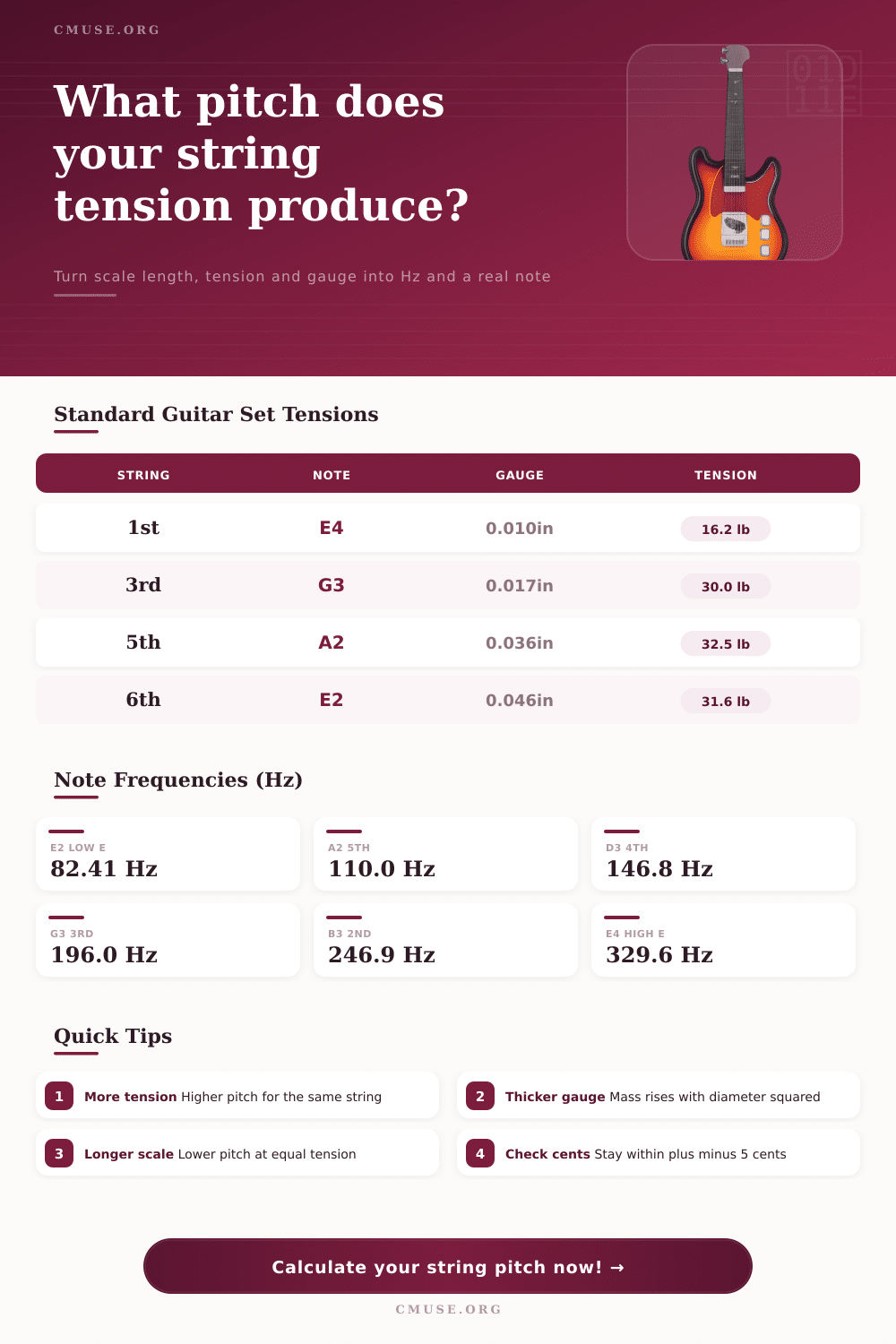
| String | Note | Gauge | Approx Tension |
|---|---|---|---|
| 1st (High E) | E4 | 0.010in | 16.2 lb |
| 2nd (B) | B3 | 0.013in | 15.4 lb |
| 3rd (G) | G3 | 0.017in | 30.0 lb |
| 4th (D) | D3 | 0.026in | 32.0 lb |
| 5th (A) | A2 | 0.036in | 32.5 lb |
| 6th (Low E) | E2 | 0.046in | 31.6 lb |
| Note | Frequency (Hz) | MIDI | Wavelength 2L* |
|---|---|---|---|
| E2 | 82.41 Hz | 40 | 1.295 m |
| A2 | 110.00 Hz | 45 | 1.295 m |
| D3 | 146.83 Hz | 50 | 1.295 m |
| G3 | 196.00 Hz | 55 | 1.295 m |
| B3 | 246.94 Hz | 59 | 1.295 m |
| E4 | 329.63 Hz | 64 | 1.295 m |
| Material | Density (kg/m³) | Common Use | Type |
|---|---|---|---|
| Plain Steel | 7850 | Treble strings | Plain |
| Nickel-Plated Steel | 8100 | Wound core/wrap | Wound |
| Phosphor Bronze | 8800 | Acoustic wound | Wound |
| 80/20 Bronze | 8750 | Bright acoustic | Wound |
| Nylon | 1150 | Classical treble | Plain |
| Fluorocarbon | 1780 | Classical/uke | Plain |
When you’ve just strung up some fresh guitar strings you might notice that low A sounds loose and high E is tight. That’s not because your hearing has gone wrong; it’s physics. If you stop guessing and start doing some calculations, you can predict what will happen. Most musicians think that tuning is simply rotating the pegs until tuner reads green, and completely overlook bigger picture.
Strings has three variables: mass, length, and tension. All are responsible for pitch of the string. Changing any one of them without altering the other two result in an unplayable instrument. Once you know how much tension you want, your desired gauge (string thickness), and your scale length, plug numbers into calculator up top, and it does the rest for you. You do not need to convert units or fumble around with density coefficients that looks less like music and more like a chemistry problem. But knowing what these numbers represent will enable you to have some control over them.
Why String Tension Matters for Your Guitar
The number represents linear mass density which means how much “heaviness” there is for each inch of a string. Because bass strings are typically thicker than treble strings, a bass string’s mass is large making it require substantially higher amounts of tension to obtain an equivalent note on thin high E string on the same scale length. That’s what makes bass strings appear stiff while the treble strings feels loose despite both being tuned to pitch. This is something people frequently flip upside down as they assume that higher pitched sounds are played at higher tensions.
In fact, you could pull on a short, light string with hardly any tension to play a high note. However, you could stretch a long, heavy one with enormous force and only achieve a sound around middle C. Why? It’s all about wave mechanics, where tension causes a rise in frequency based off the square root of that tension. To double the pitch require quadrupling the tension. That’s quite a jump and why the process surprises many people. If the mass of the string is sufficient, you can turn those pegs till they snap and not even budge the needle semitones.
What about material? Most people don’t give this enough thought. Nylon is lightweight but steel is dense. This alters the tension equation when you swap out steel for nylon on your guitar or vice versa. You will need to tune different materials differently as gauge (string size) changes. This is necessary to get same note at the same tension. It’s similar to driving around with a winter rubber tire and a racing tire on the same car; it won’t track well.
It all comes down to scale length. Compared to full size guitar, the tension needed to play at the same pitch on a short scale bass is radically reduced. That’s what makes travel guitars and baritones sound different than in your hands when you’re playing the same chord. They have less distance over which to vibrate. This means the strings is looser. If you don’t allow for this variation of length, you’ll find yourself constantly out of tune or snapping strings.
Remember: Gauge charts aren’t gospel (they’re beginning points). And by all means, use your hands and ears to tell you whether a string is too floppity-floppy or too stiff-stiff. The gauge chart can confirm whether you and physics are getting along well. Want to play with a low B on a seven-string? Don’t just grab the thickest wrap you can find, but check what the tension actualy is before you crank it up. And save yourself some neck angle and sanity. You should of checked that first.
Find the sweet spot. It is the one where your hand doesn’t fight the string and the string sings. Then keep those cents offset inside that narrow five-cent window. Keep it in tune.