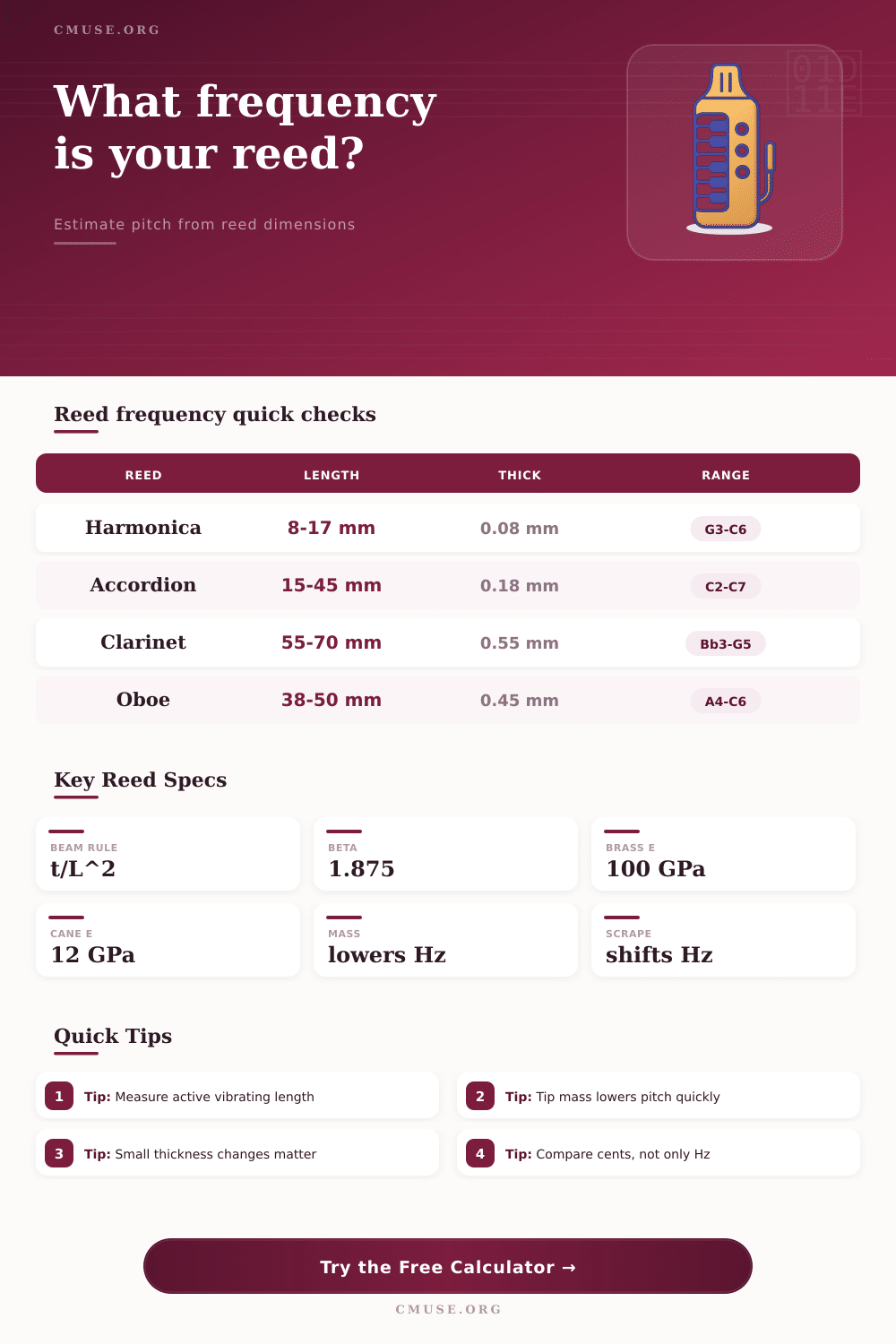
Reed Frequency Calculator
Estimate a vibrating reed's natural frequency from active length, taper, thickness, material stiffness, tip loading, and tuning scrape corrections.
Preset use: Load a real reed family, then adjust the measured active vibrating length, widths, thickness, tuning scrape, added tip mass, and target pitch.
Calculation Breakdown
| Material/Profile | Elastic Modulus | Density | Typical Use |
|---|---|---|---|
| Yellow brass free reed | 100 GPa | 8,500 kg/m³ | Harmonica, harmonium, melodica reeds with moderate damping |
| Phosphor bronze free reed | 110 GPa | 8,800 kg/m³ | Responsive free reeds with good fatigue resistance |
| Blue steel accordion reed | 200 GPa | 7,850 kg/m³ | Accordion and concertina reeds with high stiffness |
| Stainless steel reed | 193 GPa | 8,000 kg/m³ | Durable free reeds and experimental reed plates |
| Arundo cane single reed | 10 to 14 GPa | 500 to 750 kg/m³ | Clarinet and saxophone reeds, strongly affected by mouthpiece loading |
| Arundo cane double reed | 9 to 13 GPa | 500 to 750 kg/m³ | Oboe and bassoon reeds, affected by scrape and opening |
| Synthetic polymer reed | 3 to 6 GPa | 1,100 to 1,400 kg/m³ | Synthetic single reeds with lower stiffness and stable moisture response |
| Composite laminate reed | 8 to 20 GPa | 1,200 to 1,700 kg/m³ | Layered reeds where grain direction and layup change response |
| Reed Family | Active Length | Typical Thickness | Frequency Behavior |
|---|---|---|---|
| Harmonica treble reed | 7 to 16 mm | 0.06 to 0.14 mm | Short length and light mass produce high speaking pitch |
| Harmonica low reed | 14 to 28 mm | 0.10 to 0.24 mm | Longer tongue often uses added tip mass for low notes |
| Accordion reed | 14 to 45 mm | 0.12 to 0.40 mm | Steel stiffness lets longer reeds speak at useful pitches |
| Melodica reed | 9 to 26 mm | 0.07 to 0.20 mm | Brass free reed geometry is close to harmonica construction |
| Clarinet or sax reed vamp | 45 to 75 mm | 0.35 to 0.85 mm | Actual playing pitch depends on mouthpiece and air column coupling |
| Oboe or bassoon blade | 34 to 62 mm | 0.25 to 0.70 mm | Scrape profile and opening heavily alter reed response |
| Target Note | Equal Tempered Frequency | Common Reed Example | Useful Check |
|---|---|---|---|
| G3 | 196.00 Hz | Low harmonium or accordion reed | Longer length or tip mass is usually required |
| A3 | 220.00 Hz | Bassoon reed response reference | Compare response with the bocal and air column attached |
| G4 | 392.00 Hz | Concertina, clarinet, or saxophone setup check | Small thickness changes can shift cents quickly |
| A4 | 440.00 Hz | General tuning reference and many free reed checks | Use cents offset for tuning scrape decisions |
| C5 | 523.25 Hz | Harmonica, melodica, and oboe reed comparison | Short reeds become very sensitive to length error |
| E5 | 659.26 Hz | Treble free reed or double reed upper response | Tip mass changes become more audible in cents |
| Adjustment | Model Effect | Pitch Direction | Practical Reading |
|---|---|---|---|
| Shorten active length | Frequency scales close to 1 / L² | Raises pitch quickly | A tiny length error is large on short harmonica reeds |
| Increase thickness | Frequency scales nearly with thickness | Raises pitch | Thickness measurement should be averaged over the vibrating area |
| Add tip mass | Frequency divides by square root of added mass factor | Lowers pitch | Wax or solder near the tip has strong leverage |
| Scrape near tip | Reduces effective stiffness and may reduce mass | Usually lowers pitch | Use a negative stiffness correction for first-order estimation |
| Scrape near base | Reduces root stiffness | Can lower pitch and soften response | Base work changes stability more than small tip work |
| Narrow the tip | Reduces modal mass more than root stiffness | Often raises pitch slightly | Taper factor is approximate because real mode shape changes |
Reed frequencies is the pitch that is produced by a reed as it begins to move. Reed frequency is a most important factor in the way that a reeded instrument speak. Many people only consider the factor of reed frequency when a reed is not matching the pitch that is required for that instrument.
A calculator can be used to determine the reed frequency by inputting parameter such as active length, width, thickness, material, tip mass, and any corrections for scraping the reed. The calculator will provide mathematical answer to these parameters, but will not be able to provide the human judgement required to determine which of these parameters are the most important for that instrument and reed. Active length is the distance from the fixed line of the reed to its free tip.
What Affects Reed Pitch
Reed frequency and active length is directly related to one another, as active length is a parameter that is squared in the equation for determining frequency. If the active length of a harmonica reed is shortened by half a millimeter, the pitch of that reed will change significant. However, if the same amount is removed from the active length of an accordion reed, the pitch will change to a more lesser extent.
Active length is a parameter that are affected by the total length of the reed. Therefore, extra care must be taken with short reeds when altering their active length. Thickness is a parameter that has an effect upon frequency that is opposite to that of active length.
If the thickness of a reed is increased, its frequency will also increase. This is due to the fact that the stiffness of the reed increase at a faster rate than its mass if the thickness of the reed is increased. If the tip of a reed is shaved, the frequency will only change by a small amount.
However, if the same amount of material is shaved from the root of the reed, the change in frequency will be more significant. Width taper is a factor that can impact the frequency of a single reed. A reed that feature a width taper will be narrower at its tip than the remainder of the reed.
Because there is less mass at the tip of the reed, it will feature a higher pitch than a reed of equal thickness but without a width taper. Each of the reeds may have the same average thickness, yet possess a different pitch if the width taper of each reed are different. Tip mass is another factor that can impact the pitch of a reed.
If the player increases the tip mass of a reed, as by adding wax or solder to the tip, the frequency will decrease. Players will often use tip mass to lower the pitch of a sharp reed without having to alter the root of the reed. The material of the reed will impact the constants that are used within the equations for calculating reed frequency.
If brass is used for the reed, the density and the modulus of elasticity of the metal will be high. However, for cane reeds, the density and the modulus will be lower. Because the mass of cane is lower than brass, it is possible for the reed to be of similar length to metal reeds yet still produce the same pitch.
Moisture will impact cane but not metal reeds. Because cane will absorb the moisture from the air, the modulus will drop and the pitch will fall. Metal reeds will remain stable in relation to change in humidity.
The reference tables located on the page indicate the typical length and thickness of reeds for each category of musical instrument family. Each family of instruments requires a different length and thickness for its reeds. For instance, the reeds for harmonicas must be short and thin to allow for the instruments to fit within the harmonica’s comb.
Bassoon reeds, in contrast, need to be long and thick in order to allow for the reed to move a large mass of air. The calculator can be used to determine the various lengths and thicknesses that can be used for the reeds prior to cutting into the metal or cane. The calculator is just a starting point for the length and thickness of reeds for an instrument.
A reed is never an independent element of an instrument. Its movement are created by the air supply to the instrument and its movements are restricted by the frame that holds it. These two element will alter the movement of the reed, therefore altering the pitch of the reed when mounted to the instrument.
Consequently, the players ears will make adjustment to the length and thickness in order to find the correct pitch. Beyond the parameters that can be entered into the reed frequency calculator, there are additional corrections to be made to the reed, though the calculator cannot model these aspect. For instance, while the calculator does model the impact that different amount of stiffness have upon reed frequency, it cannot model the impact that scraping the reed will have upon the reed.
If the calculations indicate that a reed needs to be pitched lower, the decision must be made as to whether the tip of the reed should be scraped or the root of the reed. It is also a decision that must be made whether to accept the calculated pitch if it is too high. The number from the calculator will help to indicate these decisions, but never replace the player’s ability to make those decisions.
Another parameter that should of been considered is the relationship between active length, thickness, and mass. These three factor will have an impact upon the stability of a reed. If these factors are within a good proportion to one another, small alterations to the reed will have significant and predictable changes to its pitch.
However, if these factors are not in an appropriate proportion to one another, then the reed will be unstable. These factors can be considered before filing the metal or cane for the reed. By considering these factors, a player can avoid removing the material that can later be filed to achieve the desired pitch.